Abstract GC and HPLC both have a place in research, product assessment, and environmental monitoring. While GC works best with analytes below 1000 daltons, HPLC is suited to separating higher molecular weight compounds in order to provide qualitative and quantitative information. HPLC chromatographic separations and separatory systems are characterized by the retention and resolution of analyte peaks, as well as their selectivity and plate number (efficiency).
Keywordsretention, selectivity, resolution, efficiency, plate number, separation, matrix, mobile phase, stationary phase
LevelBasic
Separation techniques play an important role in modern analytical chemistry. Most chemical analyses involve the separation of complex samples. These mixtures contain at least one component in which we can be interested for different reasons e.g.:
- Assessment of a product
- Continuous monitoring of production process as part of quality control
- Monitoring and controlling industrial waste products as preventative quality control of the surface water
- Determination of amounts of pharmaceuticals and their metabolites in biological samples in clinical research of (new) drugs.
The components we wish to analyze (called analytes) are usually accompanied by other components that are generally present in much larger amounts. These other components are called the sample matrix. In general the nature and composition of this matrix is not of direct interest, but we have to take matrix effect into account. We speak of matrix effects if compounds present in the matrix affect sample pretreatment, separation or detection of the analytes.
Chromatography is often used to separate analytes from the matrix and to determine each analyte separately. Often the sample has to be treated - sample preparation - before we can start the chromatographic separation. Chromatography enables both qualitative (detection and identification) and quantitative analysis.
The two most commonly used separation techniques in modern chromatography are high-performance liquid chromatography (HPLC) and gas chromatography (GC). These techniques compliment each other with regard to their respective fields of application, even though there is some degree of overlap. One can say that HPLC is more versatile with respect to sample type and selectivity whereas GC is the more powerful technique with regard to separating very complex mixtures, providing that they are thermally stable.
Common separation techniques are:
- Liquid Chromatography (LC):
 LC is applied for compounds with a molecular weight of 70 up to 1,000,000.
 - Gas Chromatography (GC): GC is restricted to compounds with a molecular weight up to about 1000 in the vapour phase.
- Size Exclusion Chromatography (SEC)
- Supercritical Fluid chromatography (SFC) uses CO2 - having both liquid and gas-like properties- as mobile phase.
As the figure illustrates, chromatography covers a large weight-range of compounds:
Application areas and molecular weight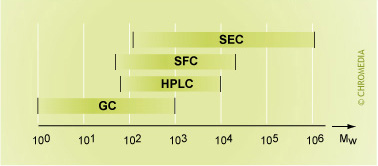
Chromatography is an excellent and extremely powerful and much used separation method. It is fast, simple, sensitive and requires little sample.
Chromatography is, above all, a separation technique. Chromatographic methods have become better and more refined, but they can accomplish nothing more and nothing less than unraveling a mixture of compounds. But this is not our sole objective; the result obtained (the chromatogram) is not the ultimate goal of an analysis. We want to understand which compound - and how much of it - is present.
Chromatography is carried out to separate an often complex sample mixture into its individual components and to obtain information in terms of:
- Qualitative analysis provides information on the identity of sample components (what?)
The identification of individual sample components can be assessed from the chromatogram. A chromatographic parameter that provides information for the identification of a sample component is the retention time. - Quantitative analysis provides information on the amount of sample components (how much?)
Quantitative analysis involves measuring the amount - the concentration - of sample components. Concentrations can be determined from the peak area or the peak height in the chromatogram.
Chromatography is a separation technique and not an identification technique. A similar sample analyzed on an entirely different chromatographic system will produce an entirely different chromatogram.
If the identity of the compound is unknown, or an absolutely positive identification is critical, identification methods merely based on retention time alone are not valid. Identification or verification can best be carried using spectroscopic detection methods, which actually provide information about the molecular structure. Differences in detector response can provide important identification information.
Common spectroscopic detection methods applied in LC are:
- UV
Using modern computerized UV detectors, it is possible to measure the detector response at two wavelengths simultaneously.
 - Diode-array
- Fluorescence
Increased specificity may be expected for a component which is monitored by, for example, a fluorescence detector. This detector requires that the analyte molecules possess a certain molecular structure that contains a so-called fluorophore. - Infrared
- Mass spectrometry
The best results are obtained by a mass spectrometer (MS). The flow rate in conventional LC-systems is often too high for direct coupling to a mass spectrometer. Columns of 2.0 mm internal diameter are preferred, but smaller internal diameters are available (as small as 0.1 mm) and can be used as well. In such a combination, the mass spectrometer can be regarded as a very sophisticated and specialized detector for the liquid chromatograph. From another perspective, the liquid chromatograph can be regarded as a very sophisticated and specialized injector for the mass spectrometer. The price of an LC-MS system is still a problem for routine laboratories.Currently, the mass spectrometer is used widely as a very reliable identification technique in LC and GC chromatography.
Identification of pyrene by UV-spectrum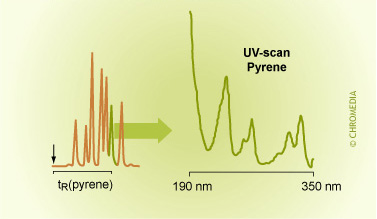 This example shows a chromatogram (brown) in which a peak is analyzed with a UV-scan when it comes out of the column and passes the detector. The UV scan of this peak shows the spectrum of pyrene.
'Fingerprint' of corn syrup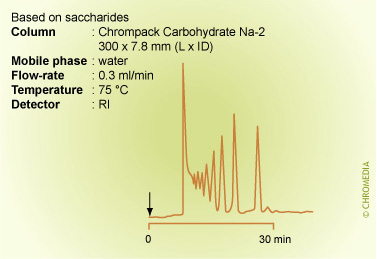
It is quite common that we are not interested in the identity of the individual sample components, but rather in the identity of the complete mixture.
Typical examples are petrochemical fractions, vegetable oils, or foods. These types of samples are usually quite complex and will yield complex chromatograms featuring a large number of peaks. In this case, a chromatogram provides a so-called 'fingerprint'. A pattern recognition profile can be carried out using a computer program which identifies the sample unambiguously. In a 'fingerprint' method, little or nothing can be directly concluded about the identity of the individual peaks, but conclusions can be drawn about the identity or purity of the sample.