Abstract How do flow rate, polarity, pH, Sample size, column length, I.D., dp influence your chromatogram? Examples and Q&A.
LevelBasic
Some examples and Questions & Answers will give you a feeling of the effect of changing your parameters.
Several chapters in Chromedia provide the knowledge on these issues. You will find them in the Topic Circles e.g.: GC basics, LC basics, LC columns, RPLC.
Some interactive means to get insight in the effect of parameters can be found in "The resolution equation" and the "Chromatogram generator" in the blue left column of this page.
If we double the flow rate, what will be the effect on the retention time tR, retention factor k, selectivity α, plate number N and the resolution Rs?
 tR ?
tR ?
Need to go back to tR, then: click here to pop up the paragraph on tR
 k ?
k ?
Need to know more on k, then click here to pop up the paragraph on k
α ?
Need to know more on α, then click here to pop up the paragraph on α
N ?Check the Van Deemter equation: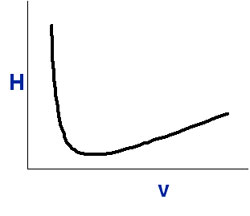
 Rs ?
Rs ?
Rs is a complex function of k, α and N. (Pop up simulation)
If we change the polarity of the mobile phase, what will be the effect on the retention time tR, retention factor k, selectivity α, plate number N and the resolution Rs?
tR ?
k ?
α ?
N ?
Rs ?
If we change the pH, what will be the effect on the retention time tR, retention factor k, selectivity α, plate number N and the resolution Rs?
Le Chatelier Principle says:
- pH affects equilibrium of weak acids (W.A.) or weak bases(W.B.)
- pH does not affect neutrals or strong acids
- pH can affect both sample and column packing
- REVERSED PHASE - Increase pH, W.A. more ionized, shorter tR. Increase pH, W.B. less ionized, longer tR, more symmetrical peaks.
- ION EXCHANGE - pH is critical factor. All factors change
- Remember - If pH affects tR, you are dealing with a weak acid or a weak base.
- Each column has a limited capacity ; if you exceed that limit and tR decreases, the peak shape become worse.
- Solution - dilute sample 1/10 and re-inject.
- All chromatographic results may change.
Effect of various sample sizes on peak shape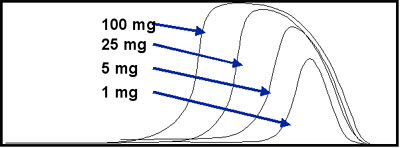
Length
Assumption for this test:
We assume that we maintain the v. Then we need to increase the pressure as the length increases.
The required pressure is directly proportional to length: double length --- double pressure.
Question. WHEN LENGTH DOUBLES, what  happens to tR, k, α, N, Rs?
Particle diameter
Smaller particles makes better columns (N and R) but need a higher (non a linear relation) operating pressure. Therefore, long lengths with very small particles are not possible.
Question. WHEN PARTICLE DIAMETER changes, what happens to tR, k, α, N, Rs?
Since the fast LC is becoming more and more applied, we will give some examples of the relationship between dp, Δp, length and tR.
Question: What will happen with our pressure if we use particles with a diameter of 5 in stead of 10?
| dp (μm) | Δp | Length (cm) | tR (min) |
| 10 | 1.000 | 25 | 10 |
| 5 | ??? | 25 | ??? |
Note that: Δp ~ 1/dp2 and tR ~ L
Answer:
This decrease of particle diameter implies a pressure increase of four times:
| dp (μm) | Δp | Length (cm) | tR (min) |
| 10 | 1.000 | 25 | 10 |
| 5 | 4000 | 25 | 10 |
However, a pressure of 4000 psi is too much for a regular system, so how do we solve this?
Question: What will we do to come to a reasonable pressure?
So tR ∞ L and N ∞ 1/dp
Let's now try a 2 μm particle:
| dp (μm) | Δp | Length (cm) | tR (min) |
| 10 | 1.000 | 25 | 10 |
| 5 | 2000 | 25 | 5 |
| 2 | ???? | 5 | ????? |
Question: So what pressure is needed to get a fast retention time?
Answer:
- LONGER COLUMN
(k doesn’t change) - SLOWER FLOW RATE
(k doesn’t change) - WEAKER MOBILE PHASE
• Normal phase - then make less polar
• Reversed phase - then make more polar (H2O) - MORE STATIONARY PHASE
• Silica gel - More surface area
• Reversed phase - RP-18 instead of RP-8 - INCREASE PARTITION COEFFICIENT
• Different stationary phase
• Lower column temperature.
- USE A BETTER COLUMN
use smaller particles, packed more tightly - OPTIMIZE FLOW RATE
- REDUCE SAMPLE SIZE
to avoid column overloading - REDUCE DEAD SPACE IN SYSTEM
make low dead volume connections and fittings - REDUCE TIME CONSTANT