Level
The following examples will illustrate more closely the effects of retention parameters k, α an Nth on resolution:
Effects of retention and selectivity on resolution
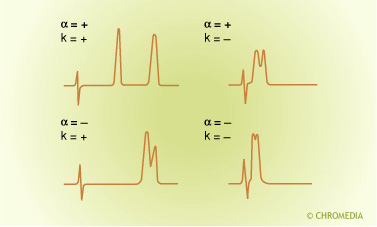
Baseline separation (top left) is obtained when:
- The retention factor k is sufficiently high (analytes are sufficiently retained by the stationary phase)
- The selectivity factor α is high (analytes exhibit a large difference in their retention factors)
When retention decreases (top right) or selectivity is reduced (bottom left), the resulting separation is poor (poor resolution). Results are even poorer when both k and α decrease simultaneously and there is virtually no resolution (bottom right).
Effects of retention and efficiency on resolution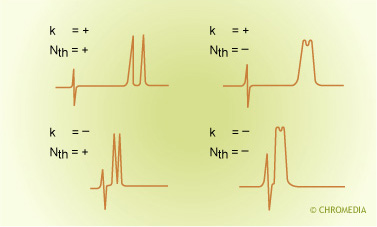
Only with sufficient retention difference for the analytes of interest (k = +) and sufficient column efficiency (N = +), can a good separation can be obtained (top left). At low efficiency  however (poor column quality) the separation is insufficient (top right).
Effect of selectivity and efficiency on resolution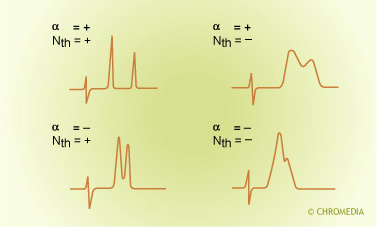
Both adequate selectivity and efficiency are needed to obtain baseline separation (top left). However, if selectivity remains the same and the column efficiency decreases, separation will decline (top right). Replacement or regeneration of the column is required. Similarly, high efficiency but poor selectivity yields inadequate separation (bottom left). Changing the nature and/or composition of the mobile phase is required.