LevelBasic
Until the nineteen-sixties, the separation of 'non volatile analytes` often was performed by flash, paper, and thin-layer chromatography. These techniques were slow, lacked sufficient separation power, and did not quantitate reliably.
During the sixties, new theoretical insights accompanied by important developments in column packing technology and suitable equipment paved the way for what is now called High Performance or High Pressure Liquid Chromatography (HPLC). The new technique provided much higher resolution, more accurate quantitative results, as well as shorter analysis times in comparison to the earlier techniques. Since its introduction, HPLC has evolved into an indispensable tool in many analytical laboratories and is applied to diverse analytical problems. Actually, HPLC refers to a number of separation techniques that use a liquid mobile phase, or eluent.
 In the early days of HPLC, straight or normal phase chromatography (LSC) and also liquid – liquid chromatography (LLC) were the major separation modes available. These techniques required relatively long equilibration times, which seriously hampered efficient method development and sample throughput in the laboratory.
Given this difficulty, the discovery of chemically bonded phases (CBP) approximately four decades ago was a historic breakthrough for chromatography. With the advent of CBP’s, different functionalities ranging from non polar to ionic could be covalently bonded or physisorbed onto a substrate. This, in turn, allowed the development of new separation modes, including ion exchange, affinity, and size exclusion chromatography.
The picture illustrates the most important separation modes in HPLC:
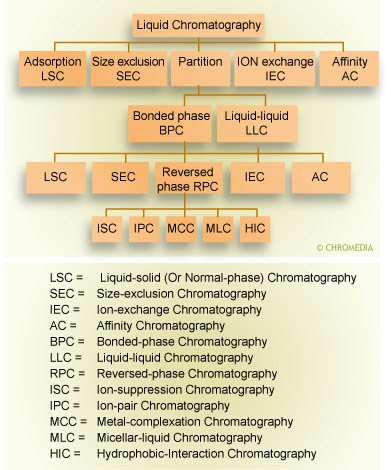
If the stationary phase is a solid phase we speak of Liquid Solid Chromatography (LSC) or adsorption chromatography. This is called "Normal phase" chromatography if the stationary phase is polar. The stationary phase can also be a thin liquid film, adsorbed to the solid particle. These liquid (like) phases are bonded (by physical or chemical interactions) to the surface.
CPB’s increased flexibility, improved stationary phase reproducibility and stability, substantially shortened equilibration and analysis times, and simplified method development, resulting in improved analytical results and higher throughput. Reverse Phase Liquid Chromatography (RPLC) is an extremely important subtechnique of HPLC employing an important subset of the CPB’s. The technique is easily recognizable since, in comparison to normal or straight phase techniques, it reverses the polarity of the original adsorbent as well as the polarity of the mobile phase.
In normal phase chromatography the solid phase is polar. Contrary, in Reversed Phase Liquid Chromatography (RPLC) the stationary phase has been treated with a coating to become nonpolar while the mobile phase is polar, thus the reverse compared to "normal-phase" chromatography. RPLC is of high importance and has its own Topic Circle.
The basics of LLC and LSC will be discussed in this chapter. The other types of chromatographic methods e.g. Ion Chromatography and RPLC will be discussed extensively in their individual Topic Circles.
We can broadly differentiate liquid chromatography based on the support material into three different types:
- Paper chromatography
This is a very simple form, where sheets of paper (= stationary phase) are introduced into a mixture of organic liquids and/or water (= mobile phase). The liquid is slowly absorbed through the porous fibres of the paper. Prior to that, the samples and the pure components are “spotted” side by side at some distance from the edge of the paper. The velocity at which the components move is dependent on the adsorption to the paper. In this way the separation between the compounds is accomplished. - Thin layer chromatography
Instead of paper, aluminium oxide or silicon oxide is used, coated on a glass plate. The mobile phase consists of a mixture of organic liquids. The mobile phase is slowly absorbed through the small channels in the particles whereby the samples components are separated. If the plates are coated with small particles (such as in HPTLC), good separation efficiency can be obtained. - Column chromatography
The first columns were (glass) tubes, filled with porous particles or oxides which act as adsorbents. The sample was brought - under atmospheric pressure- on the upper end of the vertical column. Mobile phase is then added until it is oozing form the other end of the column. Differences in adsorption of the sample will eventually result in separated fractions, containing the compounds of interest, which can be collected at the column outlet. In early days, the eye was the detector. Since some of these fractions were coloured the method was named "chromatography", a combinations of Greek for "colour" and "writing". This is the reason it was named 'Chromatography'. This term is still used for the current separation methods, HPLC, GC and IC, where colour is no longer a feature and with detectors e.g UV detectors.
These types of chromatography above are called open systems, since they are performed under atmospheric pressure.
- They are no longer used in analyses, with exception of TLC.
- They are used in sample preparations (Solid Phase Extraction) and in (semi) preparative LC.
Development to closed systems
Modern liquid chromatography systems are called closed systems, since the mobile phase is actively pumped - in a closed system - through the column. Very important for the development of chromatography in this respect was the discovery that small particles in the column produce high separation power. In the past particles of 50 to 100 µm were used, but with the development of 20 to 30 and later 10, 5 and 3 µm, HPLC (High Performance Liquid Chromatography) managed to establish itself in a modern laboratory. A disadvantage of the small particles size is the reduced permeability of a packed column; This results in a very high pressure drop across the column. Specially designed pumps must be used for the mobile phase throughput.
The stationary phase in liquid chromatography usually consists of solid, porous particles, most often with a chemically modified surface. Both the porosity and the fact that the particles are small are of major importance in the chromatographic process. The two factors combined result in a large surface area of stationary phase, in direct contact with the liquid mobile phase.
Chromatography is a dynamic process: the process of adsorption - desorption - moving through the mobile phase, takes place continuously until the moment when the compound leaves the column. The degree of adsorption depends on the compound, the stationary phase, the mobile phase and the temperature.
For an optimal chromatographic process the mobile and stationary phase are selected in such a way that they are both somewhat attractive for the sample components. The component will run through the system and spend some time in the mobile phase and some time in the stationary phase. It is a continuous dynamic process; a component, while eluting through the column, frequently transfers between the mobile and the stationary phase.
There is a competition between interactions of the stationary phase and the mobile phase with regard to the sample components, whereby the following interaction forces play a role:
- Non-specific adsorption to the stationary phase by Van der Waals forces.
- Specific adsorption by dipole - dipole interactions and dipole - induced dipole.
The stationary phase is often silicagel, often with a layer of a well-chosen coating. The choice of column material is crucial for a well performed separation. A large part of Chromedia will be focused on the column material and the selection of the optimum column .
In LC the mobile phase also plays a very important role. In "Normal-phase" chromatography the stationary phase is polar, while the mobile phase is nonpolar. Since uncoated silica is a highly polar phase, the eluent is basically nonpolar, e.g. hexane. Such extreme differences in polarity generally result in extreme high retention factors. If a sample component is only slightly polar, it experiences a very strong interaction with the stationary phase. It’s retention is almost infinite; the compound does not elute from the column.
Modifier
To bring these extremes chromatographically together, the stationary and the mobile phase are more adjusted to each other with regard to polarity. In normal phase chromatography a (slightly) polar component (modifier) is added to the nonpolar mobile phase. A large part of the polar modifier from the eluent is adsorbed to the stationary phase. After injection of the sample a competitive adsorption takes place between the sample components and the modifier at the surface of the stationary phase.
- A polar component will have a stronger affinity for the polar stationary phase and thus will be strongly retained.
- By changing the polarity of the eluent (the nature and the amount of modifier) we can control the retention and selectivity of the system.
- (In Reversed Phase Liquid Chromatography (RPLC) the stationary phase has been treated with a coating to become nonpolar while the mobile phase is polar, thus the reverse compared to "normal-phase" chromatography.)
In general nonpolar organic solvents like n-hexane or i-octane are used as initial eluent. The polarity can be adjusted by adding more polar solvents (modifiers) such as ethanol and 2-propanol, as well as e.g. dichloromethane or isopropylchloride when more subtle retention adjustments are needed. Changing the volume % of the modifier will change the retention factors of all the peaks in the chromatogram. Another type of modifier will affect the selectivity of the chromatographic system, as is shown in the examples here:
Selectivity NP mobile phase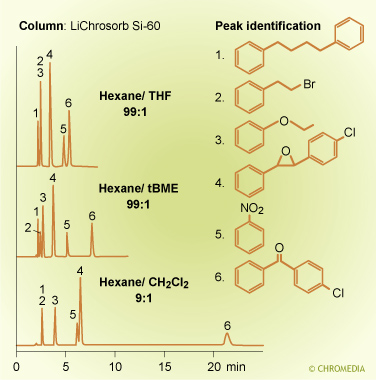
If the stationary phase is a solid, we speak of liquid-solid chromatography (LSC) or adsorption chromatography. The retention of compounds is based on adsorption of the analytes on the solid surface of the stationary phase. Compounds dissolved in the mobile phase, are retained (adsorbed) for short periods of time; then they are released (desorbed) and taken along by the mobile phase.
This oldest and most well-known LC-method is based on the adsorption of nonpolar to slightly polar compounds onto a solid adsorbent with a polar, active surface. Even though this technique was widely used at first, it is now used for special applications, such as the separation of isomers in an organic matrix, e.g. the petrochemical industry or for research with TLC or preparative column chromatography. LSC is also employed in the analysis of oil products and drugs, in studies with TLC or with the pre-purification of large volumes of sample (preparative chromatography).
Silica gel, and sometimes aluminium oxide, are used as an adsorbent in adsorption chromatography.
Adsorption chromatography (LSC)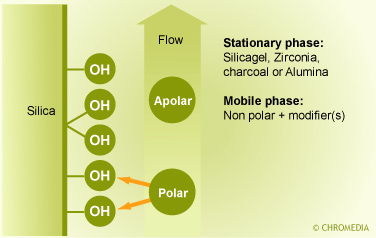
- Stationary phase: Silicagel, Zirconia, charcoal or Alumina
- Mobile phase: non-polar + modifiers
At the surface of silica there are so-called silanol groups (ºSi-OH) on the surface of the silica gel which can adsorb (nonpolar) compounds with a moderately polar functional group. The mobile phase is a relatively nonpolar organic liquid (the eluent) in which the slightly polar components are partly soluble. The compounds to be separated should not be too polar, should have a non-ionic nature and should not have a too high molecular weight (M < 1000). These properties could otherwise generate undesired adsorption to the surface, resulting in tailing peaks. If the retention of the sample components is to height, the adsorption and retention can be reduced by adding a certain amount of a (medium) polar modifier to the mobile phase. The higher the volume % of the modifier in the mobile phase, the lower will be the retention of all the peaks in the chromatogram. This is also true if the polarity of the modifier is increased.
The advantages and disadvantages of LSC are:
- Advantages:
- high resolution
- suitable for separation of isomers
- low price and long column lifetime
- Disadvantages LSC
- adsorption of H2O
- poor reproducibility
- no gradient elution possible
If the stationary phase is a liquid, we speak of liquid-liquid chromatography (LLC) or of partition chromatography. An LLC system works with two immiscible liquid (-like) phases with different properties (e.g. polarity and solubility of the analytes). The partition mechanism is based on the interactions of the analyte molecules with the liquid stationary and liquid mobile phase. The separation is based on the distribution of analytes between the two liquid phases according to their difference in solubility.
In partition chromatography the stationary phase is a liquid. This liquid stationary phase is impregnated ("coated") on a porous support material, e.g. silica.
Different silanol groups on silica surface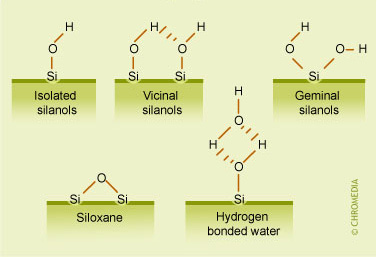
- Polar solvents as “coated” stationary phases were preferred to nonpolar solvents, because they are better adsorpted on silica.
- For a good chromatographic behaviour it is vital that the two phases are immiscible. To a stationary phase with a polar character, such as ethylene glycol, dimethylsulfoxide, formamide and also water (!), a mobile phase with a nonpolar character must be used (e.g. pentane, hexane in conjuction with chlorinated alkanes, ethers, ketones or alcohols with C6 or higher).
- Systems with widely differing polarities have a major disadvantage: the stationary phase is not strongly bonded to the support and will change together with every modification of the mobile phase.
Usually chromatography is performed at low analyte concentrations, where the solubility of the analyte is not a limiting factor. The distribution of an analytes across the two phases reflects its thermodynamic preference. The solubility of the analyte in either phase becomes important at high analyte concentrations, encountered, for example, in preparative chromatography. If the solubility limit of the mobile phase is reached, the analyte will be strongly retained. In case either phase is overloaded, strongly asymmetrical peaks are observed, the retention time of which varies with the amount of analyte injected.
Polar components are strongly retained in partition systems whereas nonpolar are practically not retained. The retentions and the corresponding selectivity's can be affected by modifying the polarities of the eluent and the stationary phase. LLC systems only operate well if the temperature remains very constant. The use of a column- and eluent thermostat is required. Solvent gradients cannot be used.
LLC has not become very popular. The majority of the samples offered, is in an aqueous matrix. Both LSC and LLC have problems with the highly polar water. A much better solution is the so-called chemically bonded stationary phases, which are dicussed here and in the RPLC Topic Circle.
[SiO2]n is prepared by controlled polymerisation of Sodium silicate (= water glass) or controlled hydrolysis and polymerization of Silicon-tetrachloride or Tetra-alkoxysilanes.
Dependent on conditions such as the pH, whether or not organic liquids are added, the temperature and the response time, spherical or irregular shaped particles can be formed. By monitoring the conditions accurately, the desired particle diameter and the pore diameter can be manufactured.
- The chromatographic properties are determined by the chemical structure of the surface and by the Specific Surface Area (SSA).
- The size of the surface is inversely proportional to the pore diameter of the particles. Hence, the smaller the pores, the more active surface area there is to provide retention.
- The specific surface area (ranging from 5 - 500 m²/g) and the pore diameter (5 - 400 nm) can be altered by changing the conditions during the production process.
Structure of silicagel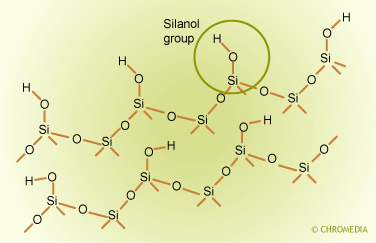
The silica gel is extremely porous and therefore has a very large specific surface area. To give an impression: A HPLC column that is fully packed with silica at 60 MPa (bar), can despite its very dense packing still contain 70% of the empty column volume of mobile phase. It shows that the largest part of the column volume is taken by the void in and between the packing particles.
Silanol groups at silica surface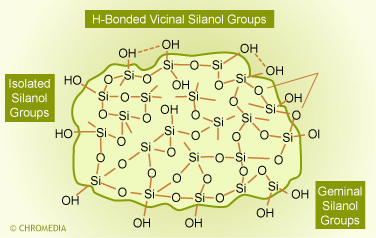
The maximum number of hydroxyl groups on silica is, independent of the type, 8¼ μmoles/m². These hydroxyl groups are extremely active; they can easily produce hydrogen bonds with water, which means that the bare silica in contact with the environment adsorbs a certain amount of water. Since this is accompanied by changes in selectivity, it should be avoided.
A silica column should therefore be conditioned and used in combination with dry solvents. Conditioning of the column usually takes quite long. The ratio of the silanol types is highly dependent on the manufacturing process. Water can also be physically adsorbed to a silanol group via hydrogen bonding and there could be siloxane bonds present. An advantage of silica is the enormous mechanical strength as a result of which the pressure in the column can be raised considerably without damaging the structure. Furthermore, a wide variety of silica materials is commercially available with different specific surfaces and particle diameters with a narrow size distribution. In particular the latter makes silica an efficient material for chromatography.
Silica properties
- Specific surface: 5 á 1000 m2/g
- Pore size: 30 á 4000 Angström
- Pore volume: 0.8 á 2.0 ml/g
- Number of silanol groups: about 8 micromol / nm2
Silicagel for HPLC is available in a wide range of specifications and properties for all kinds of applications. So, a wide variety of materials is commercially available with regard to specific surface and (very) small particle diameters with a narrow size distribution.
Limitations
- A disadvantage is the solubility of the silica structure in mobile phases with a pH above 7.5 or below 2. The normal phase columns cannot be used above and below these pH-limits.
- Another limitation in using silica is that it cannot be used for the separation of basic compounds, because the acidic character of the surface results in extreme adsorption which is shown by strongly deformed peaks (tailing).
- A very important limitation of silica columns is the very strong adsorption at the silanol groups of water, coming from the moisture in samples. Aqueous samples are not possible at all, but also the concentration of water in the mobile phase is very critical. One should control the moisture in the mobile phase carefully in order to avoid rapid changes in retention times as result of deactivation of the stationary phase.
- Overall is the use of adsorption chromatography in HPLC with (bare) silica columns limited to 1 or 2 % of all applications.
In LSC and LLC the components to be analyzed must always be first extracted into an organic phase. All these timeconsuming practical problems resulted in replacing LLC, but also LSC, with HPLC-Chemically Bonded Phases. LLC is still sometimes used to isolate biological unstable compounds and/or complex natural compounds.
In chemically bonded phases the liquid stationary phase is not physically adsorbed, but covalently bound to the silica matrix. So the stationary phase is not a real liquid anymore, but something in between a liquid and a solid. Dependent on what is bonded, it shows many similarities to LLC or LSC.
Reactions for chemical bonding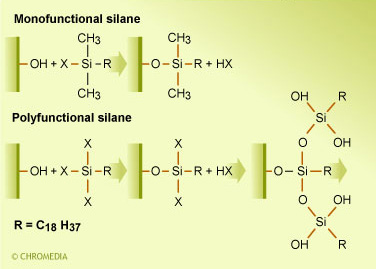
Organic groups can be bonded to silanol groups via chemical reactions, providing silica gel with an entirely different character; with chlorosilanes, alkoxysilanes or other silicon derivates. This way maximum half of the silanol groups is coupled to an organic chain (ligand). It is usually an octyl or an ocatadecyl group, but also more polar chains are commonly used. The siloxane bonding formed (º Si - O - Si º ) is stable in organic solvents and in aqueous mixtures (2.5 < pH < 7.5 at 20 ° C).
During the chemical reaction the conditions are generally chosen in such a manner that a monomolecular layer of stationary phase is formed.
If desired, a polymeric layer can be applied with which a certain group of compounds is separated which give a poor separation on the commonly used monomolecular phases. Such a covalently bonded phase has the advantage that the composition of the mobile phase can be varied within very wide limits. Even within one particular analysis as in gradient. Another advantage is that a wide variety of more or less nonpolar stationary phases have become available with which aqueous samples can be analyzed straightaway.
Polar bonded phases have the surface of silica gel covered with polar functional groups. As with pure silica these stationary phases are primarily used in normal phase HPLC, thus with more or less nonpolar mobile phases. Since they are condiderably less sensitive to the interfering influence of water and are therefore an interesting alternative for silica. In contrast to silica the conditioning time with a nonpolar eluent is very short. That is why the eluent can be changed quickly. Polar bonded phases can, compared to pure silica, also be used for gradient elution. Since the composition of the mobile phase changes during the gradient elution, it is necessary that equilibria setting is fast. With pure silica the adsorbed water presents problems. The equilibrium of this undesired, yet hard to avoid, water takes a too long time in contrast to polar bonded phases.
The difference in reaching the equilibrium time between the silica and the polar bonded phase can be explained as follows. The polarity difference between silica and the mobile phase is substantial due to the presence of the very polar silanol groups on the surface. The interfacial surface tension between the two phases is so large that the transfer of compounds (in this case water) is strongly impeded. It takes a long time before equilibrium is reached. With polar bonded phases the interfacial surface tension is much smaller resulting in a gradual transfer of the mobile phase to the stationary phase. The polarity difference is not as extreme as with pure silica.
Most active bonding positions -sites - have disappeared after coupling the ligands and the equilibrium is reached fast. The slight polarity difference is also the reason that water, in contrast to pure silica, does not have such an extreme effect. PB-phases have a less active surface, which affects the retention. The capacity factors on a chemically bonded polar phase will be smaller with the same eluent than on pure silica.
Another important difference concerns the peak symmetry. The active sites on pure silica gel (adsorption sites) exhibit, with regard to adsorption strength, a heterogeneous character in contrast to the chemically bonded phases where the adsorption strength of active sites is homogeneous. A stationary phase with homogeneous adsorption sites exhibits a greater linear dynamic range with regard to sample capacity and will produce therefore less asymmetrical peaks than a stationary phase with heterogeneous adsorption sites.
"Strong" eluents
As with all HPLC systems the retention is also caused here by the stationary phase and the mobile phase. To be more precise: the retention is caused by the polar interaction of the component molecules with the polar stationary phase, and by the displacement of the polar eluent molecules which at an equilibrium have been partly adsorbed to the stationary phase. The more polar the eluent, the less easily it can be displaced, which results in lower retention. From the viewpoint of the mobile phase you could call it a strong eluent. The stronger the eluent, the lower the retention.
Polar bonded phases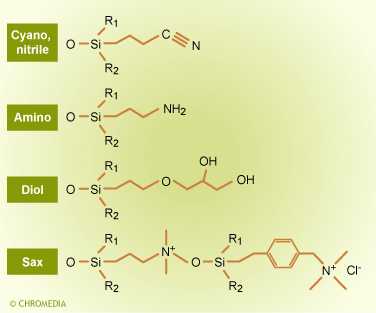
The polar groups most commonly used in the form of PB-phases are:
- amine ( - (CH2)3 - NH2 )
- diol ( - (CH2)3 - CH.OH - CH2 - OH )
- cyanide ( - (CH2)3 - CN )
The amino and cyano modified silicas can be used in reversed phase and in normal- phase HPLC.
Applications
The CN phase is very suitable for normal phase gradient elution on account of the short stabilisation time. They are used for the analysis of compounds with very long chains, e.g. detergents. Even though diol-groups look similar to silanol groups, they exhibit no strong adsorption characteristics.
Selectivity of bonded phases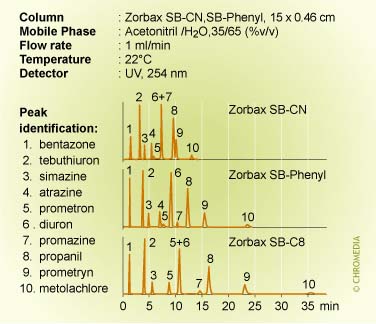
In contrast to silanol groups they have no acidic nature. The diol phase is often used for the analysis of biomolecules, such as peptides, proteins and in particular in the field of the exclusion chromatography which we will discuss later on. Besides, steroids can be separated on this phase.
Nonpolar stationary phases have bonded alkyl chains on the surface of the silica of which the chainlengths range from C-2 to C-22 . Octadecylsilica (ODS, C 18 ) is mostly used.Non-polar bonded phases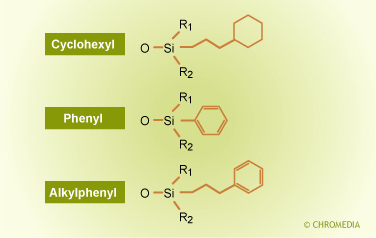
These phases are found in reversed phase chromatography (RPLC). Here the stationary phase is nonpolar and the mobile phase is polar, thus the reverse compared to "normal-phase" chromatography. It means that polar components emerge sooner from the column than nonpolar components. The eluent is usually a mixture of methanol with water, or acetonitrile with water.
The reversed phase chromatography (RPLC) is by far the most important of all current LC- techniques. It has a wide applicability. With the proper mobile phase it is possible to separate nonpolar and moderately polar components, as well as highly polar, ionic and even permanent ions. On account of its important position in the modern analytical technique, RPLC will be covered in its own Topic Circle.
Polar bonded phases have several advantages over (normal phase) silica
- No absorption of water
- Short stabilisation times
- Gradient elution
- Better peak shape
- Polarity range: Si > Diol > NH2 > CN
The amino phases are perhaps the most widely used polar bonded phases. They offer advantages such as wide applicability and specific selectivity. A disadvantage is their sensitivity to hydrolysis.
The protonization of amino groups is dependent on the pH. At pH 7 the group is completely protonized and thus positively charged. Under practical conditions it is therefore an ion exchanger.
A typical application for NH2 phases is the separation of sugars with an acetonitrile/water mixture as the mobile phase. Even though sugars are not negatively charged, they are retained on this phase. The retention is not only caused by ion- exchange, but also by the formation of hydrogen bonding between the hydroxyl groups of sugars and the charged sites of the stationary phase.
Weak (an)ion exchange mechanism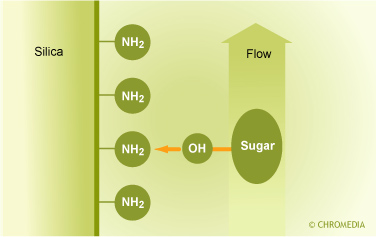
Water is an extremely polar liquid and is strongly adsorbed to a polar stationary phase. It has an extreme effect on the retention factors (and the peak symmetry) of the components. Solvents intended for the mobile phase should always be dried prior to use, or the moisture content must be controlled. "Normal phase" systems have the reputation that they can be poorly stabilised: the repeatability is not good. Shifting of retention times will occur in due course. The dry, polar stationary phase extracts water from the eluent. The eluent in turn can be affected by water from the environment. This continues until the entire system is essentially in equilibrium.
Adsorption of water, resulting in changing retentions of the components, may well be regarded as the biggest disadvantage of the use of unmodified silica gel columns in HPLC.
Normal phase separation of fat-soluble vitamins
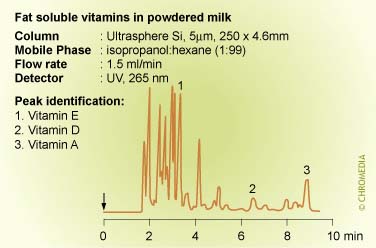
Here a typical example of a normal phase separation with a polar bonded coating.
Analysis of sugars in fruit juice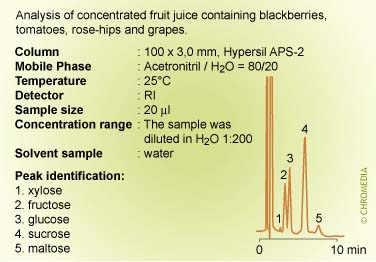
The mobile phase acetonitrile – water is typical for RPLC, but in this case the separation column is an amino propyl silane (APS) type of phase. The separation mechanism and retention behaviour is different from reversed phase. The analysis is simple and fast.
The detection for these sugars is refractive index (RI).
Non-porous particles have a very small surface area, which make them less attractive for most applications. The smaller the particles, the more this problem is alleviated.Very small (< 2 micrometer) non-porous particles may be used for hydrodynamic chromatography (HDC).
Pellicular particles, with a hard core and a porous shell, have frequently been studied for use in HPLC. They are used for (fast) separations of peptides and proteins.