Abstract Field Flow Fractionation (FFF) is the general name for a family of separation and fractionation methods. These methods all rely on the interaction between a liquid flowing through a narrow channel (the carrier liquid), and a field applied in a direction perpendicular to this flow, acting on the particles and molecules to be separated. This tutorial contains a full basic short course, for those who wish to understand essentials of FFF and how to work with it.
LevelBasic
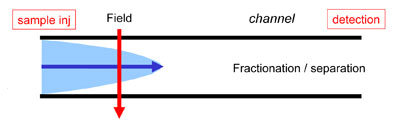
The variants of FFF differ in the type of field that is applied. In Sedimentation FFF this is a gravitational field, in Flow FFF it is the viscous force exerted by a second liquid flow, the cross flow. Other fields can also be applied (thermal, magnetic, electric), but Sedimentation and Flow FFF are the most commonly applied.
- Sedimentation FFF is used mostly for the separation of (solid) particles,
- Flow FFF for dissolved macromolecules and colloids.
Core points of Field Flow Fractionation (FFF):
- FFF can be applied for
- Natural polymers (humic acids) and colloids
- Starches
- (Modified) celluloses
- Other carbohydrates (hyaluronic acid, heparines, ... )
- Proteins and protein aggregation
- Lipoproteins
- Bio-particles (viruses, liposomes, antibodies...)
- Water-soluble synthetic polymers
- Organic-solvent synthetic polymers
- Nanoparticles, inorganic particles, latexes.
- Sedimentation FFF (SdFFF) can be performed with a simple home-made set-up, using the earth gravitational field, but for more demanding separations a sophisticated instrument with a rotating channel is required.
- Asymmetric flow FFF (AF4) is a versatile technique for the separation of macromolecules from a few kDa to > 100 MDa, but also micrometer-sized particles can be separated.
 In the optimization of AF4 a compromise has to be found between resolution, speed and detectability.
 - Cross-flow programming is a valuable tool in AF4 for wide MW-range applications.
- Commercially available instrumentation for AF4 makes application on a routine basis possible.
 Did you ever try to explain separation to your employees or students? Well, try no more: Lee Polite did it for you in a way which is hard to beat. We will open up one example of his whiteboard class. Click this link to watch the video. To see more, you can register here. Students and teachers can access free for one month. The links in the center column lead to hundreds of chapters with text, video presentations, visualisations and animations. The chapters on Analytical Chemistry 2.1 (David Harvey), as well as basics LC, GC (Harold McNair, Lee Polite and other experts) and spectroscopy chapters are on the level of colleges, laboratory schools and universities, all 'deeper' clicks lead you to more advanced knowledge on analytical techniques with all the details for in-depth understanding for professional users.
Chromedia is used globally by numerous colleges, universities and industries, our authors are ranked as the finest teachers in the world. So go ahead and discover Chromedia by getting a 30 days subscription, which is free for students and teachers. Chromedia functionalities work best on the Chrome browser. - Our expert team
- The Analytical Scientist
- American Chemical Society
- Wiley:
- separationsNOW
- spectroscopyNOW For full access to Chromedia: click here for a paid subscription.