Abstract Peak broadening plays a critical role in the separation of sample components. When two adjacent peaks are both wide, they will overlap and the separation will be incomplete (poor resolution). Ideal chromatographic peaks are Gaussian and symmetrical. Asymmetrical peaks exhibit either fronting or tailing. Peak fronting or tailing can be caused by poor column quality (degradation of column packing) or by the dead volume of the system. Peak asymmetry can lead to poor separation results. The injection system, the detector, connecting tubings and fittings can all contribute to peak broadening.
KeywordsPeak broadening, peak overlap, peak symmetry, asymmetry factor, fronting, tailing, dead volume.
LevelBasic
plays a critical role in the separation of sample components. If peaks were infinitely narrow, the various peaks will not overlap resulting in a perfect chromatographic separation. Chromatographic peaks, hoewever, always have a certain width due to various causes e.g. molecular diffusion. When two adjacent peaks are both wide they can overlap and the separation will be incomplete (no baseline separation). The chance of overlap will be much smaller with narrow peaks, so that even with small differences in retention there will be a complete, baseline separation.
Two effects occur during the chromatographic process, which are of importance for the separation result:
- Retention/selectivity
In order to separate two components during a chromatographic separation, there must be a difference in their retention (column selectivity). - Peak broadening
The analyte peak has a certain width, which becomes wider as the peak travels further distances along the column from the starting point (after injection). Ideally, the peak shape should be Gaussian (normal distribution).
Distribution process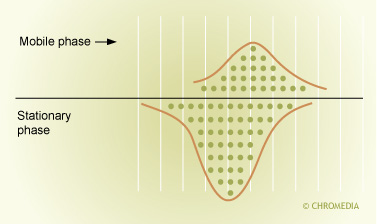
The peak width depends on two factors:
- Velocity in the column The more slowly the peak (zone) moves through the column, the wider the final peak will be. Consequently, it is normal for peaks to become broader with increasing retention time. Late-eluting peaks in a chromatogram are therefore broader than early-eluting peaks.
- Length of the column occupied by the peak , is due to the fact that the molecules of a particular component travel at slightly different velocities due to molecular diffusion and
 dispersion. This leads to an increasing peak zone dispersion effect at the peak travels from one end of the column or the other.
In the ideal case, a peak will have a  Gaussian shape and the peak maximum is defined as the retention time of a particular sample component. It is, in fact, a mean value. Peak broadening is related to the fact that each component represents a large number of identical but individual molecules.
Peak broadening can be regarded as a property of a certain column. The ability to produce narrow peaks is called the efficiency of a column. An efficient column produces (in spite of its longer length) narrow peaks.
Definitions and calculations of plate numbers and resolution are based on ideal (Gaussian) peak shapes (fully symmetrical). In practice, peak shape are often not Gaussian as a result of chromatographic and instrumental effects, including column overloading and adsorption. This is expressed by the asymmetry factor As. In order to determine this factor, which is arbitrary, comparison is made between the left and the right side width, measured at 10% of the peak height from the baseline of the peak. For a symmetrical peak As is equal to 1.0
Peak asymmetry may have undesirable effects on resolution (or separation) and on calculation of peak areas for quantitatative analysis. To describe the actual peak shape we use the asymmetry factor As. For a new column under ideal conditions, the asymmetry value generally lies between 0.9 and 1.2 .
Calculating the asymmetry factor of a peak:
At 10% of the peak height, a line is drawn parallel to the baseline, which is rectangular on the perpendicular bisector. The asymmetry factor is the distance, b, from the perpendicular bisector to the tail of the peak, divided by the distance of the perpendicular bisector from the front of the peak, a. Thus, As = b / a . If the peak is symmetrical, then the asymmetry factor is 1.0. If As> 1 the peak is tailing. If < 1 the peak is fronting or leading.
The tailing of a peak is more pronounced closer to the baseline than at the half height of the peak. As a result, the asymmetry is often measured at 10% of the peak height:
Asym = b / a (b = the peak width of the tail at 10% of peak height; a = the peak width at the front at 10% of the peak height)
In an ideal instrument, peak width is only determined by the diffusion processes in the column. In this case, the peak broadening contributed by the injection system, detector and connecting tubings and fittings is negligible:
σ inj + σ det + σ conn « σ column
However, in practice peak broadening is not exclusively caused by the factors mentioned in the plate height equation. If not properly optimised, the instrument itself can contribute to peak broadening. This becomes evident when the same column yields different plate numbers for the same separation carried out on different instruments.
The effect on peak broadening by the other components in the chromatographic system and their relative contributions increase as the volume of the column gets smaller compared to the volume outside the column.
The overall peak width is determined by:
- the injection
- the separation process in the column
- the connections between instrument components
- the detector
σ 2 overall = σ2 injector + σ2 column + σ2 connections + σ2 detector
Standard deviations are expressed without dimension. The deviation in the volume can be found by multiplying t (min) by the flow F (mL/min).
Dead volumes affect the efficiency of a column. Narrow bore, thin film columns with small internal volumes and high efficiencies will be more critically affected than wide bore, thick film columns. With respect to dead volume and its effect on chromatographic peaks, distinction can be made between:
- Dynamic dead volume
Dynamic dead volume is 'empty' volume of, for instance, a detector-jet, a piece of connecting tubing or a fitting, in which carrier gas flows in an oneven flow profile. Such an extra volume results in peak broadening. The peaks usually remain symmetrical. - Static dead volume
Asymmetrical peaks (tailing) are caused by static dead volume. This volume is is not (completely) swept by the carrier gas and is caused by, for instance, poor couplings, closed connections, wrongly constructed liners or detector-jets or a faulty installation of a column.