Abstract Here are some questions to test your understanding. For some we have made the answers already visible (put your cursor on the 'Test' button).
LevelBasic
Here I present some questions and answers for you. Feel free to send me your feedback.
This test is a part of the Chromedia basics course. Subscribers that have succesfully completed the course can apply for a Chromedia printable certificate, signed by me. For more info, mail us.
1.
If a peak elutes in 10 minutes on a 25 cm column, flow rate 1.0 ml/min.  Calculate the retention time on a 15cm column, flow rate of 1.5 ml/min.
2. a)
Linear velocity (cm/sec) should be maintained independent of column I.D. Volumetric flow-rate (ml/min) should be adjusted proportional to the cross-sectional area of the column.
If the optimal flow rate for a 4.0mm ID column is 1.00 ml/min, calculate the same for a 2.0 and 1.0mm I.D. column.
2. b)
Assuming 8 hours/day, 21 working days per month, calculate the volume of mobile used per year for a 4.0 and 1.0 mm ID column.
3. Discuss the need, if any, for careful control of pH with columns of:
a) silica gel b) RP-18 c) WAX (weak ion exchange) d) GPC
4. Predict the order of elution on:
a) silica gel; and b) RP-18 for compounds:
- methyl benzoate
- ethyl benzoate
- p-methyl benzoic acid
5. Indicate whether each of these compounds:
1.decane; 2.butyl benzene; 3.naphthalene.
can be detected by each of these detectors:
a) DAD; b) R.I.; c) MS; d) Fluorescence
6. Complete the table:
| Dp | L(cm) | N | tR(min) | Dpsi |
| 10 | 25 | 5,000 | 10.0 | 1000 |
10
| 15 | ? | ? | ? |
| 5 | 12.5 | ? | ? | ? |
7. Using the Van Deemter plot:
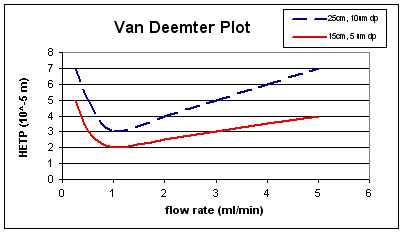
You have two HPLC columns:
- 25 cm length and 10 μm dp
- 15 cm length and 5 μm dp
From the Van Deemter plot above, calculate:
A. Which column gives the best resolution at optimal flow rate (1 ml/min) if both columns are tuned with the same mobile phase for the same sample?
B. If your sample only require 5000 plates for adequate resolution, calculate the fastest time of analysis for the 25 cm column. Assume time of analysis is 10 minutes when operating at the optimal flow rate.
1. Common LC terms
Define and discuss the common LC terms: tR, t0 (or tm), t´R, N, H, k, a and R. EXAMPLE t´R, = tR- t0. t´R is the time spent in the stationary phase. It measures the analyte solubility or adsorption with the stationary phase.
2. The resolution equation
Discuss the master resolution equation. How can you control k, µ and N?
3. Some calculations
From the following chromatogram calculate: The column is 25 cm. long and flow rate is 1 ml/min
- µ for A and B
- N for peak A
- R for A and B
- k for A
- HETP for peak B
4. Typical values
For a typical HPLC analytical column indicate:
|
| Typical Value | Range |
| length: |
|
|
| internal diameter: |
|
|
| particle diameter: |
|
|
| flow rate: |
|
|
| N |
|
|
5. Complete the following table
| dp (µm) | Length | N (plates) | tR (min) | Pressure (psi) |
| 10 | 25.0 | 10,000 | 10.0 | 1.000 |
| 5 | 25.0 |
|
|
|
| 5 | 12.5 |
|
|
|
| 2.5 | 6.25 |
|
|
|
- Why are ionic peaks so much wider on ion exchange columns than on reversed phase columns?
- A. What is a mobile phase modifier?
B. What are indications that one is needed? - A. Are buffers necessary for good reproducibility?
B. How do you decide whether or not to use a buffer? - When is it best to use gradient elution and when is it best to run isocratically?
- Does a decrease in retention time indicate that a column is going bad?
What else could reduce tR? - Do guard columns have to be identical to analytical columns in chemistry?’ particle size?; brand?
- Are there any good “rules of thumb” to use in choosing among silica, cyanopropyl or aminopropyl for normal phase separations.
- Why use ion suppression ( R.P. column) instead of encouraging ionization for ion exchange or ion pair chromatography.
In what circumstances would one choose to utilize ion pair chromatography? - What is the problem when solute peaks elute close to the solvent front? What steps should be taken to correct such a problem?
- You say that it is best to have a k between 2 and 10. How can this be achieved?
- If you have problems with tailing peaks in a chromatographic separation how would you go about correcting this problem?
- If acetonitrile is available, what is the best solvent to use in storing an RP-18 column?