Abstract Authors: Gerd Vanhoenacker and Henk Claessens
The temperature of the HPLC eluent and column has long been an underestimated parameter. Until recently, the best HPLC systems boasted an oven only to thermostat the column in order to improve analytical reproducibility by ensuring a constant temperature. This is extremely surprising given that temperature may influence many important physical parameters in a separation. More recently, however, the HPLC community has recognized temperature’s importance in optimizing separations. Furthermore, temperature has proven to be easier to adjust than the eluent composition.
Performing separations at elevated column temperatures can reduce analysis times, improve column efficiency (plate numbers), reduce peak asymmetry and help optimize retention and selectivity and finally may improve resolution and detectability. With the recent availability of narrow bore columns and the development of high performance ovens, eluent preheaters, and other associated temperature control equipment, LC-analysts have added temperature programming to their arsenal. This chapter describes how to successfully implement HPLC at elevated temperatures.
LevelAdvanced
Since the temperature of the column and mobile phase influences the retention, programming the temperature in time can be used to elute compounds from the column. If the system is capable of covering large temperature ranges, a temperature gradient can be used as in gas chromatography and in many instances, can replace the solvent gradient. This enables the use of temperature programmed elution on detectors that are restricted to isocratic operation such as a refractive index detector.
Successful implementation of HPLC at elevated temperatures depends on these key elements:
- Preheating the mobile phase to avoid band broadening related to thermal mismatch across the column
- Ability to efficiently heat both the exterior space around the column and the fluid entering the column to allow rapid temperature programming.
- Thermostatting the column effluent to protect the detector and stabilize the signal.
- Columns that are stable at elevated temperatures.
- Presence of a leak sensor that will initiate a shut-off procedure upon detection of flammable vapors.
- A backpressure regulator can be installed after the detector to prevent boiling of the mobile phase.
When using water in the mobile phase as in most reversed phase type separations, loss of the bonded phase from the silica support due to hydrolysis is enhanced at high temperatures. Therefore, traditional silica-based stationary phases usually are stable at temperatures up to 60°C and in some instances up to at least 90°C (e.g. Zorbax StableBond C18 from Agilent Technologies, XBridge BEH from Waters).
At this time, new temperature stable silica-based columns and alternative stationary phases are available which enable the application of high temperature over a long period of time while maintaining column performance.
Stationary phases with the highest temperature stability are based on materials other than silica e.g. graphitized carbon types, zirconium oxide based phases and polystyrene/divinylbenzene phases. For columns intended to be used at temperature of 120°C or higher, care has to be taken that the PEEK present in the column hardware is replaced by stainless steel.
An overview of the commercially available “high” temperature stationary phases and maximum operating temperatures is shown in Table 1. Columns should be used only within the rated specifications and guidelines provided by the vendor. Using a column outside of its recommended temperature, mobile phase or pH range can result in rapid degradation of the column. This can cause irreversible damage to the column, and lead to the production of particulates that may plug the lines and detector components of the HPLC system.
Commercially available LC columns for high temperature operation
| Base material | Column manufacturer Available stationary phases | T max 0C |
| Silica, sterically protected | Zorbax Stable Bond (Agilent) | 90 80 80 |
| Silica, polydentate | Blaze 200 (Selerity) C18 Cogent (Microsolv) C18, C6Phenyl | 200 100 |
| Silica, hybrid particle technology | Xbridge (Waters) C18, C6 phenyl | 80 |
| Silica, encapsulated | Pathfinder (Shant Laboratories) C18 | 200 |
| Zirconium oxide | Zirchrom (Zirchrom Separations) PBD, PS Carb, Diamondbond-C18 Discovery Zirconia (Supelco) PBD, PS Carbon, CarbonC18 | 150 200 150 200 |
| Polystyrene/divinylbezene | PLRP-S (Polymer Labs)
| 150 150 150 150 |
| Graphitized carbon | Hypercarb (Thermo Electron) Graphitized carbon | 200 |
Thermal mismatch is defined as the difference in temperature between the column and the mobile phase, producing a temperature profile across the column radius. Therefore, performing LC at elevated temperature requires accurate control of the column temperature and the incoming mobile phase. Thermal mismatch causes the sample front to distort resulting in band broadening, poor peak shape, and split peaks. An example of this effect is shown in Figure 2.
Comparison of LC separation at 60°C with and without mobile phase preheating.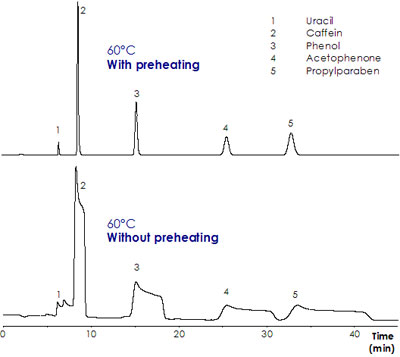
The temperature of a column can be controlled in several ways using e.g. heating blocks, water jackets and baths, and circulating air ovens. The main problems with water jackets and baths are the limited temperature gradient rates that can be achieved by such a system. The efficiency of heating blocks depends largely on the degree of contact with the column hardware. This setup also suffers from limited temperature gradient rates. Circulating air ovens have a heating capacity that mainly depends on the speed at which the heated air can be blown around the column. The main advantage is that the temperature can be varied relatively fast.
The temperature of the incoming mobile phase should be within +/-6°C of the oven/column temperature to minimize band broadening by thermal mismatch between the column wall and the incoming mobile phase and column centre. This is not a concern when using (packed) capillary columns at high temperatures. However, efficiently heating aqueous mobile phases to significantly higher temperatures with typical analytical flow rates of several hundred µL/min up to several mL/min is more of a concern. Many of the literature references used long pieces of stainless steel tubing to heat the LC columns and to preheat the incoming mobile phase, respectively. The major drawbacks of this passive preheating approach are the large dead volume that is generated by the preheating tube and the inability to adjust the heating effectiveness to a varying mobile phase composition (gradient elution) or to a changed flow rate (larger flow rate requires more heating energy). Alternatively, an active preheating approach could be used to eliminate these problems. Such a system can also adjust the mobile phase temperature during fast temperature programming.