Abstract A (bio-)analytical procedure is used to obtain qualitative and/or quantitative information on a sample. In this “Introduction” section an overview will be given on the different stages of the process emphasizing on sampling and sample preparation (SP).
LevelBasic
Normally a sample cannot be injected directly into a separation system. In the sample unwanted matrix components can be present that disturb the separation and/or detection of the analyte(s) or even damage the analytical system. In trace analysis, the concentration of the analyte frequently is so low that pre-concentration (trace-enrichment) should be performed to improve the detectability of the analyte(s). The result is that a number of sample handling – the combination of sample treatment / sample preparation (ST/SP) - steps should be performed to allow injection of the analyte(s) in the separation system.
This means that an analytical process is the way of obtaining chemical information from a sample. This process of taking samples, carrying out the chemical analyses and reporting the results, as is shown here, can be divided into a number of stages.
Stages of the analytical process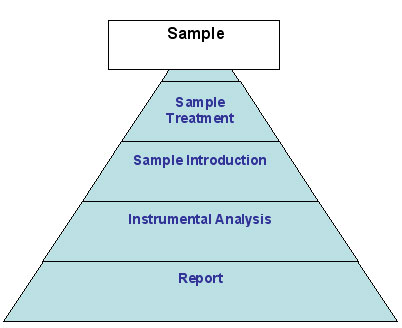
The ST/SP steps can be divided into three parts:
- Stabilizing of the
 sample (e.g., avoiding degradation);
 - Initial (non-selective) sample preparation (e.g., removal of interfering matrix components, dissolution);
- (Selective) sample treatment (e.g., concentration, clean-up).
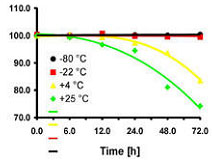 Sample stability during storage at different temperatures (www.ipj.quintessenz.de).
The importance of proper ST/SP steps can be illustrated by comparing the selectivity, the degrees of freedom and the costs of the various steps of the analytical process:
|
| Sample | SP / ST | Separation | Detection | Data-handling |
| Available selectivity | None | Few | Reasonable | Reasonable | Few |
| Available degrees of freedom | None | Many | Reasonable | Few | Few |
| Costs | Not applicable | Reasonable | Reasonable | Few to high | Few to high |
In summary the following statements can be made:
- The isolation and determination of low concentrations of (organic) compounds is a real challenge;
- The lower the concentration of the analytes, the longer method development will take;
- The ST/SP procedure(s) always should be adapted to the final goal of the analytical procedure;
- Always the most simple SP/ST procedure should be chosen, which is in agreement with the goal of the procedure;
- Always the best compromise should be found between the selectivity of the sample ST/SP step and of the separation / detection procedure.
The first stage is sampling. Here, a representative sample is taken and submitted for assay. The information required, in this stage, by the analytical chemist are the sampling details, the history of its transport and storage before receipt in the laboratory. It is important to ensure that any sample taken at this, or any subsequent stage, is representative of the original; i.e. that it is homogeneous.
Issues involved in sampling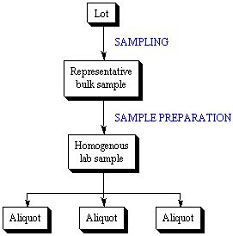 www.gifted.uconn.edu
In many cases sampling has become an integral part of the instrumental analytical procedure; here the sampling stream is fed directly into the analytical instrument. However, normally the sampling site is remote from the laboratory and then the traditional scheme as outlined above will be used. Environmental monitoring using smart sensor-based modules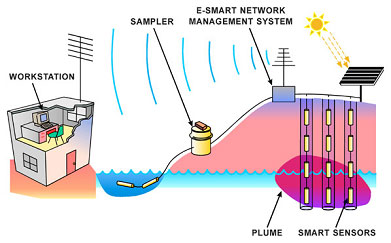 www.esmart.comAlthough nowadays there is a trend in instrumentation towards the sampling site this will not obviate the need for SP/ST. On the contrary, in the near future sampling will become an integral part of the total analytical procedure.
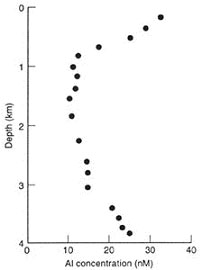 Often, obtaining a representative sample is a relatively simple part of the bio-analytical process; the subsequent stages of ST/SP, analysis and interpretation are normally the most time-consuming parts of the bio-analytical process.
Where to take a representative sample? (C.I. Measures, J.M. Edmond, Anal. Chem., 61 (1989) 544).
In the next step, the ST/SP stage, the sample must be prepared for instrumental analysis. This means that: the sample must be treated in such a way that:
- The majority of solutes – matrix constituents as well as dissolved solutes – interfering with the detection or quantitation of the analyte(s) are removed,
- While at the same time the sample is concentrated.
- The ST/SP and the instrumental analysis stage are intended to improve specificity and sensitivity of the assay.
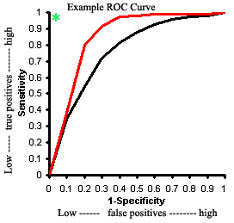 When a medical test is imperfect, scientists try to strike a balance between sensitivity and specificity. To do this, they plot sensitivity and 1-specificity on a graph, called a "ROC curve". (ROC means Receiver -Operator -Characteristic) (www.halls.md).
The initial SP steps can be divided in: labelling, mechanical processing, homogenization, gravimetric or volumetric measurement and fractionation. The initial SP steps are used to:
- Preconcentrate the analytes,
- To get the analytes into solution,
- Get the analyte(s) into a phase which is compatible with mode of separation,
- Reduce the requirements for a and/or N during the separation step,
- Make the analytes compatible with the detection device
- Enhance the sensitivity of the detector.
Nuclear protein fractionation procedure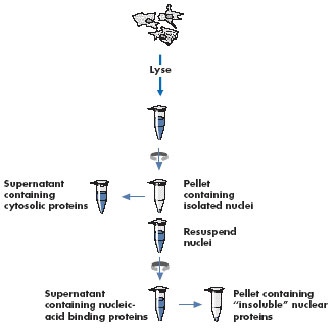 www.qiagen.com
The degree of selective SP steps depends upon many parameters – a major one is the objective of the bio-analytical method.
Example of selective DNA sample preparation (www.millipore.com).
Both initial and selective SP steps are used to:
- remove matrix effects,
- to achieve a partial separation,
- to reduce the number of interferences in the separation step.
Especially the latter means that the SP steps applied depending on the separation  technique involved.
Following the ST/SP step and the sample introduction step is the instrumental analysis stage. As explained in the ‘Starting off’ the instrumental separation procedure is:
- Mainly chromatography and capillary electrophoresis are combined with various detection principles.
- The detector output from the chromatograph can be linked to a data handling system or a chart recorder for the eventual calculation of the analyte concentration.
- Results of the analysis are then evaluated and if acceptable validated or the sample is re-assayed to confirm any findings.
- Once the results are acceptable, interim results can be issued and the final report prepared.
Over the past decade, technological advances have meant that analytical techniques can measure lower quantities of  analytes and computer control of instruments has enabled the data produced to manage efficiently. ST/SP stayed behind.
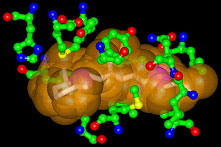 Interactions of large molecules are different from interactions of small molecules.
The actual reason for the analysis can be quite different:
- The number of compounds that has to be determined in environmental samples, food products, biological and pharmaceutical samples is still increasing.
- On the other hand the requirements for safety and quality are becoming higher and higher.
- Another reason is that not only the parent compounds should be determined, but in quite a number of cases also the corresponding degradation products or metabolites. The result is that frequently both polar and non-polar compounds should be determined simultaneously, which means that high quality separation/detection techniques should be used. The latter can be illustrated with the administration of a drug.
The information from the analytical procedure can be used to determine:
- the composition of a sample and/or the concentration of an analyte in that sample
- the status of a chemical process.
The information obtained in this way can be used to determine if a sample is according to its specification, if the water is safe to drink or if no residues of anti-microbial agents are present anymore in, for example, meat products.
The overall conclusion is that chromatographers are looking for faster, more cost-effective, easy-to-use, convenient, and safer techniques. In other words, automation is one of the key issues in modern analytical chemistry. Nowadays there is a suitable automation device for every analytical problem depending on the number of samples to be analyzed and the complexity of the sample and/or the matrix:
| Approach | Characteristics | Examples |
| Flexible | Many repetitive tasks | Robotics |
| Dedicated | Limited number of tasks | Autosamplers with x-y-z dispensers |
| Fixed | Few tasks | Continuous flow, column switching |