Abstract Sample treatment (ST) is the bottleneck in most chromatographic / electrophoretic separations.
The main ST objectives discussed in this Topic are:
1. Learn technologies and techniques:
· How do they work,
· What are the applications,
· What are the advantages and limitations,
2. Possibilities to improve laboratory operations:
· Cost (labour intensive),
· Errors (accuracy, precision),
· Time,
3. Productivity issues:
· Automation,
· Parallel versus serial processing,
· On-line versus off-line,
4. Help to make the transition from SOP’s to (new) techniques a successful one:
· Criteria for choosing sample treatment techniques.
Sampling and sample preparation in analytical chemistry will be presented in a practical way to provide the analytical chemist with the necessary tools to determine low- and high-molecular-weights compounds in a variety of matrices using chromatographic / electrophoretic, spectroscopic or immunological methods.
Method development procedures will be based on the physico-chemical properties of the analyte(s) and the matrices in which these compounds are present
This chapter provides a general introduction. The upcoming chapters will provide the necessary detail.
LevelBasic
Sample treatment (ST) is the bottleneck in most chromatographic/ electrophoretic separations.
The ST goals are:
- Removal of interferences (high and low molecular weight compounds, organic and inorganic compounds);
- Enrichment of the analyte(s);
- Phase transfer of the solutes(s).
The main focus of this topic will be on the development of total (bio-)analytical procedures and in particular on the ST steps needed to determine these compounds with either gas chromatography (GC), liquid chromatography (LC), ion chromatography (IC), affinity chromatography (AC) or capillary electrophoresis (CE), with the emphasis on automated/hyphenated  systems including high-throughput and bio-specific assays.
| Sampling | MEDIUM | |
| Separation & Detection | MEDIUM | |
| Data processing & handling | FAST |
The fact that the polarity of the compounds of interest is still increasing and the fact that sampling and sample preparation (SP) are the most time consuming parts of the total analytical scheme, explains the focus on the numerous combinations of sampling and SP procedures in combination with GC / LC and CE separation-detection approaches.
| 1. | Sample collection | Taking a representative sample |
| 2. | Sample storage and stabilization | Using proper containers and freezing of unstable samples |
| 3. | Initial (primary) sample preparation | Reducing the sample size |
| 4. | Weighing or volumetric dilution | Taking precautions for unstable and reactive samples |
| 5. | Alternative sample processing methods | Introducing solvent replacement, desalting, evaporation procedures etc. |
| 6. | Removal of particulates | Applying filtration and centrifugation steps |
| 7. | Selective (secondary) sample preparation | Introduction of liquid-liquid extraction (LLE) and solid-phase extraction (SPE) approaches |
| 8. | Derivatization | Enhancing detection and improving separation |
An analytical procedure is a means to an end; it provides information which can concern the composition of a sample or the status of a chemical process. This analytical information is then used as a basis for a decision: is a sample within specifications, is this water sample safe to drink or is the process under control?
The analytical laboratory is often on the critical path in many organizations as the assay results are needed before a decision can be taken. Therefore, the analytical laboratory is under increasing pressure to improve its efficiency and improve turnaround times while  maintaining the quality and consistency of the data reported.
There are many reasons why an analytical procedure should be performed:
- There are an increasing number of substances that, for legal reasons must be monitored to ensure the safety of the individual as their presence may be detrimental to both humans and animals.
- There is an increased consumer awareness concerning the quality and safety of manufactured products and this makes manufacturer’s test their products as quality ensures that financial losses from law suits are reduced.
- The increased or decreased concentrations of the natural constituents of the body can be used to diagnose diseases and to monitor its treatment.
In this module various terms will be used:
- Sample treatment: Total process of analyzing a sample including sampling, initial (primary) and selective (secondary) sample preparation, analysis, detection, quantitation and validation.
- Sampling: Process of taking a reliable and representative sample.
- Initial sample preparation: Process of storing, stabilizing and preparing a sample for selective clean-up and analysis.
- Selective sample preparation: Process of sample concentration, selective sample clean-up and/or phase transfer of the analyte(s).
- Analysis: Process of selective (qualitative or quantitative) determination of the analyte(s).
- Detection: Process of identifying or detection of the analyte(s).
- Quantitation: Process of data acquisition, data reduction and data interpretation.
- Validation: Process of guaranteeing the repeatability / reproducibility, robustness / ruggedness of the overall sample treatment process.
These steps are summarized in the scheme below:
The overall analytical procedure 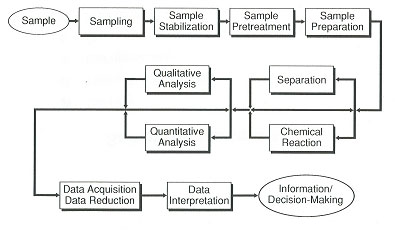
Apart from the classical methods, such as titrimetric and gravimetric techniques, many instrumental techniques have been developed, for the determination of not only the active ingredient, but also the quantification of related compounds or impurities associated with it. The recently developed analytical methods have the advantage of not only using small amounts of sample, reagents and less time, but also produce accurate results. These analytical techniques could either be:
- Physico-chemical methods. Spectroscopy, including colorimetry and spectrophotometry covering ultra-violet and visible region or fluorimetry, nephelometry or turbidimetry, and nuclear-magnetic resonance and mass spectrometry
- Electro-analytical methods. The electro-analytical methods cover potentiometry, amperometry, voltammetry, electrophoresis and polarography.
- Separation-based methods. (High-performance) liquid chromatography (LC), (high-performance) thin-layer chromatography (HPTLC / TLC), capillary electrochromatography (CEC), supercritical-fluid chromatography (SFC) and gas chromatography (GC).
- In addition to chromatographic separation methods, electrophoretic techniques, like capillary electrophoresis (CE),
 isotachophoresis (ITP), gel electrophoresis (GE) and isoelectric focusing (IEF), are relatively popular for the separation and quantitation of (charged) organic compounds.
Drug analysis
The still increasing interest on the determination of drugs has forced the analytical chemists to develop methods for their trace analysis in the presence of biological matrices. These methods should be rapid, precise, accurate and cost effective. Although costly sophisticated instruments like LC, HPTLC, GC, GC-MS and LC-MS are available, the spectrophotometer is being preferred by ordinary laboratories for its simple, economical and easy handling techniques. An overview:
| Separation techniques: | Acronym | |
| Liquid chromatography | LC | |
| (Capillary) gas chromatography | GC | |
| Supercritical-fluid chromatography | SFC | |
| Thin-layer chromatography | TLC | |
| Capillary (zone) electrophoresis | C(Z)E | |
| Hydrophobic-interaction chromatography | HIC | |
| Immunoaffinity chromatography | IAC | |
| Radio-chromatography | RC | |
| Size-exclusion chromatography | SEC | |
| Spectroscopic techniques: | ||
| Mass spectrometry | MS | |
| Ultraviolet-visible absorption | UV-VIS | |
| Emission spectrometry | ||
| Fluorescence | FL | |
| Phosphorescence | P | |
| Chemiluminescence | CL | |
| Colorimetry | ||
| Fourier-transform infrared | FTIR | |
| Nuclear magnetic resonance | NMR | |
| Electro analytical techniques: | ||
| Amperometry | AMP | |
| Coulometry / Potentiometry / | ||
| Polarography / Voltammetry | ||
| Bio-assay techniques: | ||
| Radioimmunoassay | RIA | |
| Immunoradiometric assay | IRMA | |
| Enzyme-multiplied immunoassay | EMIT | |
| Substrate-labeled fluorescent immunoassay | SLFIA | |
| Enzyme-linked immunsorbentassay | ELISA | |
| Receptor assay | ||
| Protein-binding assay | ||
| Enzymatic assay | ||
| Microbiological assay | ||
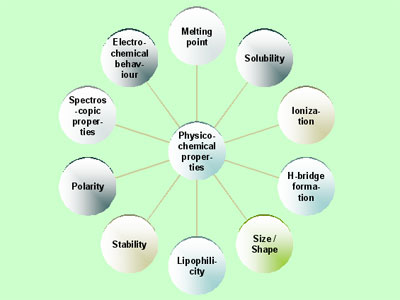
In order to develop analytical procedures for low-molecular weight (LMW) compounds in pharmaceutical formulations and biological samples the starting point always must the physico-chemical properties of both the compounds of interest and the sample matrix. Therefore, the focus will be on these physico-chemical properties and the structure-activity relationships between the solutes and matrix components such as the interaction between drugs and biological matrix components (e.g., proteins, enzymes, receptors) or pesticides and humic substances.
The intention is not to discuss all the basic principles of analytical chemistry, physical chemistry, organic chemistry, thermodynamics and kinetics in detail, but just to provide the information necessary to develop new or to modify existing analytical methods that can be used in pharmaceutical chemistry, bio-analysis and pharmacochemistry.
In addition the physico-chemical and bio-pharmaceutical properties of a compound are determined by its structure. These properties, on its turn, are related to processes like:
- solubility,
- absorption,
- protein binding,
- partitioning,
- elimination
- metabolism.
In (bio)-analytical chemistry (BAC) these properties determine which analytical techniques can be used and what the actual conditions must be. It will be obvious that there is a strong correlation between the various physico-chemical properties.
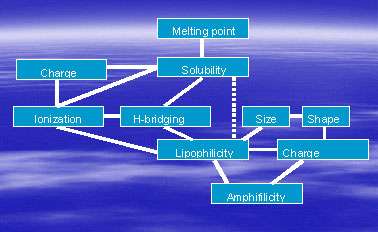
From the examples mentioned above it will be clear that the emphasis will be on the relation between the chemical structure, or in other words the physico-chemical properties of a compound, and the determination of these compounds in a (complex) sample matrix. The final objective is that the information provided can be used to develop simple qualitative and quantitative methods for organic compounds in a variety of matrices. In order to obtain this goal the following parameters will be discussed:
- Physico-chemical properties of organic molecules like polarity, acid-base properties, solubility, stability, absorption/adsorption, etc;
- Composition of sample matrices and their effect on the analytical results (e.g., analyte-matrix binding, stability);
- ST/SP procedures (e.g., filtration, centrifugation, extraction).
---------------------------------------------------------------------
There are two magic words that will be discussed throughout the whole topic: pH and pKa
After studying the Topic on “Structure-related sample treatment” it should be possible to answer the following questions:
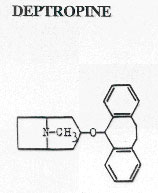 Deptropine is it an acid?
Deptropine does not dissolve in water?
Deptropine is not stable?
Deptropine cannot be analyzed using a C18 column?
Deptropine does not have UV absorbance?
Deptropine is it extremely polar?
And the final question:
Which liquid chromatographic method can be used to determine this compound and several others e.g. maleic acid, propanolol and chlorphenirame, simultaneously, in urine?
-------------------------------------------------------------------------------
With respect to environmental, pharmaceutical and bio-analysis this means that the following topics features are of importance:
- Insight in structures of chemical compounds and physico-chemical properties like pKa, polarity, stability, solubility, chromophores, etc;
- Composition of biological materials and, to lesser extent, pharmaceutical formulations and environmental samples, and their influence on the analytical results (e.g. stability, matrix binding);
- Initial (primary) sample treatment procedures (e.g., filtration, precipitation, extraction);
- Selective (secondary) sample preparation procedures (e.g. solid-phase extraction, immunological approaches, hyphenated and automated system
In order to do deal with these features a number of sub-questions should be answered. These sub-questions are related to the following physico-chemical properties of the analyte(s) or the matrix molecules:
- Name, molecular weight, structure;
- Appearance, colour, smell;
- Acid-base properties;
- Functional groups;
- Polarity (partitioning coefficients);
- Solubility;
- (Chemical) stability;
- Spectral properties;
- Bio-pharmaceutical properties;
- Sample treatment / sample preparation;
- Separation / detection;
- Quantitative aspects (validation).
Sample analysis scheme
Except for the relatively straightforward analytical applications in most cases an overall sample analysis scheme should be constructed. This is because direct sample injection into a chromatographic / electrophoretic system, normally is not possible because unwanted matrix components can disturb the separation and/or detection or can clog the analytical device. In other cases the concentration of the analyte(s) or the degradation products or metabolites may be too low to allow a direct injection procedure. The result is that ST/SP is an important aspect of the total analytical procedure.
Bio-analytical chemistry (BAC) involves a number of different disciplines such as:
- Therapeutic drug monitoring (TDM): ‘The measurement and the clinical use of blood (serum/plasma) drug levels (concentrations) to adjust each patient’s individual drug dosage and schedule to each patient’s individual therapeutic requirement’. In order to perform TDM, quantitative methods for the determination of these drugs, their metabolites and their degradation products should be available.
- Biomonitoring outshines the indirect assessment of exposure in determining which pollutants enter the body,
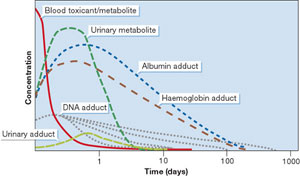 and whether they cause disease or disability. Non-persistent toxicants move quickly out of the blood as they are metabolized to water-soluble compounds that can be extracted in urine. Some chemicals or metabolites may bind to proteins or to DNA and persist in the body for a longer period of time. (Fig from www.nature.com)
 - Toxicology (clinical, forensic, post-mortem). Used to determine if alcohol, drugs or other poisons have contributed to the death of a person.
- Drugs-of abuse. ‘Any substance that, because of some desirable effect, is used for some purpose other than that intended’
- Pharmaceutical analysis. The questions in pharmaceutical analysis are again quite different. Questions that are relevant are dealing with the identity, concentration and stability of the drug in the formulation. In addition information on the impurities, shelf-life and release-rate of the drug from the formulation are essential.
- Food analysis. The properties of foods and their constituents are characterized. Analytical procedures are used in food analysis to provide information about a wide variety of characteristics such as composition (e.g., lipids, proteins, water, carbohydrates, and minerals), structure, physico-chemical properties and sensory attributes. The data obtained are used to produce on an economical, safe and nutritious way.
- Environmental analysis.
Environmental system analysis is an important tool to analyze sustainability, e.g. environmental impact, optimal resource management and how outside factors affect farm management.
Trace environmental quantitative analysis (TEQA) is not only dealing with the determination of organic and inorganic compounds in e.g., air, ground, water, plant effluent, leachate, soil, sediment), by also with the determination of these compounds in body fluids and tissues because the intake of environmental pollutants by humans, and the potential of biohazards is a key issue in environmental chemistry. This means that bioterrorism and biomonitoring are important issues in this respect.
Environmental monitoring is completely different from TDM.
Environmental monitoring (Click to enlarge)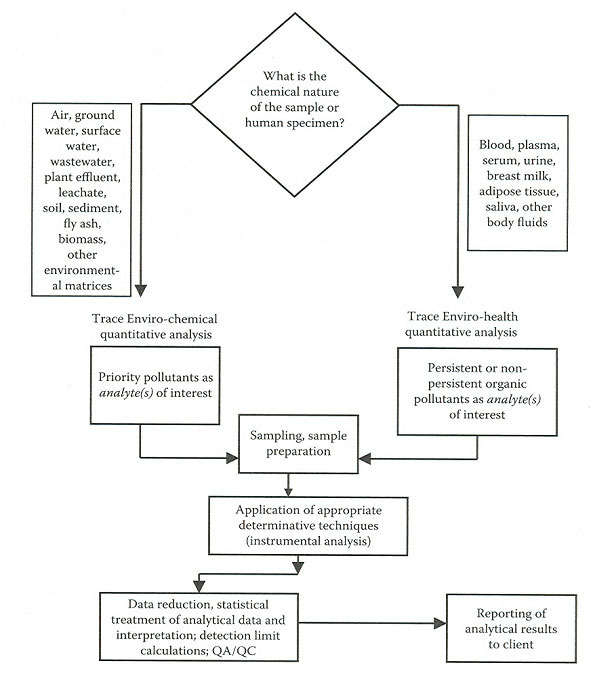 B.J. Alloway, D.C. Ayres, Chemical Principles of Environmental Pollution, Blackie Academic & Professional, London 1997
Environmental analysis can be:
- Analytes entering the environment, amounts involved, original sources and spatial distribution;
- Effects of analytes on humans, crops, livestock and eco-systems;
- Trends in concentration of analytes over time and the reason for this;
- Extent inputs, concentrations, effects and trends can be modified;
- Establish baseline concentrations for comparison;
- Assess need for legislative controls;
- Activate emergency procedures;
- Determine suitability of resources for proposed uses.
In addition to in TDM BAC is important in Pharmacochemistry. The strategy in pharmcochemistry is to find and to document structure-activity relationships (SAR), with the goal to develop new drug candidates.
Using the term activity means for example:
- Dynamic interactions with biological targets like receptors and enzymes;
- Kinetic parameters like membrane penetration and metabolic conversion;
- Toxicological properties like mutagenesis, cell and organ toxicity.
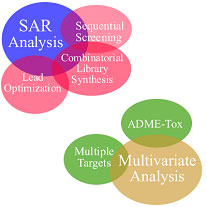 Quantitative-structure activity relationships (QSAR) play an important role in drug development. (www.goldenhelix.com).
Pharmacochemistry can be divided into a number of (sub) disciplines like:
- (Bio)organic chemistry (synthesis and combinatorial chemistry);
- Physical chemistry and structural chemistry (SAR, computational chemistry);
- (Bio-)analytical chemistry;
- Molecular and structural biology (including bio-informatics);
- Pharmacology (including bio-transformation and partitioning);
- Molecular toxicology.
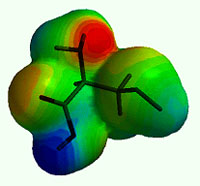 Electron density in the amino acid cystein calculated using a quantum-chemistry computer program (Computational Chemistry). The picture shows the surface where the electron density is 0.002 electrons/Å3 (meaning that nearly all electrons are inside the surface). The grey scale shows the electrostatic potential at this surface, darker portions representing negative potential (http://nobelprize.org).
The popularity of LC can be explained by the fact that in bio-analytical research analyte stability, metabolism (biotransformation), distribution as well as excretion are important and that the strength of LC is that qualitative as well as accurate quantitative information can be obtained of the parent compounds as well as of polar and extremely polar metabolites. LC also has some disadvantages: relatively time-consuming sample preparation techniques are normally needed and relatively large sample volumes (0.5 -1.0 mL) are normally required.
In contrast, immunological techniques require no sample preparation and only 50 -100-mL volumes are needed, but these techniques lack the selectivity of LC methodsImmunoassay formats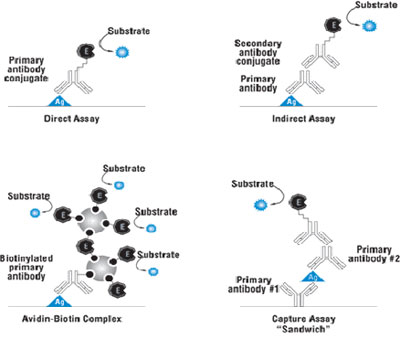 www.piercenet.comFor a considerable number of analytes radio-immunoassays (RIA) are more frequently used than LC methods, but although this is the case for, for example, cyclosporins, the RIA procedures overestimate the cyclosporin concentration because the polyclonal antibodies used react with cyclosporin as well as its metabolites.
However, although cross-reaction is one of the major limitations of immunoassays (IA), the production of highly specific monoclonal antibodies can overcome this problem which means that especially enzyme-linked immunosorbent assay (ELISA) will be an important bio-analytical tool next to LC:
Principle of enzyme-linked immunosorbent assay (ELISA)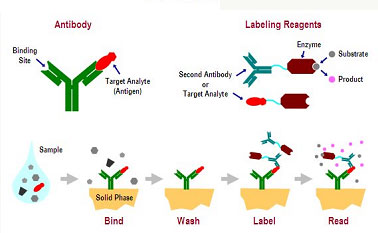 www.biosystemdevelopment.com
Since both techniques, LC and IA, have their own advantages and limitations, the combination of these two techniques, the so-called bio-specific detection, seems to be rather promising.