Abstract GCxGC was introduced in 1991 by John B. Philips and has been rapidly gaining interest over the last decade, especially during the past five years. There are several reasons for that. The GCxGC-hardware (which was initially very fragile) has become much more robust and reliable, and dedicated software for processing the GCxGC-data has become available. In addition, an increasing number of applications has been published in the scientific journals which greatly simplify method development.
Still, there are currently many conventional one-dimensional GC applications in use which can be improved by ‘adding a second dimension’.
KeywordsThis article was written in cooperation with Jan Beens.
LevelBasic
In this section, only a few application areas will be highlighted. They should give the reader an impression of the possibilities of GCxGC. A more comprehensive overview of the various application areas is given in the 'Further studies' below.
Summarizing the advantages over conventional 1D-GC techniques:
- GCxGC provides a better overall separation compared with conventional 1D-GC techniques
- GCxGC often results in structured chromatograms which is a great aid in peak identification
- Peak identification is more reliable since it is based on two retention times
- The second dimension in GCxGC can separate analytes from an interfering matrix
- GCxGC provides a higher sensitivity than 1D-GC (4-5 times higher)
The power of GCxGC is often demonstrated by showing group-type separations of complex samples which contain homologous series (petroleum, chlorinated alkanes, fatty acids, etc.). In these applications, it is usually not the goal to achieve a complete separation of all individual peaks; but instead compounds with the same chemical properties (number of carbon atoms, the same functional groups, the same degree of branching) have to be quantified as one group.
The GCxGC plots of such group-type applications show a great deal of structure: compounds with similar structure show up as clusters in the three-dimensional GCxGC plot and can be quantified quite easily. This means compound properties can be deduced from the coordinates of peaks in the GCxGC plot. For these group-type separation applications, there is no adequate one-dimensional separation technique available.
This can be seen in the example shown below: the conventional one-dimensional chromatogram of a kerosene provides only very limited information. Only the most abundant peaks are visible, but even these still suffer from a lot of co-elutions. In comparison, GCxGC provides a much more detailed sample composition. The sample constituents are separated according to their number of carbon atoms and the number of aromatic and saturated rings.
Separation of a kerosene. Top 1D-GC, n-paraffins protruding from the non-normals (n-C12 indicated). 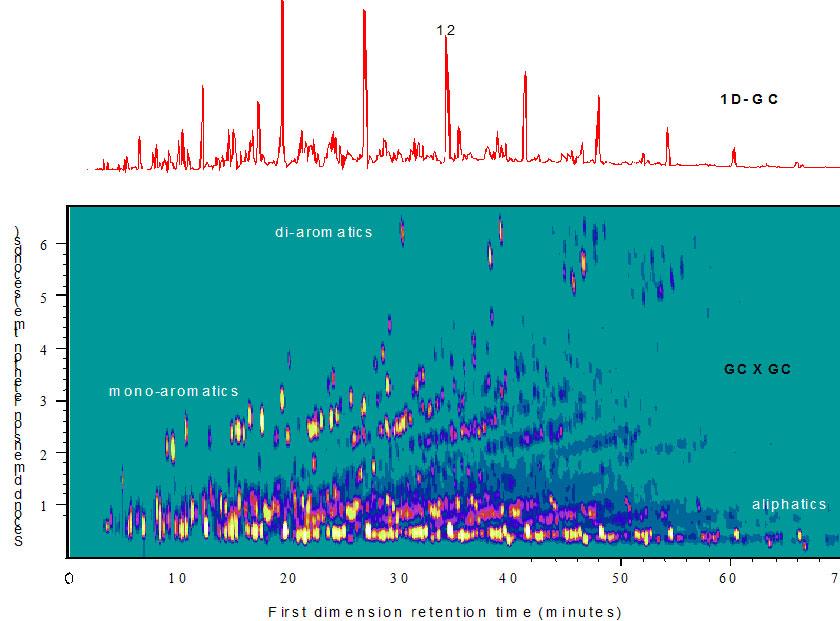 The top frame depicts the 1D-GC separation, with the n-paraffins protruding from the non-normals (n-C12 indicated).
The lower frame is a colour plot of the GCxGC separation. Since components with the same first dimension retention time are co-eluting in the 1D-GC separation, the plot clearly shows that even the n-paraffins have quite a number of co-eluents in 1D-GC. The grouping of the different groups is clearly visible. Within the groups there are ‘roof tiles’ of components with increasing C-number. Within these ‘roof tiles’ compounds with increasing polarity and/or boiling point (generally with a decreasing branching onto the molecule) have increasing retention times in both dimensions.
In the past, such samples were often analyzed using ‘hyphenated’ techniques such as LC–GC. Nowadays, these are often replaced (and outperformed) by GCxGC which provides a much higher total resolution and is much faster.
In a similar fashion, GCxGC often improves the identification and quantification of individual peaks in samples with series of structurally related compounds (fatty acid methyl esters, PCBs, technical mixtures containing homologues series).
Also in these applications, the relationship between peak position and properties makes compound identification much easier and more reliable. This is especially a great aid in cases where single-compound standards are difficult to obtain.
GC×GC separation of herring oil. 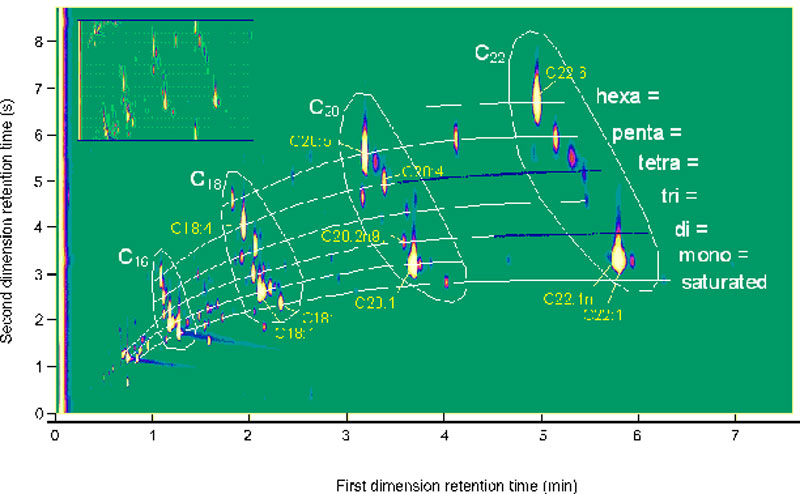 GC×GC separation of herring oil. The structured colour plot clearly shows the clustering of compounds with the same number of carbon atoms (within the polygons) and alignment of compounds with the same number of double bonds (curved lines).
Separating methional and sotolon from interfering compounds
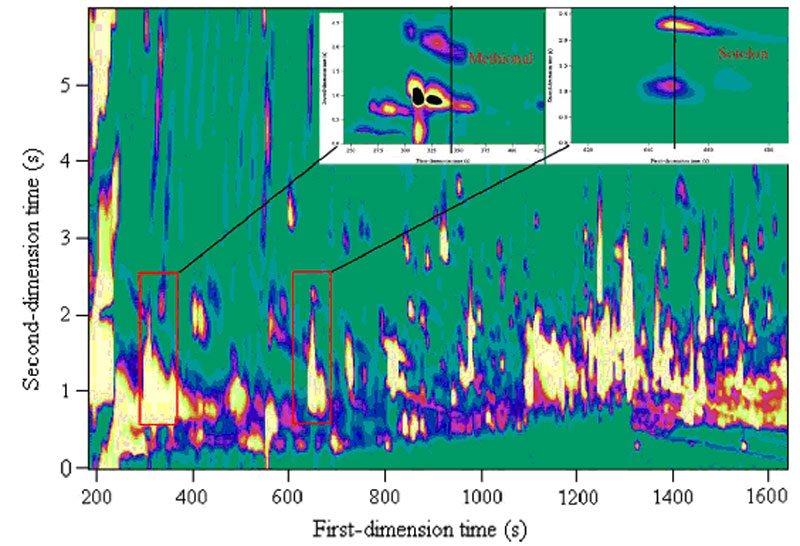 In the example shown above, GCxGC separated two compounds responsible for the flavor of a food extract (methional and sotolon) from interfering compounds. Identification and quantification of these compounds by means of conventional GC–MS is very difficult due to the complexity of the sample. Also, the two compounds do not posses selective ions that could be used for quantification.
 As a last example, an application is shown in which GCxGC is mainly used to separate the analyte(s) of interest from an interfering matrix. This significantly simplifies sample preparation. Sample clean-up steps (such as SPE, LC, etc.) which are usually laborious, time consuming and may often cause a partial loss of analytes, can be omitted or simplified. The example below shows a GC´GC-ECD chromatogram of a dust extract containing a rather high concentration of polychlorinated alkanes which would mask other contaminants such as polybrominated diphenylethers in a 1D-GC separation.
GCxGC separation of a dust extract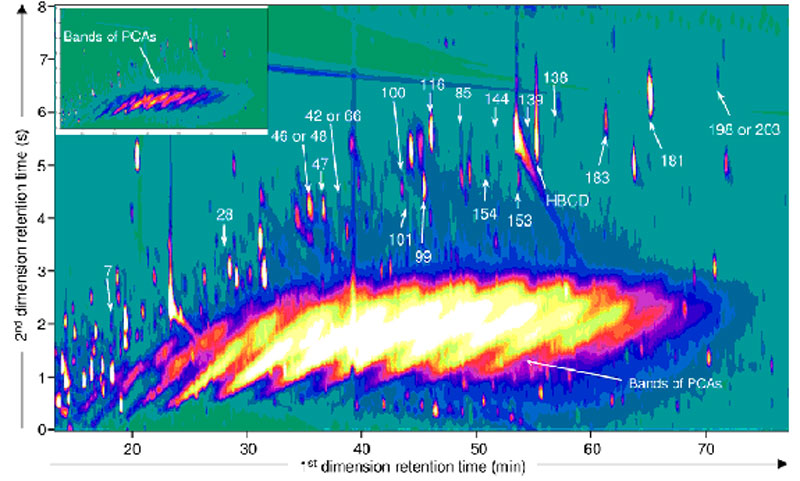 GCxGC separation of a dust extract. No preliminary sample preparations have been performed. The numbered peaks are chlorinated alkanes, well separated from the massive hump of alkane matrix material.
In the past fifteen years numerous investigators in academic as well as in research institutions, have, apart from trying to understand the principles of the technique and optimising it, engaged one selves in applying it to unravel complex samples. From those hundreds of reports it is clear that GCxGC can be successfully applied to a large range of samples. In fact, all samples that are amenable to gas chromatography can be successfully analysed by GCxGC.
Those areas include petrochemical, organohalogen, environmental, food, fat, fragrances, biological and biota samples. The table below demonstrates the specific areas on which GCxGC has been used for target analyses, group type analyses or fingerprinting. (A more comprehensive overview of the various application areas is given below in the five reviews).
| Sample areas | Analysis type |
|
|
|
| PETROCHEMICAL PRODUCTS |
|
| Hydrocarbon compounds | target, group type, fingerprint |
| Hetero-atom-containing compounds | target, group type, fingerprint |
|
|
|
| ORGANOHALOGEN COMPOUNDS |
|
| Polychlorinated biphenyls | target, group type |
| Polychlorinated dibenzo-p-dioxins and dibenzofurans | target, group type |
| Toxaphene and polychlorinated alkanes | group type, fingerprint |
| Polybrominated diphenyl ethers | target, group type |
|
|
|
| ENVIRONMENTAL STUDIES |
|
| Pesticides | target, group type |
| Soils and sediments | target, group type, fingerprint |
| Air and aerosols | target, group type, fingerprint |
| Cigarette smoke | target, group type, fingerprint |
|
|
|
| FOOD, FATS, OILS AND FRAGRANCES |
|
| Fats and oils | target, group type |
| Flavours and fragrances | target, group type |
| Essential oils | target, group type, fingerprint |
| Alcoholic beverages | target, group type, fingerprint |
| Miscellaneous (coffee beans, resoles, roast beef) | target, group type, fingerprint |
|
|
|
| BIOLOGICAL AND BIOTA SAMPLES |
|
| Drugs in blood | target |
| VOCs in human breath | target, group type |
| Metabolomics | group type, fingerprint |
| Biota | target, group type |
GC×GC separation of a Light Catalytically Cracked Cycle Oil (LCCCO).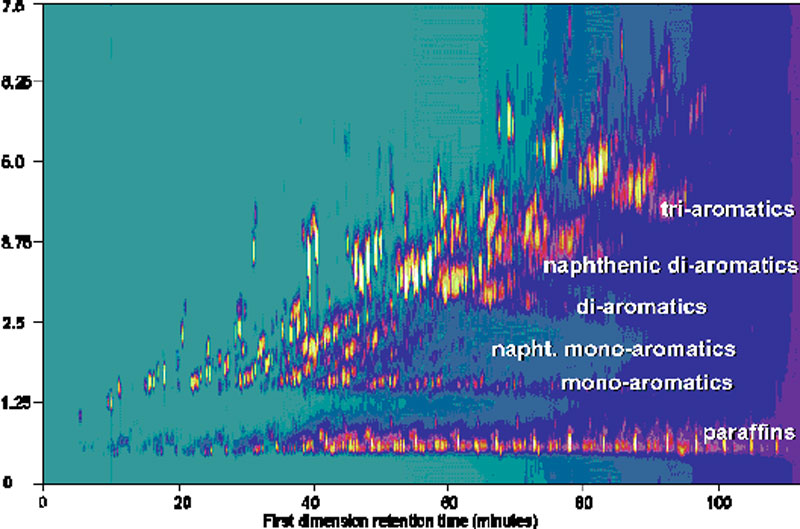 The groups are indicated by their names.
Di-aromatics section of a GC×GC-ToF MS separation of an LCCCO. 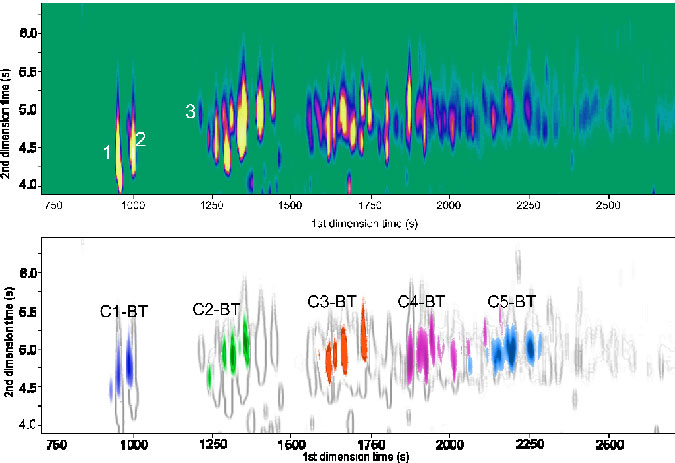 Upper colour plot: TIC, 1. 2-methyl-naphthalene, 2. 1-methyl-naphthalene, 3. ethyl- and dimethyl-naphthalenes + methyl-benzothiophenes.
Lower colour plot: selected ions colour plot. The benzothiophenes (BT) are indicated in colour, the original TIC contour plot is shadowed behind the selected compounds in grey.
J. Dallüge, J. Beens, U.A.Th. Brinkman, Comprehensive two-dimensional gas chromatography: a powerful and versatile analytical tool, J. Chromatogr. A 1000 (2003) 69-108.
M .Adahchour, J. Beens, R.J.J. Vreuls, U.A.Th. Brinkman, Recent developments in comprehensive two-dimensional gas chromatography (GC×GC), I. Principles and instrumentation, Trends in Analytical Chemistry 25 (2006) 438-454
M. Adahchour, J. Beens, R.J.J. Vreuls, U.A.Th. Brinkman, Recent developments in comprehensive two-dimensional gas chromatography (GC×GC), II. Modulation and detection, Trends in Analytical Chemistry 25 (2006) 540-453
M. Adahchour, J. Beens, R.J.J. Vreuls, U.A.Th. Brinkman, Recent developments in comprehensive two-dimensional gas chromatography (GC×GC), III. Applications in petrochemicals and organohalogens, Trends in Analytical Chemistry 25 (2006) 726-741
M. Adahchour, J. Beens, R.J.J. Vreuls, U.A.Th. Brinkman, Recent developments in comprehensive two-dimensional gas chromatography (GC×GC), IV. Further applications, conclusions and perspectives, Trends in Analytical Chemistry 25 (2006) 821-840