Abstract This chapter describes aspects of nanoscale liquid chromatography (nanoLC). NanoLC is a miniaturized HPLC technique performed using columns with an internal diameter (i.d.) between 10-150 µm. The name nanoLC refers to the mobile-phase flow rate which is in the nanoliter per minute range. The main advantage of using smaller i.d. columns in HPLC is the increased detection sensitivity that can be obtained as a result of reduced sample dilution. For that reason nanoLC is ideally suited for the analysis of small sample amounts. In addition, the low flow rate used in nanoLC facilitates easy coupling to mass-spectrometric detectors. The main application of nanoLC is the separation of biomolecules in proteomics and biotechnology.
KeywordsnanoLC, Miniaturization, column switching, proteomics, peptide sequencing
LevelBasic
In this chapter we focus on several aspects of nanoLC. After discussing the advantages of nanoLC in more detail, the instrumental requirements for successful operation of nanoLC are outlined. Typical applications of nanoLC include peptide mapping and multidimensional separations will be discussed.
Routine HPLC analyses are traditionally performed on columns with an internal diameter (i.d.) of 4.6 mm. These columns are robust, have a large sample capacity and are available in a broad range of stationary phases. Reduction of the column i.d. results in less sample  dilution during the chromatographic process, thereby yielding higher detection sensitivity for concentration sensitive detectors such as UV and electrospray MS. For this reason
  miniaturization of HPLC was already started in the early 1980's. As a result a family of new HPLC techniques classified by the internal diameter of the column exists nowadays which are listed in Table 1:
| HPLC technique | Column Internal Diameter | Flow rate | Relative Gain in Sensitivity |
| Conventional LC | 4.6 mm | 1.0 ml/min | 1 |
| Narrowbore LC | 2.1 mm | 200 µl/min | 5 |
| Microbore LC | 1.0 mm | 50 µl/min | 21 |
| Capillary LC | 300 µm | 4 µl/min | 235 |
| Nano LC | 75 µm | 250 nl/min | 3800 |
NanoLC is one of the most extensively miniaturized HPLC techniques and is typically performed on columns of approximately 75 µm i.d. using a mobile-phase flow rate of around 250 nl/min. In order to obtain as much information as possible these samples are ideally analysed by nanoLC coupled to mass-spectrometric detection, yielding maximum detection sensitivity.
In practice, the choice for a certain column i.d. depends on various considerations:
- available sample amount
- sample complexity
- type of detector
Reduction of the column internal diameter (i.d.) in HPLC can be attractive for several reasons:
- increased detection sensitivity
- easier coupling to mass-spectrometry interfaces (ESI and MALDI)
- lower solvent consumption
The analytical requirement of improved detection sensitivity is in many cases the most important reason for applying smaller i.d. columns, especially for minute amounts of samples. The increased detection sensitivity is the result of higher solute peak concentrations in the detector due to reduced sample dilution in smaller i.d. columns . As the sample dilution is directly proportional to the volume of the column a straightforward approach to yield improved sensitivity for concentration sensitive detectors such as UV or ESI-MS, is to apply smaller i.d. columns.
After sample injection radial dispersion will cause the sample to distribute over the entire cross section of the column. The concentration of the sample at the end of the column is inversely proportional to the square of the column diameter. Hence, the theoretical increase in sensitivity that can be achieved by replacing a standard column for a nano column can be calculated by the so-called down scale factor (f):
f = i.d.standard2/ i.d. nano2  Replacing a standard 4.6 mm i.d. column by a 75 µm i.d. nano column and assuming that an equal amount of sample is injected without dispersion gives a theoretical increase in detection sensitivity of almost 3800 (f = 46002/752).
The relative sensitivity gain factor for various HPLC columns is listed in Table 1. In practise the gain in sensitivity is normally smaller because of decreased sensitivity of the miniaturised detection system.
Another advantage of reducing the column i.d. is the better flow rate compatibility with mass spectrometric detectors. The smaller volumetric flow rate results in smaller droplet sizes in electrospray ionization (ESI). The smaller droplets are easily evaporated, which result in increased ionization efficiencies and subsequently improved detection sensitivity.
A third advantage of applying smaller i.d. columns is the reduced mobile-phase consumption in non-split nanoLC systems. This aspect can be important when expensive mobile phases are used, e.g. deuterated solvent in the coupling of LC to NMR .
The performance requirements for nanoLC columns are similar as for standard HPLC columns with respect to efficiency, selectivity, and  stability. A mobile-phase flow rate in these column of approximately 250 nl/min is ideal for the coupling to nano electrospray MS.
For the production of packed nanoLC columns standard slurry-packing techniques can be employed.
However, the small volume of the nanoLC column put severe constraints on the unions, retaining frits and connections in order avoid  dead volume. Therefore the retaining frit must be prepared in the fused silica-tubing.
A widely used and attractive column tubing material is fused silica. To increase the mechanical robustness the fused-silica tubing is gladded with a protective coating. The smooth inner surface of fused silica, the high mechanical strength, and light transparency after removal of the gladding are unique characteristics that make this the preferred material for the production of nanoLC columns. A disadvantage is the limited pH stability of fused silica in comparison to PEEK and stainless steel.
An important consequence of the strongly reduced column i.d. is that the amount of stationary phase available for interaction with the solutes, and thereby the sample capacity is limited. Comparing two columns of identical length and packed with the same stationary phase the maximum amount of sample that can be injected is proportional to the square of the column i.d.s. For a well packed C18 nanoLC column of 75 µm x 15 cm approximately 10 ng of a peptide (1000 Da.) can be injected without causing dispersion due to mass overloading.
Monolithic structures have been applied in liquid chromatography and form an alternative to particulate stationary phases. The monolithic stationary phase is formed by an interconnected structure, prepared by a polymerization process. A scanning electron microscope (SEM) micrograph of the cross section of a 100 µm i.d. polystyrene-divinylbenzene (PS-DVB) monolithic column is shown below:
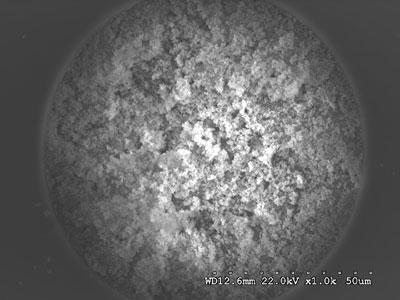
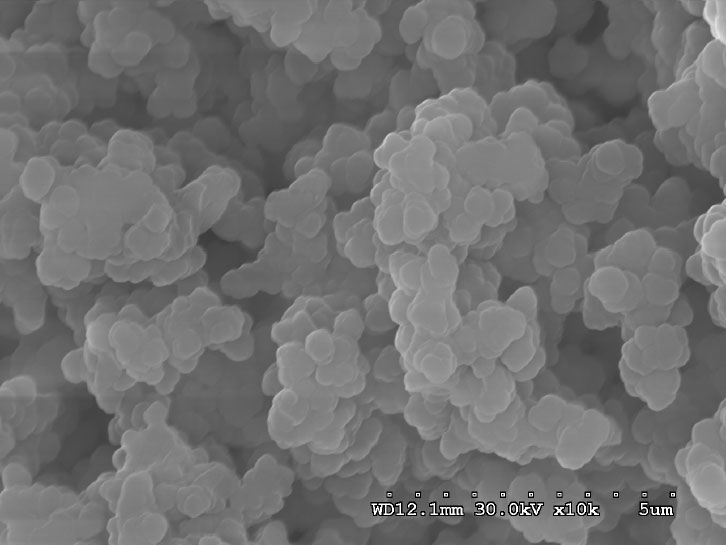
Figure 1 – SEM micrograph of 100 µm i.d. PS-DSVB monolithic column (Click image to enlarge)
Two types of monolithic column have been developed: silica-based and organic polymer based. Although the morphology of silica- and organic polymer based monoliths is completely different, both structures are characterized by large flow through pores and high column permeability. The mass transfer of sample in the monolithic structure is primarily driven by convective flow instead of much slower diffusion resulting in highly efficient separations.
The advantages of monolithic columns:
- High column efficiency
- High column permeability
- Tuneable morphology and selectivity
- In-situ polymerization allows preparation in micro-fluidic devices
- No need for retaining frit
Silica monolithic columns must be modified with C18 alkyl chains for use in RP-HPLC. In contrast, polymer based monolithic structures prepared from polystyrene-divinylbenzene are hydrophobic and allow application as RP stationary phase without modification. Silica and polymer monolithic stationary phases have been prepared in 20-100 µm i.d nanoLC columns for the separation of small molecules and biopolymers, respectively.
In the chromatogram below a typical separation of peptides on a PS-DVB monolithic column is shown. The peak width at half height for peptides is between 2-3 s under the applied gradient conditions. The high column efficiency is ideal for the separation of complex peptide or protein samples.
Separation of peptide mixture on 200 µm i.d. x 5 cm PS-DVB monolithic column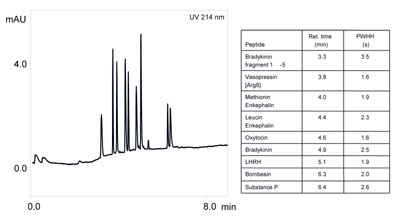
Further reading:
Svec, F., Huber C.G. Analytical Chemistry 75 (2006) 2100-2107
Monolithic materials – Promises, challenges, achievements