Abstract HPLC requires high-purity solvents. Trace dissolved contaminants (especially UV-absorbing molecules) or undissolved particulates in the mobile phase cause significant problems. Filters are used to remove particulates, but these can become blocked. Special consideration must be given to the possibility of bacterial growth or salt crystal formation if buffers are used. Solvent pH is important in many analyses. Solvents must be degassed with helium purging, ultrasound, or vacuum filtration to avoid the development of bubbles in the system.
KeywordsUV absorbance, Solvent reservoir, Purity, Refractive index, Filter, Algae, Salt crystals, Degassing, Vacuum filtration, Ultrasonic treatment, Helium purging, Bacteria, pH, Buffer, Mobile phase
LevelBasic
Many solvent parameters influence the detector signal e.g. the composition of the solvent, UV absorbance and refractive index. HPLC solvents must be compatible with the column and with the detector. The  purity of solvents used for the mobile phase is essential. In general, we prefer solvents with a high purity and good specifications e.g. low UV absorption, low water content, no by-products, no solid particles and only traces of additives such as stabilizers.
Stringent specifications are necessary to prevent problems such as:
- Blocking the system.
- Irreproducible retention times.
- Alteration of column properties by contamination (and subsequent changes in separation)
- Unwanted effect on detector sensitivity, e.g. extra noise.
- Extra drift, in particular in gradient elution, which complicates the quantitation of small peaks.
- Ghost peaks in gradient elution.
- Strong UV absorption by the solvent which lowers the signal.
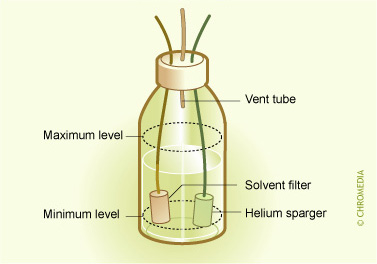
The nominal volume of the reservoir is usually one litre. The reservoir is normally made of (brown)  glass, since this is suitable for all types of solvents. Two or more reservoirs can be used, each containing an organic liquid, water or buffer solution.
Some HPLC systems incorporate a device to bubble helium slowly through a porous filter made of stainless steel. In this way the liquid is permanently degassed. There is a vent hole in the lid of the reservoirs to remove the excess of vapour or helium.
HPLC filters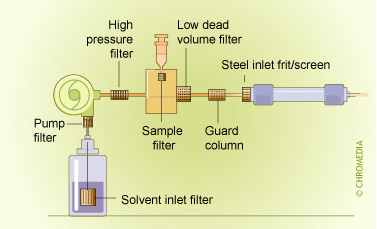
At the pump, the solvent feed line of the pump is fitted with a stainless steel filter with an average pore diameter of about 5 µm. It prevents algae or salt crystals (from a buffer solution) from being drawn into the valve system of the pump head. Such particles can even cause permanent and expensive damage to pump components.
Bacterial and algal growth can also block the filters. Filters can be unblocked by blowing compressed air through them in the opposite direction and by rinsing with 10 vol% 2- Propanol in water. If this is not sufficient, the filters can be placed in an ultrasonic bath for one hour with 10 vol % 2-Propanol.
As a rinsing agent, 2-Propanol is preferred to other organic solvents such as acetone or methanol. It is an excellent solvent for both nonpolar compounds and polar compounds. In addition, it has a great wetting power.
Liquids from an opened bottle (even if they are "HPLC grade") must always be filtered through a filter with a pore size of 0.50 µm.
Since liquids are drawn through filters under vacuum, gas is removed at the same time. The solvent is then ready for use in the HPLC pump.
Degassing of the mobile phase can be executed in different ways. The effectiveness of degassing varies from technique to technique.
- Ultrasonic treatment: The solvent is placed in an ultrasonic bath for 15 minutes. This is a noisy process, generating quite a lot of solvent vapour. It is not a very effective method and can lead to selective evaporation of some of the more volatile solvent components. In practice it is only useful for isocratic analyses.
- Vacuum (filtration): The solvents are individually degassed (online) by vacuum treatment as they flow towards the pump. After leaving the reservoirs, each solvent is fed into the degasser where it flow through semi-permeable tubes. A built-in pump supplies vacuum around the outside of the individual tubes. Dissolved gas molecules diffuse through the plastic walls of the special tubing, resulting in continuous on-line degassing. In general, this system is adequate for most HPLC pumps.
- Helium purging: Pure helium is bubbled slowly through the fine pores of a filter immersed in the solvent (mixture), creating fine bubbles. Dissolved gases diffuse into the helium and are driven out of the solvent. This process is very effective and takes less than 10 minutes daily.
Depending on the type of application, water should:
- Contain little UV absorbing components (for gradient elution)
- Have a low conductivity (caused by ions in the solution)
- Not have solid particles
Ions and particles can be removed by distillation. Organic compounds which absorb in UV or can be oxidized can be removed adequately by:
- Pre-purification on a reversed phase column or reversed osmosis system
- UV-irradiation of water. Aromatic compounds in particular are decomposed to UV transparent compounds.
Water prepared for HPLC normally contains very little of this type of organic compounds. When the ion-exchangers and the filters are regularly replaced with new cartridges, the water quality is guaranteed. Special laboratory systems are available for preparation of ultra pure water from tap water.
If water is stored in bottles it should be inspected for turbidity or precipitation due to bacterial growth. This will occur in particular when water contains buffers and little or no organic solvent. Adding a maximum of 0.01 % v/v sodium azide will prevent growth of algae.
Non- to medium polar uncharged compounds can be separated with neutral mobile phases. With RPLC (Reversed Phase LC), we can also separate very polar and ionic compounds by adding buffers to the mobile phase. Buffer solutions are also used in ion-exchange chromatography.
Some remarks on the use of buffers:
- Their solubility in organic solvents is considerably less than in water. Be sure that the buffer is completely dissolved in the aqueous solvent prior to mixing with an organic modifier. When the sequence of mixing is not expressly stated in a method, do not mix the buffer solution directly with the pure organic liquid, but first dilute the organic liquid with water. If the buffer precipitates the solution becomes turbid. Always check buffers for transparency and replace them if necessary.
- The pH of the mobile phase is always specified for the aqueous solution (without organic liquid). The buffer is then mixed with the required volume percentage of organic modifier.
- If the eluent contains buffer and the system is out of use for some time, let the solvent circulate slowly (0.20 ml/min). This prevents the formation of salt crystals. When the system is not to be used for a longer period of time, flush the mobile phase out of the system with a solution of water and modifier.