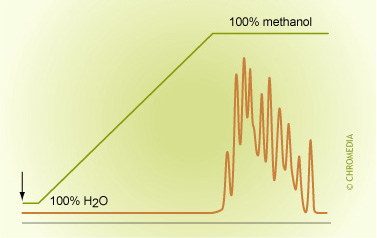
Abstract Some problems that arise during the gradient run are specific to the gradient elution. These problems include baseline disturbance, pressure variation and performance problems with the gradient equipment. The dwell volume has to be known accurately since it contributes to a first isocratic stage at the beginning of the gradient program.
LevelBasic
The quality of a gradient separation may be affected by the following instrumental parameters:
- The quality of the gradient pump
- The efficiency of solvent mixing
- The dwell volume of the system
Delay of gradient pump system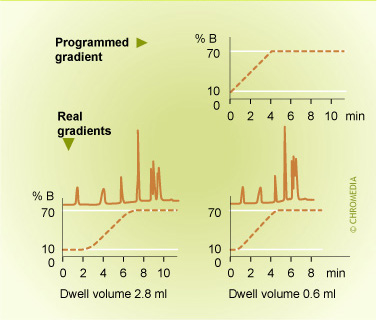
Dwell volume
In a gradient elution, the composition of the mobile phase in the column always lags behind the composition at the pump, as is seen in the illustration. This is due to dwell volume, the void volume between the mixing point and the top of the column. Note also that mixing within the dwell volume smears out the sharp change in mobile phase composition. For a low-pressure system, dwell volume is determined by the volume of the proportioning valves, the pump head, the mixing chamber and the connecting tubing. For a high-pressure system, it includes the mixing chamber and all of the connecting tubing. Both high pressure and low pressure mixing systems have void volumes ranging from 0.1 to 3 mL or even more. In principle, one would expect to observe a smaller dwell volume in a high-pressure system. This is not a given, however. Some brands of gradient equipment are better in this regard. The effect of the dwell volume on the retention times is dependent on the column volume and the flow rate. Early eluting components might even elute under isocratic conditions (ie. the initial solvent composition) since the gradient front requires time to arrive at the column.
Example: Assume the dwell volume is 1 ml. If the column diameter is small (2 mm) and we assume a typical flow of 0.2 ml per minute, it takes 5 minutes for the gradient to reach the top of the columnand an additional column dead time, t0 to reach the end of the column. All components eluting before (5 minutes+ t0) experience an isocratic separation with the eluent concentration at which the column was conditioned. At a flow more typical for a 250 x 4.6 mm column, say 1.5 ml per minute, the “dwell time” is only 40 seconds. Thus, the lag is more significant when the column volume is low since lower volume columns require correspondingly lower flow rates.
Mixing volume
In addition to the dwell volume, a pump is characterized by its mixing volume. This is an extra volume, in addition to the dwell volume, related to the amount of eluent a pump needs to change from one composition to another. If the gradient system mixes very efficiently, the mixing volume is essentially equal to the dwell volume. In practice, the mixing volume is always slightly larger than the dwell volume. The mixing volume influences the shape of the gradient profile. As can be seen at the corners of the solvent profiles in the illustration above, the sharp corners of a programmed gradient are always smoothed out by the mixing volume (and delayed, of course, by the dwell volume). This tends to be a problem with steeper gradients, where the eluent composition changes rapidly with time. In changing a method over from one instrument to another, the mixing volume must be considered.
The repeatability of the gradient conditions is crucial to chromatographic repeatibility. This is particularly important for routine analyses. Realize that with a gradient of 10% per minute, the k-values of the components are reduced by a factor of two approximately every minute. Every percent deviation in composition gives a retention error of 10% or more. Inter-intrument repeatibility, however, is not typically a problem. Yet the accuracy of information must still be verified continuously, because instruments age as well (system suitability test). As has been mentioned, both high-pressure and low- pressure mixing systems can give satisfactory repeatability. The quality of the gradient is more a function of the manufacturer (i.e. the brand) than the type of mixing.
Performance test of a gradient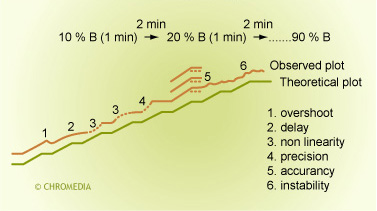
Performance test of a gradient
The figure above illustrates many of the performance problems that one may encounter when using gradient equipment. The engineering considerations are more complicated than just the volume of the mixing chamber or the dwell volume of the system, so one cannot simply choose a high pressure system over a low pressure setup. The most rigorous test would be actually running a test sample on the system under consideration and then comparing it to the the chromatogram obtained on a known, approved system. To this end, test chromatograms are provided with most systems. In considering test chromatograms, one should pay particular attention to the correspondence of the retention times and the resolution of early-eluting components.
The viscosity of the solvent is always an issue in HPLC, especially as packing materials become smaller. The issue becomes more complicated when gradient separations are used. Constant volume flows are obviously important for repeatable results. This is complicated if the viscosity changes continuously since the effort the pump has to make to maintain volumetric flow increases with the viscosity. Thus, the gradient system must adjust not just the eluent composition, but also the pressure generated by the pump.
Viscosity of water-methanol mixtures at 20°C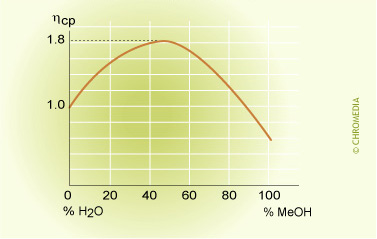
Mixtures of methanol and water exhibit a notoriously drastic and complex shift of viscosity with changing solvent composition. As per definition, the viscosity of water is 1 cpoise at 20°C. Pure methanol is 0.6, but a mixture of about 1:1 has a viscosity of 1.8! Clearly, the viscosity is not linear with solvent composition. As a result, the pressure across a column changes tremendously over the course of a methanol/water gradient. This can result in a dramatic reduction in column lifetime. Also, the detector sensitivity or baseline can drift significantly if the detection method is sensitive to solvent viscosity (e.g. fluorescence and conductivity detectors).
Gradient blank
A gradient should always be carried out first without injection of a sample in order to verify that the eluent used is sufficiently pure. In general, solvents that are not HPLC-grade can contain organic impurities which can concentrate at the top of the column during the first part of the gradient (here, we assume that the mobile phase contains water). As the amount of organic modifier increases, these components will finally elute, adding peaks that are not actually in the  sample! Poorly defined ghost peaks can also contribute to baseline drift.
Ghost peaks with gradient elution