Abstract Multidimensional gas chromatography (MDGC) can be defined as any GC separation process carried out with an integrated (switching) system of two or more columns. Multidimensional systems in which the columns are combined by column switching can optimize the separation capabilities of the different columns. There are numerous possibilities for MDGC ranging from simple two column arrangements, to complex systems involving several columns and precisely timed switching facilities. However MDGC is not a widely utilized technique in general, because it is thought to be complex in operation. Nevertheless there are practical situations, which can benefit from the use of combined columns and some of these will be discussed.
LevelBasic
Attempts to separate mixtures of this type on a single column are rarely completely successful and even the use of several different columns operated  independently is unlikely to improve the situation because of peak shuffling effects.
Multidimensional systems in which the columns are combined by column switching can optimize the separation capabilities of the different columns. Typical situations, which can benefit from the use of multidimensional GC, are:
- The separation of components which cannot be separated on a single column.
- Selective separation of regions selected from a precolumn separation. This process is known as heart cutting.
- Separation of the most volatile part of a wide boiling range sample. The residual sample is then removed by reversing the direction of carrier gas flow through the pre-column; a process known as backflushing. This is also carried out on single columns as a way of venting high boilers.
Packed column systems are often used to perform complex separations in the petrochemical industry particularly for the analysis of (process) gases or samples with a broad boiling range containing various classes of compounds. Currently many applications can be found in various areas.
Some multidimensional systems are completely automatic and designed for specific applications, as in analyzers for particular products. Others are constructed for more general applications of the above three categories. There are two major problems to overcome in the design of multidimensional systems:
- The problem of the compressible nature of the gas.
This requires that any column switching operations should not cause significant changes in the pressures at different points in the system. - The need to keep extra-column volumes to negligible proportions.
To avoid significant extra-volume effects one must use either precision switching valves specifically manufactured for capillary GC, or switching mechanisms that do not involve any direct contact with the sample. Commercial valves are manufactured for capillary-sized columns and will fulfil these requirements but an alternative method is based on the use of pressure balancing systems. Deans (1968) first described a method of heart-cutting using packed columns based on this principle and this is now being extended to open tubular columns. Packed columns are still used in several analyzer systems but there is a trend to replace these with open tubular columns incorporating the Deans switch to gain the benefits of faster analysis and better separation.
Connecting two columns in series without  flow switching is the simplest possible arrangement for a multi column system and its main function would be to optimize the separation of complex mixtures by combining the selective properties of two different stationary phases.
As in MDGC it is clearly not advisable to have the second column a wider diameter than the first column, unless each zone is re-focussed between the two columns. This can usually be done by:
- Cryogenic focussing or
- The use of a small bed of absorbent
Direct serial coupling of two columns, as a way of optimizing difficult separations is potentially a very powerful technique, which is not in fact widely practiced.
One practical use of selectivity tuning by column coupling is to develop new phases having optimum separation characteristics for specific types of complex samples.
The total retention time for each component varies linearly with the fractional lengths of the two columns, and so an optimum separation should be possible by connecting the appropriate lengths together. The optimum lengths of two combined columns lengths can be found:
- From a graph of total retention time versus fractional length of column. This principle is only valid under isothermal conditions.
- A considerably better method is to compute the resolution of all possible pairs of components over the entire range of the respective fractional lengths, and to plot a minimum resolution map.
Samples often contain "heavy ends" or residual components, which are not required for analysis. They need to be removed from the column to avoid contamination.
The simplest way to remove them is to reverse the carrier gas flow through the column after the components of interest have eluted. A configuration of this application using an 8-port valve is shown.
With the valve in the foreflush position, sample from the injector passes
- Through the valve
- Then through the column
- Back through the valve
- Finally to the detector.
Another flow of carrier gas is supplied at the same flow rate to the valve and to vent. When components of interest have left the column the valve is turned to the backflush position, which reverses the flow through the column to vent the  residual sample.
The main disadvantage of this system is the fact that all compounds, i.e. including polar and residual ones, have to pass the valve.
A backflush system, which performs the same function but using pressure balancing according to Deans for reversing the column flow, is shown below.
- The flow is set (CF = flow controller) to give the required carrier gas velocity through the column and the natural midpoint pressure is noted.
- The pressure at the midpoint is adjusted with the pressure regulator (CP) to give a slightly higher pressure than the natural midpoint pressure.
- The result is a foreflush flow through the column to the detector.
- For backflushing, the three-way valve (which may be mounted outside the oven) is switched to prevent access of carrier gas to the column and the vent is opened. Thus the pressure difference across the column is reversed due to the applied controlled midpoint pressure and the flow will reverse and leave the system through the restrictor to vent.
Although both of these techniques are mono-dimensional systems they can be used equally well as two-dimensional systems for the removal of heavy ends. Thus the column shown could be a low efficiency pre-column such as a (packed or) wide bore thick film column, with a second open tubular column connected immediately prior to the detector in the valve system, or in place of the restrictor in the Deans system.
Heartcutting is a powerful technique that can be applied to a wide variety of samples. Some typical examples are:
- Enrichment of trace components, particularly those in the tail of major components.
- Analysis of co-eluting compounds from a pre-separation column.
- Elimination of large amounts of solvent, particularly if this causes problems in the detector.
A number of manufacturers supply multidimensional capillary systems, ranging from simple conversion kits to sophisticated instruments in which the different columns can be accommodated in separate ovens enabling them to be operated under different temperature conditions. The following options are usually available:
- "Sampling" (heartcutting) of pre-column chromatograms at required positions and application of the fraction to a second high resolution column.
- Cryogenic or absorption focussing of the fraction eluting from the precolumn prior to its application to the
 second column by rapid vaporization.
 - Backflushing of sample residue from the precolumn.
This system enables fractions to be selected from column A and passed to column B that would normally contain a different stationary phase capable of separating the components of the selected fractions.
In most cases column A is a precolumn with a higher capacity than column B. Some form of focussing is then necessary, consisting in practice of either a cold trap, or a trap containing a suitable absorbent.
A variety of multi-dimensional GC systems has been developed for the complete characterisation of gasoline and naphtha-type samples. The ultimate of these multi-dimensional systems has been the introduction of the PIONA-analyser (Boer et al., 1971), This system exploited the unique separation of naphthenes and paraffins per carbon number on a column packed with zeolites of a very specific pore size (molecular sieves 13X). In later years it was expanded to samples having boiling points up to 270°C and implemented in a commercial instrument, which is still in use in the majority of the refinery laboratories for the compositional analyses of gasolines and naphthas.
Other investigators developed comparable systems with capillary columns, some of which incorporated a mass spectrometer, but these were never commercialised. Lately, with the introduction of oxygenates in gasolines, all of these analyser systems experience the shortcoming that they are not able to separate the oxygenates from the hydrocarbon matrix.
A new multi-column system, the Reformulyser based on the principles of the original PIONA-analyser, has been developed to overcomes this shortcoming.
Reformulyser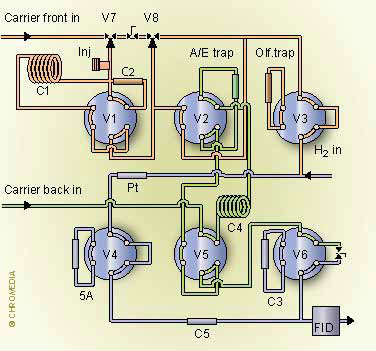
The chromatogram hereunder shows an application commonly used for the analysis of natural gas. Although there are many possible types of natural gas analysis, the most important determinations are for nitrogen, carbon dioxide, and lower hydrocarbons.
Chromatogram of reformulyser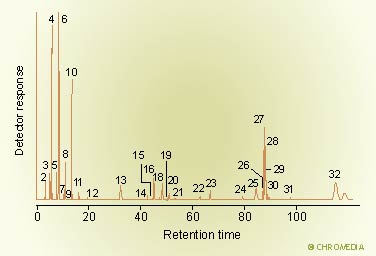
Set up of natural gas analyser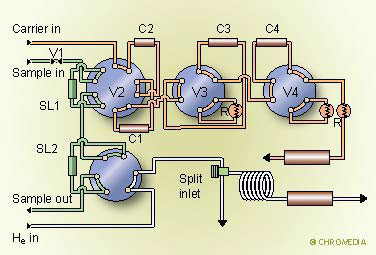 SL = sample loop, V1 = two-way valve to block the sample lines, V2 = ten-port valve, V3, V4 and V5 = six-port valves, R = restriction, TCD = thermal conductivity detector, FID = flame ionisation detector.
The packed column section contains a stripper pre-column (column 1), which separates the C6+ fraction by backflushing as a total. H2S, CO2, C2, O2, N2 and C1 are trapped in column 3 and column 4, while C3 through C5 hydrocarbons elute from column 2 to the TCD. The remaining components are separated by columns 3 and 4 and detected by the TCD. The second channel, through valve 5, uses a split/splitless injector in order to decrease the bandwidth of the injected sample from the sample loop. The capillary column separates the individual components up to C10. The lower limit of detection of this second channel is 0.001 %vol.
Similar switching configurations have been developed for other analysers, which are often used in petrochemical applications and on-line (process) systems.