Abstract Refractive index detectors monitor the refractive index of column eluent (a bulk property), and are thus universal detectors. The detector monitors refractive index either by measuring the deflection of a light beam passing through an interface with the eluent or by measuring the amount of light reflected by the interface at angles near the critical angle. Refractive index detectors require careful control of temperature and are not very sensitive, operating in the mg/L range.
KeywordsDifferential refractive index, Refractive index, Bulk property, Universal, Temperature, Flow variation, Gradient, Refraction, Deflection method, Reflection method, Critical angle, Thermostat, Prism
LevelBasic
The refractive index detector, also called the Differential Refractive Index Detector, detects solutes by monitoring the refractive index of the column eluent relative to a reference cell containing air, mobile phase, or a transparent material with a specified refractive index. Refractive index detector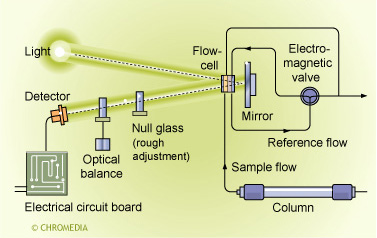
A refractive index detector is a universal detector since it monitors a bulk property of the solution. Unfortunately, RI detectors have a very low sensitivity (mg/L range) and are subject to several caveats:
- RI detectors are very sensitive to changes in temperature. Both the detector and column must be thermostatted.
- The detector is sensitive to flow variations. Furthermore, the cell is quite fragile and one should be careful when using high flow rates.
- RI detectors cannot be used in gradient elution since the eluent composition changes during the analysis. The change in eluent composition is reflected in baseline drift. In theory, it would be possible to correct this if the eluent flow were split into column and reference cell flow before the injector. This is not possible in practice, however.
- Most LC detectors are flow-through detectors. Generally their detection is non-destructive, allowing coupling of detectors in series. When an RI detector is used in series with other detectors, it should be the last detector in the series.
Reflection method
The reflection method is based on the principle that the amount of light reflected by an interface between two media (one of which is the flow cell) depends on the angle of incidence of the incident beam and the refractive indices of the two media (Fresnel's law). Thus, the intensity of the reflected light is a function of the refractive indices of the two media.
The flow cell is glued with its flat side against a prism. The angle of incidence is chosen in such a way that the incident beam is almost entirely reflected (critical angle of incidence). The reflected light is focused onto a photo cell. Small changes in the refractive index within the flow cell give a large change in the light intensity of the transmitted beam under these conditions. Detectors employing the reflection method are able to change the angle of incidence in order to match the critical angle at different eluent refractive indices.
Deflection method
When a light beam goes from one homogeneous medium to another homogeneous medium, it is deflected in a certain angle. The intensity of the deflected beam is more or less constant. The deflection angle is a function of the refractive indices of the two media. The displacement of the deflected beam (the location at which it is detected on the photo cell) is an indication of the concentration of an eluting component.
The cell block consists of two hollow prisms, which are glued together. One of the prisms functions as a reference cell and the other as the sample cell. Modern designs include precision thermostats to control the temperature of the cell block. It is very important that the reference cell be filled with mobile phase of exactly the same composition as that provided to the column. Thus, it must be purged before the analyses begin and several more times in a day.
Sugars cannot be detected by UV. The analysis of sugars in food, as illustrated below, is a classic application of the RI detector. Detection of saccharides with RI detector
 Did you ever try to explain separation to your employees or students? Well, try no more: Lee Polite did it for you in a way which is hard to beat. We will open up one example of his whiteboard class. Click this link to watch the video. To see more, you can register here. Students and teachers can access free for one month. The links in the center column lead to hundreds of chapters with text, video presentations, visualisations and animations. The chapters on Analytical Chemistry 2.1 (David Harvey), as well as basics LC, GC (Harold McNair, Lee Polite and other experts) and spectroscopy chapters are on the level of colleges, laboratory schools and universities, all 'deeper' clicks lead you to more advanced knowledge on analytical techniques with all the details for in-depth understanding for professional users.
Chromedia is used globally by numerous colleges, universities and industries, our authors are ranked as the finest teachers in the world. So go ahead and discover Chromedia by getting a 30 days subscription, which is free for students and teachers. Chromedia functionalities work best on the Chrome browser. - Our expert team
- The Analytical Scientist
- American Chemical Society
- Wiley:
- separationsNOW
- spectroscopyNOW For full access to Chromedia: click here for a paid subscription.