LevelAdvanced
Chromatographers are becoming increasingly interested in RPLC columns of improved chemical and thermal stability. The reasons for this are diverse and include:
- Method development is a time consuming but
 crucial stage in the development of analytical protocols.
 - Once an analytical protocol has been established, analysts want to use their columns for a minimum number of sample injections. Thus, the column must be chemically and thermally stable under the given conditions.
- Columns which can withstand a significantly
 higher eluent pH allow the separation of basic analytes under ion-suppression conditions. This may allow simpler analysis protocols for these substances. Similarly, columns that are stable at low eluent pH may allow the separation of acidic analytes under ion-suppression conditions.
 - In analytical as well as preparative RPLC, the sample loadability of a column can be improved substantially by separating the analytes in their non-ionic forms.
- Thermally stable columns allow the use of the temperature as a parameter in the optimisation of selectivity and efficiency.
The longevity of RPLC columns can be maximized by:
- by using stationary phases based on chemistries that provide high resistance to solvent attack
- by using experimental conditions (particularly eluent composition and column temperature) that protect the column
- Obviously, a combination of both of these approaches is ideal.
Silica remains the substrate for the vast majority of RPLC stationary phases. Therefore, it is not surprising that both academia and manufacturers have invested substantial effort in further improving the chemical and thermal stability of silica based RPLC columns in recent years. Recall that silica is a dream chromatographic starting material with the exception of its accelerated dissolution above pH =7, a not-insignificant problem. At high eluent pH’s, the silica backbone itself may start to dissolve, resulting in decreasing column efficiency and, finally, in clogging of the column. A (Top of figure) = synthesis of a sterically protected or bulky phase; B (Bottom part of figure) = bidentate attached phase.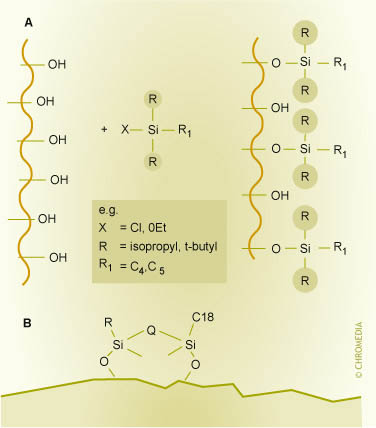
Examples of rplc phases of improved chemical stability: A (Top of figure) = synthesis of a sterically protected or bulky phase; B (Bottom part of figure) = bidentate attached phase.
 thicker walls between their pores in comparison to SilGel silicas. The use of sterically protecting monofunctional silanes and bidentate silanes (illustrated in figures A and B, respectively) has also been found to improve column stability.
 A typical C-18 phase is illustrated in A in the following figure. Notice that the two methyl groups flanking the ligand. In phase B, the methyl groups are replaced by bulky side groups such as isopropyl or t-butyl groups, producing a sterically protected phase. This steric protection is very effective in preventing hydrolysis of the organic ligand. As a result, these sterically protected phases are much more stable at extreme pH’s and temperatures than their conventional counterparts. Figure B illustrates another tactic used to improve chemical and thermal stability. The basic concept of this approach is to optimize the spacing group Q (e.g. ethyl or propyl). This results in a dual and very stable bonding of the organic ligand to the silica surface. The chemical stability of these bidentate phases allows coverage of a substantial part of the pH range.
Types of phases with different stabilities.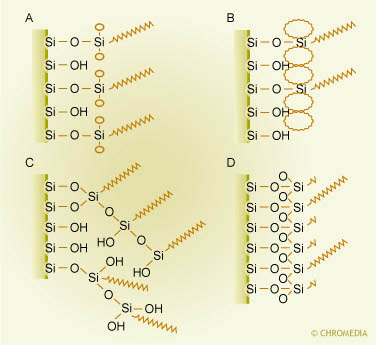 Pictures A and B in illustrate the densely bonded and bulky (respectively) phases discussed earlier plus two more important phases: picture C is a vertically polymerized bonded phases, while D is a horizontally polymerized phase. Each of these phases has a different thermal and chemical stability.
The chemical stability of these bidentate phases allows coverage of a substantial part of the pH range. This illustrates the stability of bidentate phases.
Stability of bidentate C-18 column at pH 11.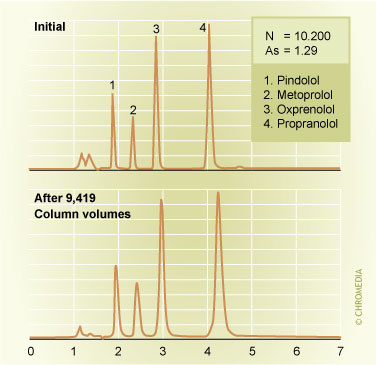 Stability of bidentate C-18 column at pH 11. Column: Extend® C-18 column 15 cmx.046 cm (Agilent Technologies), Newport, DE, USA). Sample: beta-blockers; eluent: acetonitrile-00.017M aqueous potassium phosphate buffer, pH 11.0 (50:50, v/v); flow rate: 1.5 ml/min; temp: 230
Even after 10,000 column volumes of an aggressive pH=11 eluent, the column continues to perform satisfactorily. This volume is approximately equivalent to a month of continuous use during 8 hour days.
Organic-inorganic hybrid silicas (a detailed article by Uwe Neue can be found under this link) form another class of substrates with substantially improved chemical and thermal stability. During the synthesis of this type of substrate, methylsiloxane or ethylsiloxane groups are built into the silica structure, in addition to the ever-present silanol groups. These siloxane groups increase the hydrophobicity of the substrate and reduce the silanol activity significantly. Next, these substrates are modified to, for example, a C-18 phase and are eventually further endcapped. An example of such an endcapped C-18 phase produced from organic-inorganic hybrid silica is presented in this illustration.
Various ligands and groups on substrate.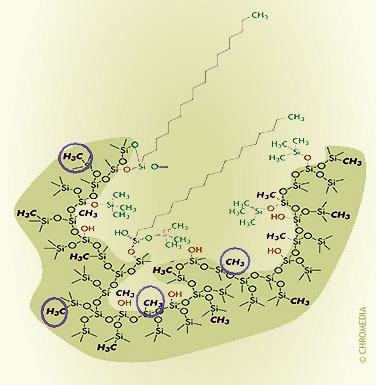 The individual C-18 ligands, trimethylsiloxane endcapping ligands, and methylsiloxane groups on the substrate can be distinguished in the illustration.
In the next picture, the chemical stability of this so called X Bridge RPLC phase is demonstrated under pH = 12 eluent conditions .Stability after repeated injections of the test analytes propranolol, diphenhydramine, nortriptyline and acenaphtene under buffered eluent conditions of ph =12.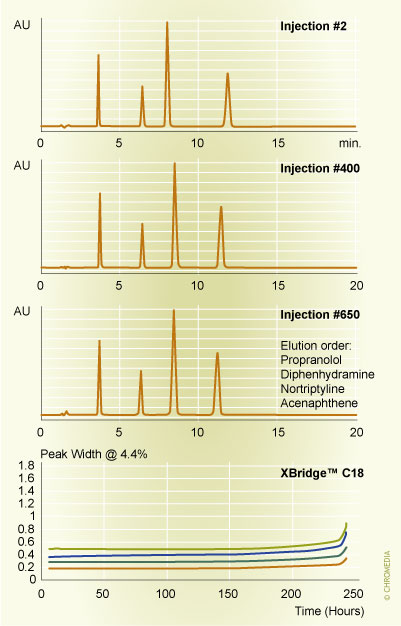
These and other new types of RPLC phases show a significantly increased chemical and thermal stability compared to their conventional counterparts. The illustration below shows the recent progress in the manufacture of silica based RPLC phases of improved stability.
Recent silica based RPLC phases show improved stability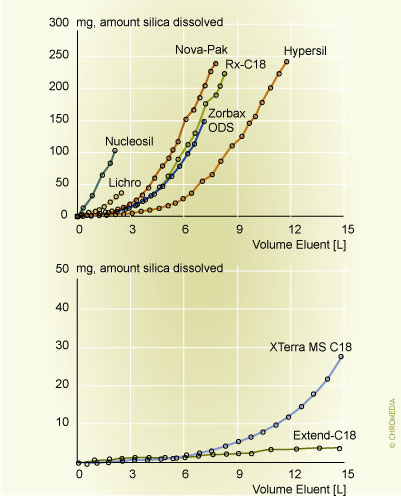 A. Comparison of silica support dissolution for some commercial C-18 columns. Columns: 15 x 0.46 cm i.d., except 15 x 0.39 cm i.d. for Nova-Pak C18; conditions: methanol-sodium carbonate/ bicarbonate (0.1 M) buffer pH 10.0; 50:50 v/v; flow rate 1.0 ml/min, except 0.72 ml/min for the Nova-Pak column; ambient temperature; molybdate colorimetric analysis for dissolved silica.
B. Comparison of silica support dissolution of two commercial C18-columns (viz. Extend of Agilent Technologies, XTerra™ MS of Waters) of the "2000" generation. Experimental conditions are the same as in A.
Both the organic-inorganic hybrid C-18 and the bidentate phases show convincing improvement. Clearly, these and comparable columns can be safely used with 10 to 15 liters of aggressive eluent. In contrast, the conventional substrates in A of the same figure (notice the difference in the Y-axis scales) deteriorate much earlier. The rate of deterioration varies, however, so there are no general rules that can set the thermal and chemical stability. At present, most RPLC phases are intentionally manufactured for use in specific pH and temperature ranges.
Although the new generation of silica-based RPLC phases have opened up new analytical possibilities, chromatographers want to use their columns at ever more extreme conditions with low or high eluent pH’s and at elevated temperatures up to and even beyond 150 ºC. Therefore, much effort has also been put improving the chemical and thermal stability by using substrates that are more stable than silica and alternative chemical modifications, e.g. zirconia and alumina.
Unfortunately, neither zirconia nor alumina is amenable to modification via covalent bonding. In these cases the chemical modification is achieved by polymer encapsulation. A substrate for example zirconia or silica is coated with a thin film of a prepolymer. Next by gamma radiation or thermal treatment, the prepolymer is crosslinked and at the same time, forms a physically adsorbed skin on the substrate. Many different types of such polymer encapsulation layers, including the well known polysiloxanes and polyethers, can be deposited on zirconia and alumina. Aluspher RP Select, a widely used stationary phase, consists of alumina on which a polybutadiene layer has been deposited. The manufacturer claims that this RPLC phase is stable over the entire pH range. There are other examples where polybutadiene and other polymer layers are used to coat zirconia substrates. The figure below illustrates the high chemical and thermal stability of such polybutadiene-coated zirconia.
chemical and thermal stability of a polybutadiene-coated zirconia column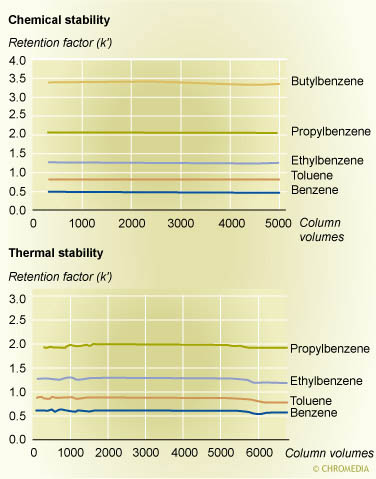 Analysis of the (a) chemical and (b) thermal stability of a polybutadiene-coated zirconia column. Conditions (a): wash fluid: 90:10 v/v. 1 M sodium hydroxide in water-methanol (pH=14); mobile phase: 50:50 v/v. acetonitrile-water; temperature 35C. Conditions (b): mobile phase: 15:85 v/v. acetonitrile-water; temperature 195C. Column (a,b): 150 mm x 4.6 mm ZirChrom-PDB; flow rate (a,b) 1.0 ml/min.).
This figure demonstrates that the phase can be used under pH =14 conditions and at a temperature of at least 195 ºC for 5000 to 6000 column volumes without any deterioration. It is emphasized that alumina and zirconia show Lewis basic, acidic, and ion exchange activity. This may complicate the interactions between the analytes and the chromatographically active surface of these phases. As a result, the retention and selectivity behaviour of alumina and zirconia phases can be quite different from their silica-based counterparts. Analysts taking advantage of the stability of these phases may have to spend more effort in method development since they are not as widely characterized. In the next table the chemical and thermal stabilities of a number of important different types of RPLC phases are summarized qualitatively.
A substantial number of RPLC phases offering a large variety in chemical and thermal stability are available now. Each of these phases, however, has its own specific limitations with respect to eluent pH and operating temperature.
| Phases | Chemical stability | Thermal stability | ||
| Low pH | Intermediate and high pH | |||
| Silica substrate | + | - +++ + ++ | ++ | |
| Polymer | ++++ | ++++ ++++ | +++ | |
| Alumina substrate | +++ | +++ + ? | ? | |
| Zirconia substrate | ++++ | ++++ + ++++ | ++++ + ++++ | |
- Covalently modified silica based phases may have different chemical stabilities. As discussed above, a number of specific types of RPLC phase are stable in the pH range between 2 -12. The thermal stability of these phases is generally limited to about 70 to 80 °C.
- The chemical stability of silica-based polymer coated RPLC phases is still quite limited. This is particularly true in the high pH range. Zirconisation or titanium grafting of the silica substrate substantially improves the chemical stability of such phases.
- Polymer RPLC phases are chemically stable over nearly the entire pH, while their thermal stability may extend to 80 or 150 °C.
- The chemical stability of alumina is much better than silica substrates. Alumina substrates are chemically stable in the range 2 < pH < 13. Covalently bonded alumina phases show a poor chemical stability. In contrast, polymer coated alumina phases have sufficient chemical stability in the acidic, neutral and high pH range.
- Zirconia substrates are chemically stable over nearly the entire pH range and their thermal stability is also very high. Like alumina, the chemical stability of covalently modified zirconia based RPLC phases is insufficient when compared to silica based phases.
All in all, there are many reasons to develop yet more chemically/thermally stable RPLC phases.
We have already discussed the many reasons for the persistence of silica based stationary phases in the RPLC market, as well as the variability in the chemical and thermal stability of these silica phases. In addition to the retention and selectivity properties of modern phases, the efficiency and the thermal and chemical stability have become important criteria in selecting RPLC columns. By treating columns properly and adjusting experimental conditions to protect the column, analysts can extend column life-- sometimes drastically. The longevity of silica based RPLC columns can be influenced by:- The nature of the substrate and bonding chemistry of the particular column, as has been discussed
- The eluent pH and the nature and concentration of the buffering salts therein
- The nature and concentration of the modifiers in the eluent
- The temperature of the column
For example, in figure ? the mass of silica flushed from the column is plotted as a function of the volume of different eluents, all at pH=7 and 60 °C. Once again, the mass of silica dissolved is taken as a measure of column deterioration.
Effect of buffer on silica support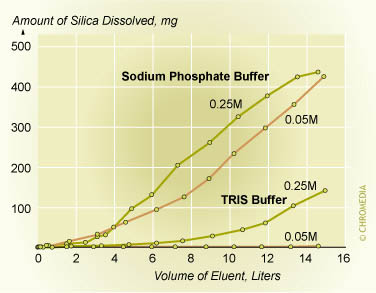 Effect of buffer type and concentration on silica support dissolution. Columns: Zorbax RX-C18, 15 x 0.46 cm I.D.; purge: acetonitrile-sodium phosphate and TRIS buffers, pH=7 (20:80 v/v); 1.0 ml/min; 60 oC.
Obviously, the buffer type and concentration have a significant effect on column life. There is evidence of significant column failure after just one or two liters of the phosphate buffers, while the TRIS-eluted column shows much less deterioration. Clearly, the speed of column failure increases for either buffer as its concentration increases- the 50mM TRIS buffer shows little or no impact on the column after 15 liters, where the 250 mM buffer would have already had a substantial impact. These effects can be ascribed to the different pH shifts in the eluents caused by the buffering salts, as well as complexation effects, particularly in the case of the phosphate buffer. This will be discussed in more detail in the paragraph "eluents "
In general, the longevity of RPLC columns can be substantially improved by:
- Selecting a suitable RPLC column. In general, stationary phases having longer ligands viz. C-18/ C-8 versus C-4 show better chemical stability, especially under aggressive eluent conditions. Furthermore, the chemical stability and thus, column longevity, is usually larger for higher surface density phases and phases that have been thoroughly endcapped.
- The use of ‘soft ‘ (e.g. organic) buffers at the lowest possible buffering salt concentration. Sodium appears to be the most favourable buffer counter ion.
- The use of acetonitrile rather than methanol as the organic modifier in the eluent.
- Keeping the column temperature requirement as close to room temperature as is feasible.
In summary, the selection of a suitable column for a specific separation problem is a first and crucial step in RPLC method development. By following the few well established rules discussed above, the longevity of conventional and “next generation” RPLC columns can be improved substantially. For a more in depth treatment of this subject, I refer the reader to "Review on the chemical and thermal stability of stationary phases for reversed phase liquid chromatography “ J. Chrom. A. 1060 ( 2004 ) 23-41 and the references therein.