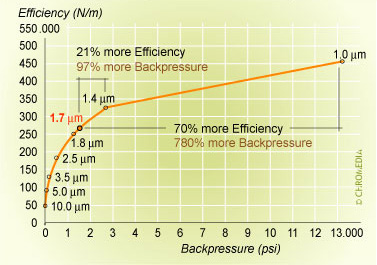
Abstract The historical trend among column packings has been towards smaller and more regularly shaped particles. Regular particle shape improves the uniformity of the packed column bed. Decreased particle size improves the efficiency (N) of a column, though there are also other important considerations when selecting a column. Resolution increases with the square root of N. Thus, decreased particle size can increase resolution, but at the expense of increased backpressure, the risk of more frequent column blockage, and increased difficulty of column manufacture.
KeywordsMiniaturization, Efficiency, van Deemter equation, A-term, Cm-term, Cs-term, Particle size, Particle shape, Packing, Analysis time, Solvent consumption, Plate number, Resolution, Darcy’s law, Pressure drop, Backpressure, Blockage.
LevelBasic
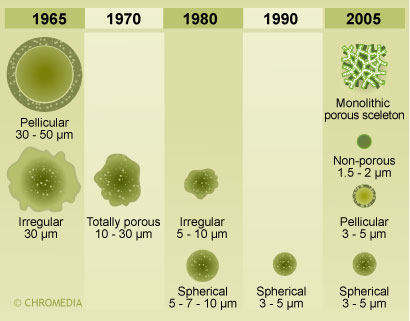
The miniaturization of column packing particles has historically been of great interest. Modern HPLC derived the designation High Performance as a result of several breakthroughs in this area. The development of spherical, non-porous, small pellicular particles, as well as the recent introduction of monolithic stationary phases significantly improved the quality and practicality of chromatographic separations.
The size of the packing particle in particular affects both the column’s separation efficiency and the effect of eluent velocity on separation  efficiency. Nonetheless, the benefits of smaller particle size are somewhat difficult to understand and require separate consideration of each of the three terms in the Van Deemter equation:
- The particle size plays a role in the A-term, in the Cm-term and, to a lesser degree, in the Cs-term.
- The overall contribution is more complex, but a rule of thumb is that the particle size of the packing is inversely proportional to the plate number of the column.
- Currently, standard HPLC columns use 3 and 5 micrometer particles.
- More recently, however, columns have been introduced with particle diameters between 1.5 and 2.0 microns. In addition silica and organic based monolithic columns have appeared on the market in addition to the better-known particle-packed columns.
A good packing material is essential to generating adequate column efficiency. It should:
- Have a regular particle structure
- Have a small distribution in the average particle size
- Be packed (with an appropriate technique) into a column with an extremely smooth internal wall structure.
It is extremely important that the particles are regularly shaped:
- The more regular the particles, the more uniform the final column bed will be. Most manufacturers now use spherical particles to produce well packed and efficient columns.
- Likewise, a smaller particle diameter distribution increases the uniformity of the packed bed.
Thus, a uniform shape and size result in higher quality columns.
Note the relative minima of the two curves in the van Deemter plot below. The 3 µm column (green) is more efficient at any flow and reaches its maximum efficiency (minimum H) at a significantly higher flow rate than the 5 µm column. Additionally, the 3µm curve shows a shallower minimum, allowing the analyst to increase flow rates without significant decrease in efficiency.
Particle size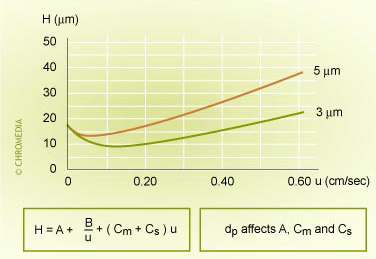
Particle size and plate number not linearly proportional
The plate number does not affect the degree of separation linearly: the resolution is  proportional to the square root of the plate number.
The resolution is of paramount importance. However, it is not the only criterion by which an analysis protocol is judged:
- The analysis time,
- Sample capacity,
- Column longevity and the
- Sensitivity of the method
are important considerations as well. In addition, economic factors also play a role such as:
- Solvent use,
- Costs of disposal
- Total analysis time.
We will discuss particle size, and column length and diameter with regard to these criteria.
Particle size distribution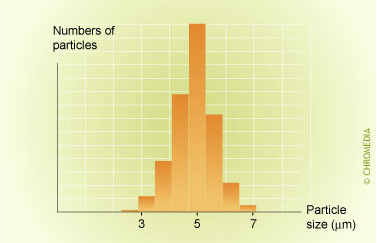
- Smaller particles offer improved efficiency and resolution.. The use of such particles may increase however the risk of column blockage and generates higher pressure drops.
- Each time a smaller particle is developed, adjustments must be made to column packing procedures. Packing of columns becomes more difficult for very small particles (< 2 µm).
- The manufacture of small particles is more difficult with respect to control the dispersion of the particle size. A typical particle size distribution for nominally 5 micron particles shown in the histogram above. As a rule of thumb, the particle size distribution of a good packing material should not be larger than about 25% of the nominal particle diameter.
Darcy's law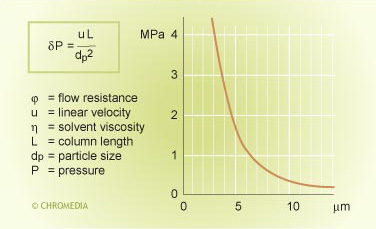
Darcy's law (the illustration shows a simplified version) indicates that the pressure required to force the mobile phase through the column is determined by the:
- Required eluent linear velocity
- Column’s specific permeability
- Length of the column
- Average particle size of the stationary phase.
- Viscosity of the eluent
The length affects the pressure linearly, while the particle size effect is inverse  quadratic. Very small particles may generate practical problems. Up to recently 3 and 5 micron stationary phases are common, smaller particles (e.g. 1.8 micron) are moving into the market. The increased pressure causes as a side effect an increase in temperature of the column. More on this in the RPLC section.
Plate number and backpressure as function of particle size