Abstract The analyte peak has a certain width, which becomes wider traveling further distances along the column after the injection. The chance of overlap will be much smaller with narrow peaks, so that even with small differences in retention there will be a complete, baseline separation.
LevelBasic
Two effects occur during the chromatographic process, which are of importance for the separation result:
- Retention/selectivity
In order to separate two components during a chromatographic separation, there must be a difference in their retention (column selectivity). - Peak broadening
The analyte peak has a certain width, which becomes wider traveling further distances along the column from the starting point (after injection). Ideally, the peak shape should be Gaussian (normal distribution).
Distribution process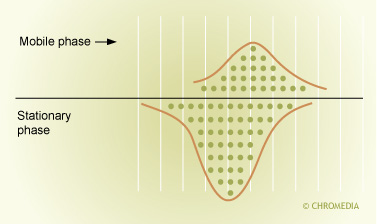
The  extent of peak broadening plays a vital role in the separation of sample components. If two adjacent peaks are both wide, they will overlap and the separation will be incomplete (no baseline separation). The chance of overlap will be much smaller with narrow peaks, so that even with small differences in retention there will be a complete, baseline separation. Peak broadening can be regarded as a property of a certain column. The ability to produce narrow peaks is called the efficiency of a column. An efficient column produces (in spite of its longer length) narrow peaks.
Peak broadening is not exclusively caused by the factors mentioned in the plate height equation. If not properly optimised, the instrument itself can contribute to peak broadening. This becomes evident when the same column yields different plate numbers for the same separation carried out on different instruments The injection system, the detector, connecting tubings and fittings can all contribute to peak broadening.
The effect of the other components of the system increases as the volume of the column gets smaller compared to the volume outside the column.
Peak width is determined by:
- the injection
- the separation process in the column
- the connections between instrument components
- the detector
σ 2 overall = σ2 injector + σ2 column + σ2 connections + σ2 detector
Peak variances are expressed without dimension. The deviation in the volume can be found by multiplying t (min) by the flow F (ml/min). In an ideal instrument the peak broadening is only determined by the diffusion processes in the column. In that case is:
σ 2inj + σ2det + σ2conn « σ2column
Dead volumes affect the efficiency of a column. Narrow bore thin film columns with small internal volumes and a high efficiencies will be more critically affected than wide bore thick film columns. With respect to dead volume and its effect on chromatographic peaks, distinction can be made between:
- Dynamic dead volume
Dynamic dead volume is 'empty' volume of, for instance, a detector-jet, a piece of connecting tubing or a fitting, in which carrier gas flows in an oneven flow profile. Such an extra volume results in peak broadening. The peaks usually remain symmetrical.
- Static dead volume
Asymmetrical peaks (tailing) are caused by static dead volume. This volume is is not (completely) swept by the carrier gas and is caused by, for instance, poor couplings, closed connections, wrongly constructed liners or detector-jets or a faulty installation of a column.