Abstract Liquid Solid Chromatography ( LSC ) – also called Normal ( NPLC ) or Straight Phase Chromatography - was one of the first separation techniques. It uses a polar stationary phase and a relatively less polar, mostly organic mobile phase. With the tremendous popularity of the more recent Reversed Phase Liquid Chromatography ( RPLC ), NPLC has been displaced to a certain extent, but is generally underestimated and still attractive. In fact, NPLC is a superior technique for the separation of substances that are chemically closely related, as well for the separation of isomers and diastereomers. NPLC has also found a niche in sample preparation techniques, especially for the separation of complex mixtures within chemical subclasses. This introductory chapter provides the basics and some applications and examples of this technique.
LevelBasic
Normal Phase Liquid Chromatography was one of the first separation modes available in the early days of modern High Performance Liquid Chromatography. LSC or NPLC can be characterised by the use of a polar stationary phase and a relatively less polar, mostly organic mobile phase Typical stationary phases for NPLC include inorganic oxides such as silica, alumina, zirconia, and carbon, as well as chemically modified polar bonded phases. Of the inorganic oxides, silica is the most important stationary phase in NPLC.
NPLC is particularly suitable for:
- The separation of non-ionic analytes, which are sufficiently soluble in organic solvents
- For polar analytes, which are poorly soluble in aqueous RPLC eluents.
- Some NPLC phases (especially inorganic oxides) can separate isomers, stereoisomers and diastereomers.
- NPLC also remains popular for its ability to separate chemical subclasses.
NPLC can be an option in the following cases:
- The sample is unretained by RPLC (sample is too hydrophilic)
- The sample is too strongly retained by RPLC (sample is too hydrophobic)
- RPC separation is unable to achieve adequate band spacing (a=1)
- The sample contains positional isomers, stereoisomers or diastereomers
- Recovery of significant amounts of organic soluble sample components is desired (Preparative LC)
- The sample is dissolved in a non-polar solvent (causing direct-injection problems if using a RPLC column).
The retention and selectivity processes in RPLC and NPLC are very different and are generally spoken of in terms of partition and adsorption processes, respectively. This implies that many classes of sample analytes are best separated by one technique or the other. Such differences in the retention and selectivity potential of RPLC and NPLC on bare and bonded phases are summarized in the next table.
| Compounds | RPLC | NPLC phases | NPLC polar bonded phases |
| Homologue series of organic analytes | +++ | + | ++ |
| Analytes carrying functional groups | + | +++ | ++ |
| Isomers, diastereomers | + | +++ | ++ |
+ = weak
++ = medium
+++ = strong
| Comparison of Normal versus Reversed Phase Liquid Chromatography | ||
|
| Normal phase | Reversed phase |
| Stationary phases | Polar; | Moderate to non-polar; |
| Mobile phases | Less polar; non aqueous: | Polar; aqueous: |
| Samples | Insoluble in aqueous solutions | Soluble in aqueous solutions |
| Suitability | Non-ionic organic analytes | All except large analytes |
| Equilibrium time | Lengthy | Short |
As in other modes of HPLC, silica is favoured as the starting material in the manufacture of chemically modified phases. The figure below illustrates the structure of a silica substrate, including the active silanol and  siloxane groups.
Silanol groups at silica surface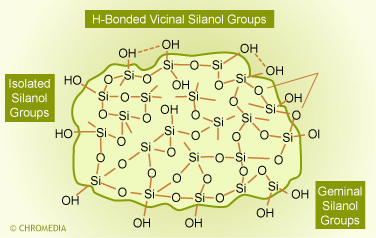
A number of chromatographically important properties of silica are:
- Specific surface: 5 to 1000 m2/g
- Particle size : 2 to 10 micrometer
- Pore size: 30 to 4000 Angström
- Pore volume: 0.8 to 2.0 ml/g
- Number of silanol groups: about 8 μmol / nm2
The use of inorganic oxide based stationary phases in NPLC can lead to some practical difficulties such as the chemisorption of eluent contaminants and instability in the level of hydration of the stationary phase’s surface. This, in turn, can lead to long column equilibrium times and poorly reproducible gradient analyses.
Most of these problems can be overcome with the use of chemically modified polar bonded stationary phases, however. In these phases polar ligands such as cyano, diol and amino groups are chemically attached to a substrate (e.g. silica). An in-depth discussion on the preparation and properties of chemically modified stationary phases can be found in the RPLC section.
The picture below shows examples of such polar phases, including cyanopropyl, aminopropyl and diol ligands:
Polar bonded phases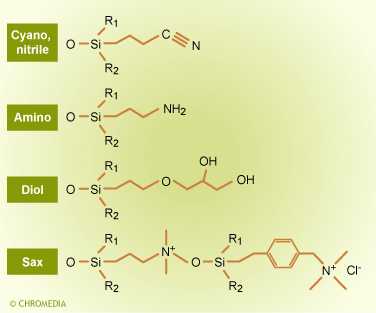
Chemically modified NPLC stationary phases can be considered deactivated inorganic substrates.
The remaining active sites (silanols in the case of silica) together with the attached polar ligands now determine the retention and selectivity. Therefore, these chemically modified polar bonded phases are energetically less  active compared to bare inorganic phases.
In NPLC the localization and non-localisation properties of sample analytes (and also of the mobile and stationary phases) are the dominant factors in retention and selectivity. The presence, strength and relative positions of polar centers in eluent and sample molecules determine their localizing or non-localizing properties.
Molecules with significant localizing properties interact strongly with the active sites on a stationary phase, for example the silanol groups on silica. In contrast, non-localizing molecules interact with a stationary phase only weakly, if at all. These properties also determine the relative strength of eluents:
- The retention and selectivity of NPLC can be controlled by properly combining polar, localizing solvents with apolar or non-localizing solvents.
As an example, the localizing, non-localizing, and basic properties of a number of commonly used NPLC solvents obtained on silica are summarized in the table:
| Solvent | Type | |
| Hexane, heptane | Non-localizing | |
| Carbon tetrachloride | Non-localizing | |
| Toluene | Non-localizing | |
| Chloroform | Non-localizing | |
| 1 or 2- Chloropropane | Non-localizing | |
| Dichloromethane | Non-localizing | |
| 2-Propyl ether | Minor localizing | |
| 1,2-Dichloroethane | Non-localizing | |
| Diethyl ether | Localizing and basic | |
| Methyl t-butyl ether | Localizing and basic | |
| Ethyl acetate | Localizing | |
| Dioxane | Localizing and basic | |
| Acetonitrile | Localizing | |
| Tetrahydrofuranne | Localizing and basic | |
| Acetone | Localizing | |
| 1 or 2- propanol | Localizing and basic | |
| Methanol | Localizing and basic |
Retention and selectivity in NPLC is generally described with one of two different models:
- The competition or displacement model developed by Snyder and Soszewinski. This model assumes a monolayer of surface-adsorbed solvent. Retention and selectivity originate from the displacement of these solvent molecules by the sample analytes (more particularly by their functional groups).
- The solvent interaction model developed by Scott and Kucera. This model assumes a surface –adsorbed eluent bilayer. Retention and selectivity originate from displacement effects between sample analytes and solvent molecules in the primary solvent layer. This process is similar to the competition model. Additional retention and selectivity effects can be caused by displacement and association of analytes with solvent molecules in the second part of the bilayer.
The retention process in NPLC on a bare silica stationary phase is illustrated below.
Adsorption chromatography (LSC)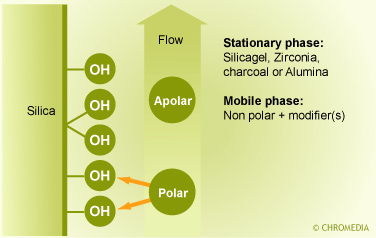
This figure points out the interactions between the polar, localizing analytes and the powerfully active silanol groups on the silica stationary phase. Meanwhile, the apolar, non-localizing analytes interact less, if at all, with the stationary phase, resulting in low retention values for these analytes. To a first approximation, retention and selectivity in NPLC are determined by the composition and the relative solvent strength of the eluent. In the table below, the relative solvent strength values of common NPLC solvents are summarized as obtained on typical NPLC stationary phases.
| Solvent | ||||||
| Alumina | Silica | Carbon | Aminopropyl | Cyanopropyl | Diol | |
| Pentane | 0.00 | 0.00 | 0.13 - 0.17 | |||
| Hexane | 0.01 | 0.01 | ||||
| CCl4 | 0.17 | 0.11 | 0.069 | |||
| 1-Chlorobutane | 0.26 | 0.20 | 0.09 - 0.14 | |||
| Benzene | 0.32 | 0.25 | 0.20 - 0.22 | |||
| Methyl-tert. butyl ether | 0.48 | 0.11 - 0.124 | 0.049 - 0.085 | 0.071 | ||
| Chloroform | 0.36 | 0.26 | 0.12 - 0.20 | 0.13 - 0.14 | 0.106 | 0.097 |
| Dichloromethane | 0.40 | 0.30 | 014 - 0.17 | 0.13 | 0.120 | 0.096 |
| Acetone | 0.58 | 0.53 | 0.14 | |||
| Tetrahydrofuran | 0.51 | 0.53 | 0.09 - 0.14 | 0.11 | ||
| Dioxane | 0.61 | 0.51 | 0.14 - 0.17 | |||
| Ethyl acetate | 0.60 | 0.48 | 0.04 - 0.09 | 0.113 | ||
| Acetonitrile | 0.55 | 0.52 | 0.01 - 0.04 | |||
| Pyridine | 0.70 | |||||
| Methanol | 0.95 | 0.70 | 0.00 | 0.24 |
The influence of the nature and composition of the solvents in NPLC eluents is further illustrated in the figure below. In this illustration five different polar solvents are individually mixed with the apolar solvent pentane to form different binary eluents. The figure clearly demonstrates the influence of the nature of the polar solvent on the final eluent strenght at similar eluent compositions.
Variation of solvent strength as function of solvent composition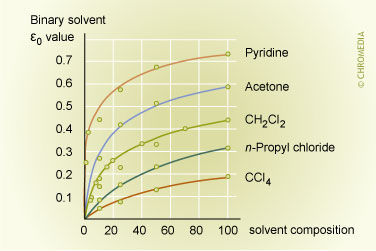 Caude and Jardy ...
Retention in NPLC can be described quantitatively by the following general formula:
log (k) = log (β) = S0 - ε0 AA + Δeas
k =retention factor
β = phase ration
S0 = dimensionless energy of interaction between the analyte and the stationary phase surface
ε0 = elution strength of the eluent
AA = dimensionless area of the adsorbed analyte (= solvent strength)
Δeassecond order correction term for alinear retention effects.
This formula shows that, under otherwise constant experimental conditions, the retention depends linearly on the solvent strength of the eluent. In the illustration below, the influence of the nature and concentration of the polar solvents THF, t-MBE and dichloromethane in binary mixture with hexane can be seen. For example changing from 1 % THF in hexane to the same concentration of t-MBE drastically changes the selectivity pattern exhibited in the chromatogram.
Selectivity NP mobile phase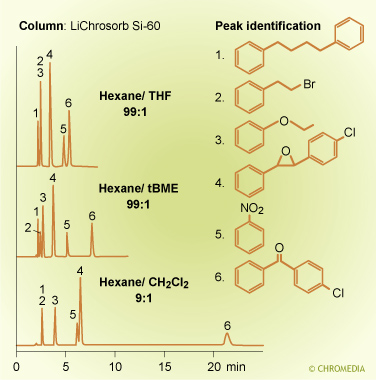
The use of modulators, also known as moderators, provides an additional tool for adjusting retention and selectivity in NPLC. This is particularly true for bare inorganic phases.
Since inorganic oxides are very polar, they can adsorb polar constituents from the eluent. These phases can act as a drying agent, adsorbing any traces of water or other polar compounds from the organic mobile phases.
Thus, the active surface sites of these stationary phases are dynamically modified by the uncontrolled adsorption of these compounds, resulting in instability in the analytes’ retention factors. This can be a serious drawback in the application of NPLC methods on bare inorganic phases, particularly for routine analyses.
Low concentrations of modulators can be intentionally added to the eluent to titrate the surface sites and adjust retention and selectivity. Using moderators in NPLC may lead to:
- Improved retention stability,
- better peak shapes,
- higher column sample loadability
- higher efficiency
A variety of compounds, including water, alcohols, and amines are commonly employed as moderators. The use of modulators can dramatically influence retention and selectivity, to obtain reproducible NPLC separation methods on bare (unmodulated) inorganic phases is not always an easy task:
- Gradient elution on these phases is difficult
- Column equilibration can become a time consuming process.
This is in contrast to RPLC, where column equilibrium times are short and gradient elution is straightforward. As a consequence, RPLC is frequently the technique of choice when gradient elution is necessary.
The retention and selectivity processes in RPLC and NPLC are very different and are generally spoken of in terms of partition and adsorption processes, respectively. This implies that many classes of sample analytes are best separated by one technique or the other. Such differences in the retention and selectivity potential of RPLC and NPLC on bare and bonded phases are summarized in the next table.
| Compounds | RPLC | NPLC inorganic phases | NPLC polar bonded phases |
| Homologue series of organic analytes | +++ | + | ++ |
| Analytes carrying functional groups | + | +++ | ++ |
| Isomers, diastereomers | + | +++ | ++ |
The following table gives a more detailed summary of the advantages and drawbacks of bare inorganic and modified NPLC phases:
| Feature | Comment |
| Convenience and reproducability | PBP (cyano, diol, amino) columns preferred. Silica columns require control of mobile-phase water content |
| Column equilibration after change of mobile phase | Silica columns may require longer equilibration |
| Column stability | Both silica and PBP columns are stable, but silica columns live longer |
| Isomer selectivity | Silica columns preferred |
| Use with gradient elution | Not recommended with silica columns |
| Preparative separation | Silica is usually favoured because of lower cost, greater stability, hihger loadability, less danger of contaminating collected sample fractions. |
The advantages and drawbacks of NPLC can be summarized as follows:
Advantages of NPLC:
- Large range in separation selectivity with many solvents and modulators available to tune retention and selectivity
- Suitable for the separation of chemically closely related analytes, including isomers and diasteromers
- Can separate analytes that are soluble in apolar organic solvents
- Suitable for the separation of chemical subclasses in sample pre-treatment techniques
- Reduced column backpressure due to use of low viscosity eluents
- More facile removal of volatile eluents in preparative HPLC
Drawbacks of NPLC:
- Predicting and maintaining eluent solvent strength more difficult compared to RPLC
- Longer column equilibrium times compared to RPLC if inorganic phases are used.
- Gradient elution not always straightforward, especially for bare inorganic phases
- Inorganic phases are sensitive to adsorption of contaminants (e.g. water) from the eluent
- Increased risk of evaporation and bubble formation due to low boiling points of solvents
- Financial consequences of purchase and disposal of organic eluents.
The separation potential of NPLC can be highlighted with the separation of two different vitamin samples.
In the first chromatogram, the separation of a sample containing vitamins A, D and E on a bare silica phase is shown. Because of the different chemical structures of these vitamins, their separation is relatively straightforward.
Normal phase separation of fat-soluble vitamins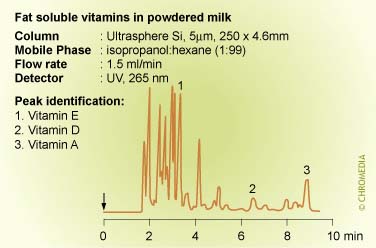
Example: Tocopherols
In the second chromatogram, below, four tocopherol vitamins are also adequately separated via NPLC on a bare silica stationary phase. These four tocopherols, however, are chemically closely related, which makes their separation less obvious than the first vitamin sample.
The separation of these tocopherols by RPLC is less likely because:
- the chemical structures, more particularly the hydrophobic parts of these four tocopherols (vitamins), are closely related.
- These tocopherols are also poorly soluble in the commonly used aqueous RPLC eluents, but dissolve well in apolar solvents.
Tocopherols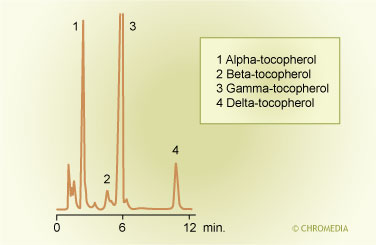
1 = Alfa - tocopherol
2 = Beta - tocopherol
3 = Gamma - tocopherol
4 = Delta - tocopherol
The separation of these tocopherols on the inorganic silica phase can be explained as follows:
The phenol group in the tocopherols strives to hydrogen bond with the silanol groups on the silica surface. However, the positions of the methyl groups in the analytes sterically hinder the bond formation to differing degrees. This results in different net interactions of the tocopherols with the silica stationary phase.