Abstract HPLC/MS interface development has always made use of existing ionization techniques. The early mass spectrometers employed electron ionization and chemical ionization. The advent of modern atmospheric pressure ionization (API) mass spectrometry revolutionized HPLC/MS interfacing.
LevelAdvanced
How ionization for LC/MS started
- In 1974 the Horning group published a series of articles on the use of atmospheric pressure
 chemical ionization (APCI) for HPLC/MS. Later the initial APCI source underwent several improvements.
 - The Sciex TAGA (Trace Atmospheric Gas Analyzer) made use of a corona discharge and a curtain gas, resulting in a more robust ion source.
- The heated nebulizer interface was a reliable introduction system for sample solutions and eluents from the liquid chromatograph.
- Then, in 1984 Fenn and coworkers (USA) and Alexandrov et. al. (former USSR) demonstrated the feasibility of electrospray ionization. This ionization technique was made more rugged by employing pneumatic assistance in the nebulization step (IonSpray). The eventual application of ESI to the molecular weight determination of biopolymers made the technique a superstar, eventually becoming the first choice for most HPLC/MS analyses.
The range of compounds that can be ionized in HPLC/MS is presented in Figure 1. At present it is possible to handle the following compounds:
- Ionic,
- High molecular weight
- Very polar samples.
Figure 1. Samples and interfaces in LC/MS
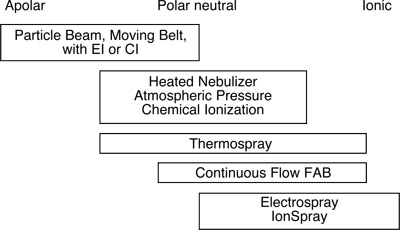
Ionization is caused by:
- Protonation or deprotonation. Electrospray is the method of choice for preformed ions (e.g. quaternary ammonium ions, phosphonium ions), and can even ionize many polar neutral compounds.
- Attachment of ammonium, lithium, sodium, acetate, formate, etc. ions is suitable for medium polarity samples.
- Attachment of transition metal ions (Ag+, Cu+) can be used for the ionization of fairly apolar compounds.
APCI.
A similar situation is found in APCI (Atmospheric Pressure Chemical Ionization): Protonation, deprotonation or ion attachment (NH4+, Cl–, acetate–, etc.) can be used for sample ionization. The reactant ions available for HPLC/MS are dictated by the composition of the HPLC eluent.
Unfortunately, it is not possible to use CH5+ and OH– in LC/MS as in GC/MS. Such strong proton donors and proton acceptors are immediately consumed by reaction with eluent vapors: water, methanol or acetonitrile. As a result, it is not possible to ionize samples with a low gas phase basicity or acidity. Charge exchange (CE) can solve this problem to some extent:
R+• + M -> R + M+• (1)
A sample can be ionized by such a reaction if its ionization energy is lower than the ionization energy of the reactant, R. Charge exchange generates molecular ions (radical cations), as is the case in EI. However, it is not as widely applicable as EI, due to the ionization energy constraint.
Atmospheric pressure PI (APPI) has been used in gas chromatography for many years. Sample components are ionized by means of the 10 eV and 10.6 eV photons emitted by a krypton discharge lamp, while carrier gases (helium, hydrogen, nitrogen) remain unionized because their ionization energies are higher than 10.6 eV. The same type of lamp can be used for HPLC/MS with atmospheric pressure PI.
The removal of an electron from a sample molecule can also be induced by photoionization (PI):
M + hν -> M+• + e (2)
if the photon energy is higher than the ionization energy (IE) of M. The question for HPLC/MS is: can we use PI at atmospheric pressure, when solvents are present in the ion source? The IE of most HPLC solvents is above 10 eV, while the IE of most samples is below 10 eV:
Figure 2. Fotoionization lamps and ionization energies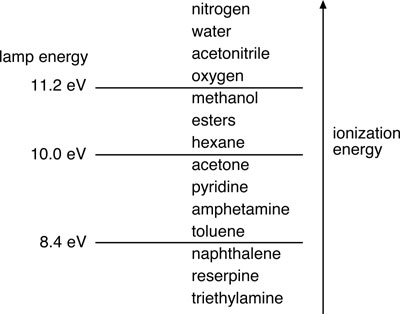
Thus, 10 eV photons can allow selective ionization of many samples.
Because the lamp window is located several millimeters away from the actual ionization region and high-energy photons are absorbed by many species, direct photoionization requires an adequate lamp radiance in order to penetrate into the ionization region.
Because photon absorption by solvent vapor and gases cannot be neglected in the 10 eV (120 nm wavelength) region, a dopant is introduced into the source at a concentration far higher than the sample. The operation of dopant-mediated APPI is as follows:
- D + hν -> D+• + e (3)
- D+• + M -> D + M+• (4)
Dopant molecules circulate throughout the source, including the surface of the lamp window. In this way, nearly all photons are consumed in ionization of the dopant, which subsequently ionize sample molecules by charge exchange.
Obviously, for a 10 eV light source, the dopant should have an ionization energy of less than 10 eV. Table 1 gives ionization energies for some common and less common dopants.
| Dopant | IE (eV) |
| Acetone | 9.7 |
| Toluene | 8.8 |
| Anisole | 8.2 |
| Chlorobenzene | 9.1 |
Additionally, for charge exchange to occur, the ionization energy of the sample should be less than that of the dopant. In principle, one can obtain somewhat selective ionization by the judicious choice of dopant since the IE of the dopant sets an upper limit to the IE of samples. For example:
- Halobenzene dopants (IE approx. 9.1 eV) can ionize a wider range of samples than anisole (IE 8.2 eV).
- Benzene has been used as a charge exchange reagent in CI and APCI, though its use is limited by the health hazards associated with this carcinogenic compound.
- Toluene is much less toxic than benzene.
- Anisole is a suitable dopant for the ionization of low IE, low proton affinity samples.
Dopants can be introduced into the ion source in three ways:
- As part of the eluent, either intentionally or simply because an eluent component happens to have a low enough IE; This option is suitable for normal-phase eluent components such as toluene, iso-octane and acetone.
- By post-column mixing with the eluent; This option requires that the dopant be miscible with the eluent. As such, acetone is commonly used in combination with reversed-phase eluents.
- As a vapor introduced via a gas line in the heated nebulizer. This option 3 allows relatively unrestricted choice of dopant, as long as the dopant is volatile enough for evaporation at the temperature of the heated nebulizer probe.
Theoretically, APPI has the advantage of generating molecular ions (M+• ), rather than the molecular adducts ([M+H]+, [M+NH4]+, etc.) observed with other ionization techniques. In practice, however, the formation of [M+H]+ ions is observed in the majority of cases.
Radical cations, M+•, are formed by direct PI or by charge exchange via an intermediate dopant ion, D+•. The latter requires that a high abundance of dopant ions, D+•, be observed in the low m/z range of a blank measurement. In the case of toluene and reversed-phase eluents (abbreviated as S in the equations below), the following ion-molecule reactions can take place
- C7H8+• + S -> C7H7• + SH+ (5)
- C7H8+• + nS -> C7H7• + SnH+ (6)
where n=2 for acetonitrile and n=3 for methanol.
| Neutral | PA (kJ/Mole) |
| Benzyl radical | 831 |
| Acetonitrile | 779 |
| Methanol | 754 |
| Water | 691 |
| Samples containing nitrogen | >900 |
From the proton affinities (PA) listed in this table we can conclude:
- Reaction (5) cannot occur for water, methanol, and acetonitrile, because the PA of each of these solvent is lower than the PA of the benzyl radical.
- The formation of cluster ions affords additional stability to protonated solvents in reaction (6).
Loss of dopant ions via reactions (5) and (6) can be eliminated by:
- The selection of solvents
 having high ionization energies and low proton affinities.
 - Selection of a different dopant is the other option. Anisole and
 monohalobenzenes do not transfer a proton to methanol or acetonitrile.
At the outset of the development of APPI, the aim was the generation of positive ions, either by direct PI of a sample, or by indirect, dopant-mediated PI:
- M + hν -> M+• + e– (2)
- D + hν -> D+• + e– (3)
- D+• + M -> D + M+• (4)
However, free electrons generated in reactions 2 and 3 are quickly thermalized and can be captured by neutrals with formation of negative ions. This process is most efficient if a dopant is introduced into the APPI source since the number density of dopant molecules far exceeds the number density of analyte molecules.
Additionally, photoemission from metal parts of the ion source should not be overlooked as a source of free electrons.
In the end, the yield of negative analyte ions depends on the nature of the solvents, additives, and contaminants, as well as the nature of the analytes. A number of reactions may play a role in negative ion APPI:
| Reaction | Type | nr |
| S + e– -> S–• | (resonance electron capture) | (7) |
| S + e– -> [S – F]• + F– | (dissociative electron capture) | (8) |
| O2 + e– -> O2–• | (resonance electron capture) | (9) |
| S + O2–• -> [S – H]– + HO2• | (proton abstraction) | (10) |
| M + e– -> M–• | (resonance electron capture) | (11) |
| M + O2–• -> M–• + O2 | (charge transfer) | (12) |
| M + O2–• -> [M – H]– + HO2• | (proton abstraction) | (13) |
| M + [S – H]– -> [M – H]– + S | (proton abstraction) | (14) |
| M + O2–• -> [M – X + O]– + OX• | (substitution) | (15) |
| M–• + O2 -> [M – X + O]– + OX• | (substitution) | (16) |
| (S denotes solvent or additive; F denotes fragment) |
Most of the reactions tabulated above are quite common in low-pressure chemical ionization mass spectrometry. Reaction (8) is responsible for the formation of Cl– ions from chloroform and other chlorinated solvents, additives and contaminants. Reactions with oxygen cannot be avoided because atmospheric pressure ion sources are never completely gas-tight, so oxygen is always present in small amounts. In the majority of cases, the formation of [M–H]– ions is more important than electron capture, but a good number of sample molecules (or derivatized samples) can form radical anions M–• (via resonance capture) or other negative fragment ions (dissociative electron capture).
In light of the present-day availability of HPLC/MS instrumentation, a few updates to Figure 1 are necessary. As shown in Figure 3, EI and low-pressure CI are no longer feasible with off-the-shelf HPLC/MS instruments.
Figure 3. Samples and interfaces in LC/MS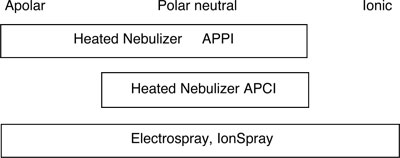
Additionally, thermospray and continuous flow FAB have become obsolete. Modern electrospray can be extended to apolar compounds when special techniques such as electrochemical ionization and attachment of coordination metal ions (Ag+) are used. APPI can be applied to polar and apolar compounds, but ionization of apolar samples by charge transfer requires careful selection of the combination of dopant and eluent:
| Dopant and eluent | Ionization | |
| Toluene, acetone | Reversed Phase | Proton transfer, MH+ |
| Toluene | Straight phase | Charge transfer, M+• |
| Anisole | Reversed phase | IP 8.2 eV Charge transfer, M+• |
| Chlorobenzene | Reversed phase | IP 9.1 eV Charge transfer, M+• |
Of course, the compatability of the ionization source with eluent flow rate is always important in HPLC/MS. It has been found that the efficiency of APPI decreases with increasing liquid flow rate in HPLC. A good compromise is 200 µL/min from a 2 mm i.d. column.
The APPI source has found utility in many applications where corona discharge APCI is employed.
Many pharmaceuticals, components in food, vitamins, and environmental contaminants can be volatilized and subsequently ionized by APPI. Compilations of APPI applications can be found:
- In the web site www.syagen.com (Bibliography of APPI publications and presentations)
- In the review paper by the group of Karst ( Bos, S.J., van Leeuwen, S.M., Karst, U.; From fundamentals to applications: recent developments in atmospheric pressure photoionization mass spectrometry, Analytical and Bioanalytical Chemistry 384 (2006) 85-99)