Abstract The mass analyzer is the heart of the mass spectrometer. It separates (in vacuum) ions according to their mass-to-charge (m/z) ratios and subsequently records their intensities. Different physical principals can be used for the separation of ions. Basic types of mass analyzers are listed in this section in order of increasing performance and price with the emphasis on analyzers typical in HPLC/MS and GC/MS coupling. The performance of mass analyzers is characterized by several parameters, such as the resolution (i.e. the ability to separate ions with very small differences in their m/z values), mass accuracy (i.e. the uncertainty in the determined m/z values), mass range, possibility of MS/MS measurement, precision of isotopic pattern.
KeywordsMass-to-charge (m/z), Analyzer, Resolution, Mass accuracy, Elemental composition, Exact mass, Quadrupole, Ion trap, Time-of-flight
LevelBasic
The performance of mass analyzers is typically quantitated in terms of resolution and mass accuracy. At a minimum, the resolution of the mass analyzer should be sufficient to separate two ions differing by one mass unit anywhere in the mass range scanned. Such resolution or a little bit higher is provided by quadrupole and ion trap analyzers and it is sometimes referred as unit mass resolution.
The following definition is typically used to calculate resolution in Mass Spectrometry:
R = m/z / Δm /z
- Usually, the peak width is measured as the full width at half maximum (FWHM) of the peak, which is nowadays accepted as a general definition of mass spectrometric resolution.
- Different definition is used for magnetic sector analyzers: R = ( (m/z)2 - (m/z)1 ) / (m/z)1, where (m/z)1 and (m/z)2 are mass-to-charge ratios of two very close peaks with the same height and peak valley overlap corresponding to 10%.
The typical values of resolution for low resolution mass analyzers (e.g. quadrupoles and ion traps) are below 5000. High resolution instruments have a resolution 15000.
The second parameter important to mass spectrometry, mass accuracy, is defined as:
mass accuracy = (m/z(exp) - m/z(theor)) / m/z(theor) *106
We can calculate mass accuracy on line with the help of .
Notice that the values are expressed in ppm units.
The principal advantage of high mass accuracy is the possibility to determine the elemental composition of individual molecular or fragment ions, which is a powerful tool for the structural elucidation or confirmation.
- For exact mass measurements, the minimum acceptable mass accuracy is 5 ppm.
- For higher m/z values or when the presence of many different elements in a given ion is suspected, the mass accuracy <5 ppm is not sufficient for a clear indication of the elemental composition.
There are several ways to help select the correct elemental composition:
- Increasing resolution,
- Consideration of fragment ions,
- Consideration of the sample history.
Obviously, correct m/z scale calibration is essential to exact mass determinations. Mass spectrometers can be either internally or externally calibrated.
- Internal calibration means that the calibration mixture is present in the ion source as the same time as the sample. Hence, conditions for the mass analyses of the sample and calibrant are absolutely identical. Internal calibration provides the highest precision, but the introduction of calibrant together with the sample may cause ion suppression effects or may introduce interfering peaks into the spectrum.
- External calibration, on the other hand, measures the calibrant before or after the analyte, mimicking the unknown’s analysis conditions as closely as possible. External calibration may provide results almost identical to internal calibration if the instrument is very stable and the calibration is performed immediately before or after the analyte analysis.
HPLC/MS coupling allows several different approaches to mass calibration:
- Internal calibration solutions can be added to the mobile phase via a T-piece after the chromatographic column (dead volumes must be reduced to avoid peak broadening), before the column (the calibrant may destroy the separation), or via a second sprayer in the ion source.
- The dual spray solution is used with electrospray but not for other API techniques.
In my opinion, the best solution is external calibration with calibrant introduction during the system dead volume (then there is no interference with chromatographic peaks) and again immediately after the analysis. For long analysis, the calibrant may be sampled periodically during the middle part of chromatogram in regions without important peaks. Such an approach eliminates ion suppression effects and mass interferences caused by the calibrant, while maintaining mass accuracy.
Single quadrupole
The quadrupole mass analyzer is the simplest type of mass spectrometer, is easily coupled to gas-phase or liquid-phase separation techniques, and is relatively low cost in comparison to other mass analyzers. Its rather low vacuum requirements (about 10-3 Pa) and high scanning speeds are ideally suited for GC/MS or HPLC/MS coupling.
The limitations of quadrupole analyzers are:
- low resolution (<5000)
- poor mass accuracy (> 100 ppm)
- limited mass range (typically up to 3000).
The principle of the quadrupole is visualised in the drawings and in the animation.
Four rods with precisely defined dimensions of about 30 cm in length are aligned parallel to each other at the corners of a square. Two opposite rods carry a positive charge, while remaining two rods carry a negative charge. A radio-frequency high voltage is applied to all rods in addition to the direct voltage. Therefore, the "positive rods" have the positive charge for the most time of scanning cycle, while the negative charge is prevailing only for very short part of the cycle due to the presence of alternating voltage. A similar explanation is valid for "negative rods" but the polarities are reversed.
Only narrow specific m/z values can successfully pass the rods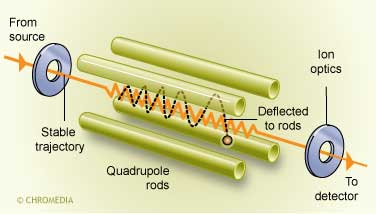
The ions enter through a small orifice in at the center of the square defined by the rods and then they follow certain trajectories based on m/z values. At a given time, only ions with very narrow interval of m/z values (e.g. half of mass unit) have stable trajectories and successfully pass through the quadrupole rods to the detector. All other ions with lower or higher m/z values have unstable trajectories and they are filtered out.
Ions 2 en 3 have unstable trajectories and are filtered out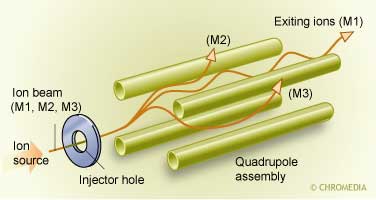 Based on this principle, the quadrupole analyzer is sometimes referred as a quadrupole mass filter. One millisecond later, A/C voltages are changed such that ions with slightly higher m/z can pass through the
  quadrupole analyzer.
Selected Ion Monitoring (SIM)
In some cases, HPLC/MS or GC/MS does not require full scan mass spectra because the structure of the analyte of interest is well known. Instead, the chromatographer is interested in maximizing detection sensitivity. In this case, selected ion monitoring (SIM) is used rather than full scans. In SIM, the A/C voltage ratio is set at a fixed value (i.e. the analyzer is not scanning), so that only the ion with the selected m/z value may pass the filter, all other ions are filtered out during the whole scanning cycle. The ion current at the detector is not a mass spectrum, but rather the dependence of the intensity of the selected m/z value with time. For multiple analyte  detection, we may record more ions using so called multiple ion monitoring in parallel or in subsequent time segments.
Triple quadrupole
If tandem mass spectrometric experiments are needed, then we must couple three quadrupoles (QqQ): Q1 is used for precursor ion isolation, q2 works as a collision cell containing a collision gas (usually argon), and Q3 analyzes product ions produced from the precursor ion isolated in Q1. In QqQ mass analyzers and other tandem mass spectrometric analyzers, additional scan types are available, including product ion scans, precursor ion scans, neutral loss scans and selected reaction monitoring.
Tandem mass spectrometry principle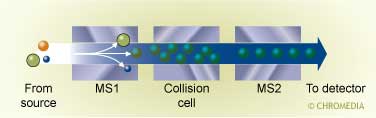 Triple quadrupole (QqQ)]
The  product ion scan means that we select a single precursor in Q1 and scan Q3 to measure the product ions arising from this single precursor ion
The precursor ion scan fixes the product ion passed by Q3, then scans Q1 to find all of the precursor ions that produce the desired product ion.
The neutral loss scan is used for the identification of ions that can lose a particular functionality in collisional fragmentation. Q1 and Q3 are scanned simultaneously such that at any given time, Q3 is passing product ions of a fixed m/z less than the precursor ion being passed by Q1.
The single ion monitoring (SIM), or multiple ion monitoring (MIM) in the case of multiple ions of interest, is used for the quantitation of known compound with fragmentation behavior known from previous measurements. We select a suitable precursor ion (e.g. [M+H]+ or [M-H]-) its most abundant product ion, which provides the highest sensitivity, with the high selectivity inherent to MS/MS. The interference of a compound generating the same precursor ion and the same product ion, all at the same time that the compound of interest elutes from the column is unlikely. Of course, isomers could produce similar MS/MS ions, but such an isomer should elute at slightly shifted retention time in a well optimized chromatographic system.
Spherical ion trap
An ion trap is often referred to as a 3D quadrupole, because the rotation of quadrupole along the z axis produces the ion trap shape.
The ion trap has a distinct advantage over the quadrupole, in that it is capable of tandem mass spectrometric experiments to the n-th power (MSn) in one  small device.
The scanning cycle in the trap is as follows:
- First, the ions formed by ESI or other ionization technique outside the trap are injected into the ion trap analyzer,
- Then the ion gate is closed by applying a voltage on the skimmer.
- Ions are trapped by the AC voltage applied to the ring electrode and then cooled to the middle of the trap due to the presence of helium as dampening gas.
- Then, the selective instability scanning is performed, manipulating the voltages such that ions ions are ejected towards the detector in order of increasing m/z.
- Ejected ions are detected and the process is repeated
- The signal averaged to provide a full scan mass spectrum in less than one second.
For tandem mass spectrometric experiments, the selected precursor ion is isolated in the trap, while all other ions are expelled. Then collisions between the analyte ions and the helium present in the trap (now working as collision gas) are promoted, resulting in the dissociation of precursor ion. Product ions then scanned out sequentially to produce the MS/MS spectrum of that particular precursor ion. Structure elucidation and studying fragmentation pathways may require the investigation of additional fragmentation events, so one of the product ions can be isolated and fragmented. This next generation of product ions is then scanned out sequentially to generate an MS/MS/MS (or MS3) spectrum. Theoretically, we can continue up to MSn. In practice, the lifetime of the ions and the sensitivity limit the procedure somewhere between MS3 and MS5, which is normally sufficient for detailed studies of fragmentation patterns.
Linear ion trap
The main difference between spherical and linear ion trap is that the latter has a higher ion capacity. Linear ion traps resemble normal quadrupoles, but with a few modifications. When ions enter the region inside rods, then voltages are applied to the caps at both ends of the rods to trap the ions inside. The trapping mechanism and available scan types are similar as for conventional ion traps, but the device volume is higher resulting in higher storage capacity and an increased linear dynamic range without the danger of the space charge distortions of the trapping characteristics of the ion trap.
Orbitrap
The orbitrap is the newest type of mass analyzer and was introduced commercially in the past three years. It is basically a trap-type device, because ions are trapped in the orbitrap, then they travel in a circular motion before being selectively ejected according to their m/z values. Similar scan types as for ion traps can be performed, but the orbitrap provides very high resolution and a high mass accuracy comparable with QqTOF instruments. The instrument is still in the development and other improvements in its performance can be expected.
The physical principle of this analyzer is very simple. When ions of different m/z are all given identical kinetic energies, the lighter ions will move faster, and thus, will have shorter flight times between the repeller and the detector. Simply speaking, "smaller ions fly faster than larger ions".
The derivation of the basic equation describing this phenomenon is also straightforward. The flight time is defined as the distance (l) divided by the velocity:
t = l / v
The kinetic energy of ions accelerated by a given electric potential V is given by:
Ek = ½ m.v2 = z.V
The combination of these equations will lead to:
m/z = 2.V.t2/l2
Unfortunately, we must assume that the ions are all accelerated from initial velocities of 0 to the same final kinetic energy. In practice, none of these is true, diminishing the practical resolution of TOF analyzers.
There are two basic ways to improve the resolution:
- The first one is called delayed ion extraction. The ions are extracted from the ion source after a very short delay, which helps the decrease the initial distribution of kinetic energies since ion motion is dampened by collisions prior to extraction. This approach is used mainly with MALDI ionization.
- The reflectron. The second approach is the use of the reflectron described in the following paragraph.
The main advantage of TOF analyzers is their theoretically unlimited mass range. Here, the high mass cutoff depends only on how long we wait until ions reach the detector. In practice, however, the diminished response of the detectors at high mass effectively limits the TOF to m/z less than 106. Reflectron TOF (rTOF) analyzers provide a significant increase of mass resolution up to 25000.
The second advantage is the highest scanning speed among MS analyzers, which makes TOF well suited for coupling to ultrafast chromatography where chromatographic peaks are extremely narrow.
The reflectron (often called an ion mirror) is a system of concentric ring electrodes whose voltages increase stepwise as ions penetrate deeper into the device. Ions arriving at the reflectron penetrate to a depth related to their kinetic energies, but independent of their m/z values.
In other words, if we have two ions with identical m/z values but with different kinetic energies due to the initial energetic distribution, the reflectron causes the slightly higher energy ion to have to travel farther than a slightly slower ion of the same m/z. As a result, both ions of that m/z arrive at the detector at the same time.
The reflectron brings the slow and fast ions together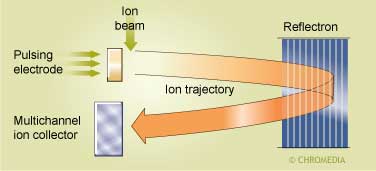
TOF reflectron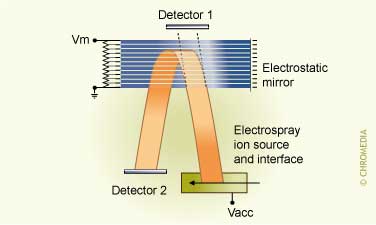
Continuous and delayed extraction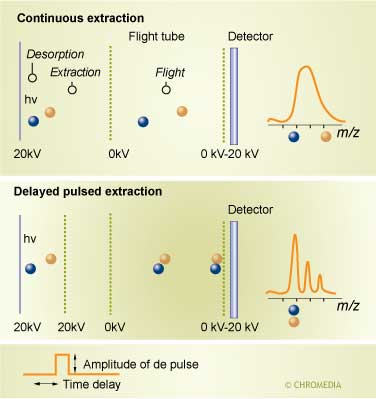
Hybrid QqTOF analyzer
The QqTOF mass spectrometer is a hybrid mass analyzer:
- A first quadrupole is used for the isolation of precursor ions
- the second quadrupole is used for subsequent CID in (hexapole or octapole configurations maybe used for the collision cell as well).
- Finally, product ions are analyzed in an rTOF analyzer with the orthogonal acceleration.
Among modern analyzers, the QqTOF has great potential for the structural elucidation of complex biological and natural mixtures, and is frequently used in proteomics, metabolomics, lipidomics, natural compounds identification, etc. The coupling to separation techniques is easy and routinely provides mass accuracies better than 5 ppm with both external and internal calibration, in addition to a resolution above 20000.
TOF coupled to Quadrupole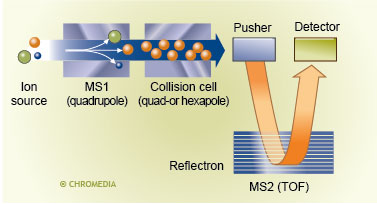
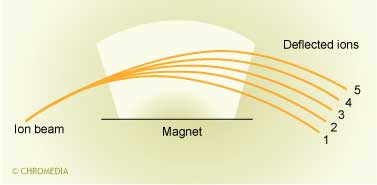 Magnetic sectors rely on the curved path taken by ions moving in a magnetic field, and the dependence of that path on m/z. The relation between m/z and the curvature of the ion’s path can be derived from basic physics. First, consider that the equilibrium of centripetal and centrifugal forces must be fulfilled:
 B.z.v = m.v2/r
Remember that the kinetic energy of ions accelerated by an electric potential V is:
Ek = ½ m.v2 = z.V
and combining both equations:
m/z = B2. r2/ 2.V
Principle of the magnet analyzer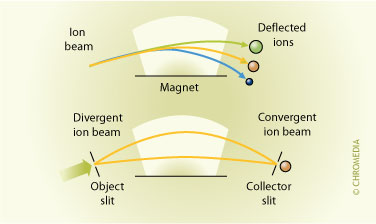 A magnetic analyzer alone does not provide impressive resolution because of the distribution of initial kinetic energies of ions. Kinetic energies can be unified (similarly to rTOF mass analyzers) by the use of the second sector with electrostatic focusing. The result is referred to as a double focusing magnetic sector mass spectrometer.
The coupling of magnetic analyzer with HPLC or GC is possible, but not so common because this analyzer has higher vacuum requirements and a slower scanning speed. Other types of mass analyzers with comparable performance do not suffer from such technical difficulties, so they are usually preferred for chromatographic coupling.
Double focussing uses two magnets to improve resolution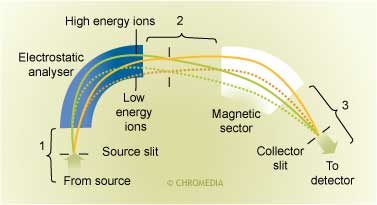
ω = B.z / m
Scheme of ICR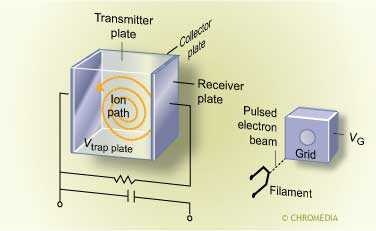 After the ions have been trapped by the magnetic field, the wide-band frequency excitation is performed. The excited ions pass a set of metal detector plates with each orbit. The ions’ motion induces an A/C image current between the two plates. The image current is recorded and Fourier transformed to produce the mass spectrum. There are several complicated methods for producing tandem MS in an ICR analyzer, including infrared excitation and electron capture dissociation.
Ion cyclotron resonance (ICR)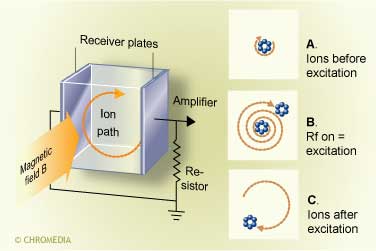
- The least expensive quadrupole analyzer is suitable only for basic experiments, e.g. determination of molecular weights of individual chromatographic peaks, but without MS/MS feasibility.
- Ion trap exhibits relatively good price-to-performance ratio among low resolution analyzers providing MSn possibility very useful for studying the fragmentation paths and the structure confirmation.
- Triple quadrupole analyzer is typically used for quantitative purposes due to the appropriate scan functions, e.g. single and multiple reaction monitoring.
- Hybrid QqTOF analyzer is the cheapest high resolution tandem mass analyzer, which has an increasing popularity nowadays due to favorable price, good performance and easy-to-use operation in comparison to more sophisticated Fourier transform analyzers giving the highest performance, but at ultimately high price level.
Depending on the prevailing application field, the most suitable analyzer should be selected, of course considering funding possibilities as well. Complex omics techniques can be hardly done on the simple quadrupole analyzer, while the selection of FTICR mass spectrometer for the verification of molecular weights of synthetic products is a wasted investment.
The following table summarizes typical values of operating parameters and prices as of 2006. Reported values may change quite quickly due to the extremely fast development of mass spectrometric instrumentation. Keep in mind that the "typical values" used for inter-instrument comparison may not cover all instruments variants from all manufactures. In spite of these limitations, the tables should serve as a rough guide for newcomers in the field.
This table compares the basic types of mass spectrometers on the market used in HPLC/MS. It helps to choose the most suitable analyzer for particular purposes considering the instrument price as well. The comparison of mass analyzers has been prepared in February 2007 for HPLC/MS, in some extent it is also valid for GC/MS, but the most expensive analyzer types (ICR, Orbitrap and QqTOF) are not frequently used in GC/MS.
Table 3.1 Comparison of instrument parameters.
| Analyzer | Mass range | Resolution [Δm/z] | Resolving power, FWHM [*10-3] | Mass accuracy | MS/MS | Scan rate | Vacuum | Price |
| Q | 3 | 0.1 - 0.7 | - | low | - | 0.5 - 4 | 10-3-10-4 | 70 - 100 |
| QqQ | 3 | 0.1 - 0.7 | - | low | MS/MS | 0.5 - 4 | 10-3-10-4 | 130 - 200 |
| IT | 4 - 20 | 0.1 - 0.7 | - | low | MSn | 5 - 10 | 10-3-10-4 | 100 - 150 |
| LIT | 4 - 20 | 0.1 - 0.7 | - | low | MSn | 1 - 4 | 10-3-10-4 | 200 - 250 |
| Orbitrap | 6 | - | 50 - 100 | <5 | MSn | 0.5 - 2 | 10-7 - 10-8 | 450 - 500 |
| oa-TOF | 20 - 40 | - | 15 - 20 | <5 | - | 20 | 10-5 | 200 - 250 |
| QqTOF | 10 - 40 | - | 15 - 25 | <5 | MS/MS | 20 | 10-5 | 300 - 400 |
| Double focusing magnetic sector | 5 - 15 | - | 30 - 80 | <5 | MS/MS | 0.1 - 0.5 | 10-5-10-6 | 400 - 600 |
| FTICR | 5 - 15 | - | 100 - 1500 | <2 | MSn | 0.3 - 1 | 10-9-10-10 | 700 - 1500 |
This table summarizes typical values of operating parameters valid in February 2007. Reported values may not cover all instrument variants on the market, especially prices are subject to changes, but other parameters may change quickly as well due to the fast development in MS instrumentation.
The comparison should serve as a first rough guide for newcomers in the field.
Click here for an enlarged printable version.
Some comments:
- Specially designed mass spectrometers may have parameters outside the listed ranges, for example TOF analyzers may have significantly higher mass ranges for off-line HPLC/MALDI-TOF coupling (not included here) or for special QqTOFs for studying non-covalent interactions.
- Higher scanning speeds can be achieved with TOF instruments used for fast chromatography at the cost of reduced mass accuracy.
- The use of hyperbolic rods technology for quadrupoles may improve the parameters to the level close to TOF analyzers at the cost of reduced sensitivity, etc.
- The limitation of QqTOF configuration in the mass range is caused by the transmission of first quadrupole mass filter.
- Another questionable parameter is the mass accuracy, where the value "<5 ppm" is given for all TOF based analyzers, double focusing magnetic sector analyzers and orbitrap, but there are differences among individual manufacturers and instrument variants.
- The listed values of mass accuracies better than 5 ppm should be routinely achieved with the external calibration and typically 2-3 ppm and better with the internal calibration. Orbitrap analyzer and some QqTOFs have a potential to work routinely with mass accuracies below 3 ppm even with the external calibration and similarly FTICR mostly provides values bellow 1 ppm. The comparison of scan rates is difficult, because different analyzer types use different definitions.
- The scan rate is usually expressed as mass units per second for ion traps and quadrupoles, time per decade for magnetic sectors and the number of scans per second for TOF analyzers. The table shows recalculated typical values in the same units (scans/s) for all analyzers in the mass range of 50 - 2000 m/z. Slower scan rates may be required to obtain the top performance for some instruments.
- The basic types of mass analyzers are based on the quadrupole technology (Q, QqQ and QqTOF), trap based technology (ion traps, linear ion traps and orbitraps), TOF technology (TOF and QqTOF), the separation in magnetic field and FTICR as the top mass spectrometric device.
- In the group of hybrid analyzers combining two different principles of ion separation (for example QqTOF), several other hybrid combinations are available on the market, such as the combination of QqQ and QqLIT in one device, the combination of IT and TOF analyzers, the implementation of ion mobility separation together with the separation according to m/z, etc.
- To keep the reasonable simplicity of this table, not all variants of hybrid instruments have been listed here.