Abstract One of the most sophisticated forms of multidimensional GC is comprehensive two-dimensional GC (GC×GC). Separation and analysis in two dimensions is much more powerful than in one. A retention plane has much more peak capacity than a retention line and so can accommodate much more complex mixtures. Component identification is potentially more reliable because each substance has two identifying retention measures rather than one. Separations are likely to be more structured in two dimensions, leading to recognizable patterns characteristic to the mixture source.
LevelBasic
Separation and analysis in two dimensions is much more powerful than in one:
- A retention plane has much more peak capacity than a retention line and so can accommodate much more complex mixtures.
- Component identification is potentially more reliable because each substance has two identifying retention measures rather than one.
- Separations are likely to be more structured in two dimensions, leading to recognisable patterns characteristic to the mixture source.
One of the most sophisticated forms of multidimensional GC is  comprehensive two-dimensional GC (GC×GC). It provides a two-dimensional separation in which sample substances are distributed over a retention plane formed by the operation of two independent columns.
GCxGC scheme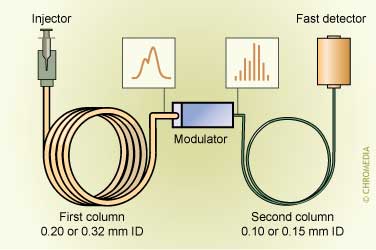
In GC×GC two independent GC separations are applied to an entire sample:
- The sample is first separated on a normal-bore high-resolution capillary GC column in the programmed temperature mode.
- All of the effluent of this first column is then focused in very many, very narrow fractions at regular, short intervals and subsequently injected onto a second capillary column, which is short and narrow to allow for very rapid separations.
The resulting chromatogram has two time axes (retention on each of the two columns) and a signal intensity corresponding to the peak height.
Retention in GC is basically governed by two factors:
- The volatility of the analyte (pure-component vapour pressure, pio)
- Interaction of the analyte with the stationary phase (activity coefficient at infinite dilution, γi∞ .
By selecting a non-polar column, the separation in the first dimension is mainly based on the volatility of the analytes (“boiling-point separation”). The analytes will be eluted from the first column at different temperatures, but with very similar volatilities at the time (temperature) of elution.
The second separation, which is so fast as to be essentially isothermal at the elution temperature from the first dimension, is completely determined by the activity  coefficients of the solutes. Both enthalpic (energy of interaction) and entropic factors contribute to γi∞ , so that the separation on the second column can be based on polarity, molecular geometry, size, etc.
Since every peak eluting from the first dimension column is cut into five or six fractions, the separation of each of these fractions on the second dimension column must be finished within a few seconds. This puts stringent requirements to the re- injection and the separation on the second column and on the detection device. This focusing and re-injection is performed with a modulation system.
Three types of modulators are in use at this moment:
- Using a thick-film modulation capillary for retaining the fraction, and a heating device for focusing and re-injection (Phillips et al., 1999).
- The second type applies cryogenics for retaining and focusing the fraction in the front end of the second column and the heat capacity of the oven air to re-inject the fraction (Kinghorn and Marriott, 1999).
- A recently introduced system (Beens et al., 2001) with no moving parts can be regarded to use the advantages of both the previous modulators. Small jets of CO2 cool very short sections of the secondary column and the oven air in turn heats it up, in order to focus and re-inject the fractions in narrow pulses.
Presently complete GC×GC systems can be purchased from different manufacturers (Zoex, Thermo Electron, Leco) and are provided including the necessary software for data processing.
The dimensions of the second column are chosen such (length of about one meter, ID of 100 or 150 µm and a thin film of stationary phase), that it provides the necessary speed:
- It finishes the separation of all the constituents of the fraction within a few seconds
- And Before the next fraction is re-injected
- The detector must have a small rise time and permit a high sampling rate (≥ 100 Hz).
Most modern FID detectors fulfil these requirements. When using a mass spectrometer, only the fast scanning Time-of-Flight (TOF) spectrometers with scanning frequencies of over 100 scans/s are suited.
Data treatment; Data generation and visualisation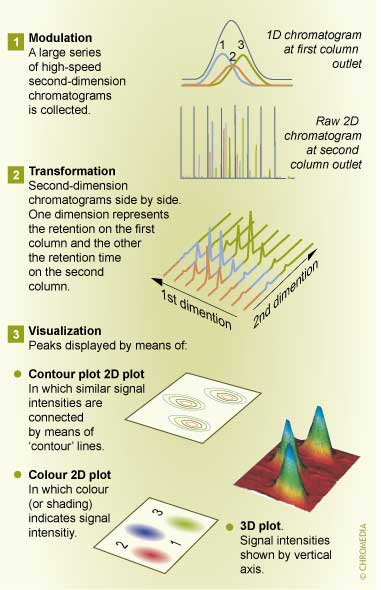
Analytes belonging to the same chemical group-type will have approximately the same activity coefficients and hence exhibit about the same second dimension retention times. This will result in ordering in the chromatogram, where compounds of the same group-type are arranged in bands along the 2D-plane (Blomberg et al., 1997). Identification is thus not only facilitated but is also very reliable. An example of such an ordered chromatogram is the GC×GC separation of a non-aromatic solvent, i.e. a fraction containing only saturated hydrocarbons.
GCxGC Structures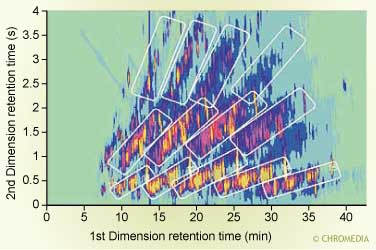 The abundant crowded band of spots at the lower end of the figure represents the alkanes, where each high intensity n-alkane (from n-C10 up to n-C16) can be seen as a white spot at the high end of the polygon enclosed spots. The white polygons enclose clusters of isomers of the compounds of the same formule. In between those n-alkanes are the branched alkanes situated, from alkanes with a low degree of branching just in front of the n-alkane, up to the highly branched ones with even lower retention times. Above the alkanes, “roof-tiles” of monocyclic alkanes are present, each tile representing different isomers with the same number of carbon atoms, again with the lowest branching on the right side of the tile (highest retention time) and the ever higher branched ones more to the left side of the tile. The top of the plot finally exhibits the dicyclic alkanes, again ordered from bottom to top by decrease of branching of the molecule.
From the underlying data file, the different group types can be extracted to a reconstructed one-dimensional chromatogram.
Tip. A low-high polarity arrangement for the chosen column set is most often employed in GCxGC. However, interesting ‘inverted’ arrangements of column sets for GCxGC analyses have been reported (high-low polarity column arrangements). These two arrangements lead to interesting inversions of peak positions in the 2D space. For instance, in the first case polar compounds elute with late 2D retention, but in the latter, polar compounds elute early in the 2D dimension. Clearly interesting retention trends and optimisations can be obtained!
GC×GC separations offer terrifically high peak capacities (approximately equal to the product of the peak capacity of the first and the second column). Because of the orthogonality of the two separation mechanisms, a very substantial fraction of this theoretical peak capacity may actually be used in practical separations.
Calibration and measurement of substance quantity in two dimensions is not fundamentally different than in one dimension. A given substance passes through the series of two chromatographic columns and eventually reaches the detector which produces a proportional signal. Either the peak signal or the integral over all the time the substance passes through the detector can be measured and related to substance quantity. A GC×GC peak exists on a data plane and its integral must be taken over both dimensions to give a peak volume, which is directly proportional to the quantity of substance forming the peak. The peak on the plane is composed of several second dimension peaks as the same substance reaches the detector in several sequential secondary chromatograms. The integral is the sum of the integrals of each of these individual peaks. Peak integration provides high quality quantification (Beens et al., 1998).
Separation of PCDFs/PCDDs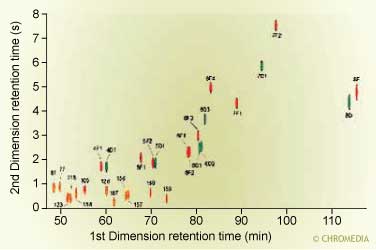
Quite a number of different GC×GC applications have been studied now and their practicality has been demonstrated, but the potential applications are far more wide spread. The number of components in a sample for which GC×GC becomes the method of choice depends on the specific nature of the sample and analytes, but in most cases it is probably substantially less than one hundred and may often be less than about thirty. An example is given in the previous figure, containing ten separated polychloro-dibenzofurans (red, from tetra 4F to octa 8F), seven dioxins (green, from tetra 4D to octa 8D) and 12 dioxin-like polychloro-bifenyls (orange, CB 81–189).
Environmental Chemistry
The environment, both natural and human impacted, contains exceedingly complex mixtures. Most environmental chemistry to date has focused on individual substances rather than the mixtures that contain the substances. A number of those complex environmental mixtures have been submitted to GC×GC with satisfactory results. Also in petrochemistry, farmaceutical, food and biological samples comprehensive two-dimensional gas chromatography has been applied successfully, like the next analysis of an extract of a river sediment. The large envelope of saturated hydrocarbons, that would coelute with all the (multiring) aromatics in 1D-GC, is now nicely separated. And so are the aromatics, that elute in clusters according to the number of aromatic rings.
GCxGC is now used in many different areas.
The environment, both natural and human impacted, contains exceedingly complex mixtures. Most environmental chemistry to date has focused on individual substances rather than the mixtures that contain the substances. A number of those complex environmental mixtures have been submitted to GC×GC with satisfactory results, as the example hereunder: Example of GCxGC: Analysis of a river sediment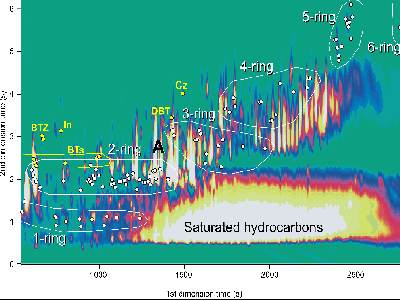
Also in petrochemistry, farmaceutical, food and biological samples comprehensive two-dimensional gas chromatography has been applied successfully, like the next analysis of an extract of a river sediment. The large envelope of saturated hydrocarbons, that would coelute with all the (multiring) aromatics in 1D-GC, is now nicely separated. And so are the aromatics, that elute in clusters according to the number of aromatic rings. A large compilation of applications has been published in Trends in Analytical Chemistry:
- M .Adahchour, J. Beens, R.J.J. Vreuls, U.A.Th. Brinkman, Recent developments in comprehensive two-dimensional gas chromatography (GC×GC), I. Principles and instrumentation, Trends in Analytical Chemistry 25 (2006) 438-454
- M. Adahchour, J. Beens, R.J.J. Vreuls, U.A.Th. Brinkman, Recent developments in comprehensive two-dimensional gas chromatography (GC×GC), II. Modulation and detection, Trends in Analytical Chemistry 25 (2006) 540-453
- M. Adahchour, J. Beens, R.J.J. Vreuls, U.A.Th. Brinkman, Recent developments in comprehensive two-dimensional gas chromatography (GC×GC), III. Applications in petrochemicals and organohalogens, Trends in Analytical Chemistry 25 (2006) 726-741
- M. Adahchour, J. Beens, R.J.J. Vreuls, U.A.Th. Brinkman, Recent developments in comprehensive two-dimensional gas chromatography (GC×GC), IV. Further applications, conclusions and perspectives, Trends in Analytical Chemistry 25 (2006) 821-840