Abstract The quality of a chromatographic separation is measured by the resolution, Rs of any two peaks. In a simulation you can see the effect of the resolution on the chromatogram.
KeywordsResolution, Resolution factor, Separation.
LevelBasic
Separation in modern chromatography is defined quantitatively in terms of the relative amount of peak area overlap.  Resolution is the degree of separation between two adjacent peaks and indicates to what extent they overlap.
Resolution is defined as the difference in retention times with the width of two adjacent Gaussian peaks as defined in the 'Resolution equation' in the simulation hereunder. The higher Rs, the better the separation.
Chromatographic peaks are ideally Gaussian in shape and the above equation is based on the number of standard deviations between the two peaks. Since most chromatographers, however, prefer to use more practically measurable chromatographic parameters, we define resolution as the average number of peak widths between the two peak maxima, keeping in mind that the peak width is equivalent to four standard deviations. This is the formula:
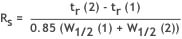
Three important parameters can be combined into the so-called resolution factor factor, Rs, which us a way to quantify separation quality. This formula is much more useful to understand the effect of parameters: