Abstract By Henk Claessens and Gerd Vanhoenacker.
Performing separations at elevated column temperatures can reduce analysis times, improve column efficiency (plate numbers), reduce peak asymmetry and help optimize retention and selectivity and finally may improve resolution and detectability.
LevelAdvanced
The temperature of the HPLC eluent and column has long been an underestimated parameter. Until recently, the best HPLC systems boasted an oven only to thermostat the column in order to improve analytical reproducibility by ensuring a constant temperature. This is extremely surprising given that temperature may influence many important
 physical parameters in a separation. More recently, however, the HPLC community has recognized temperature’s importance in optimizing separations. Furthermore, temperature has proven to be easier to adjust than the eluent composition.
 Performing separations at elevated column temperatures can reduce analysis times, improve column efficiency (plate numbers), reduce peak asymmetry and help optimize retention and selectivity and finally may improve resolution and detectability. With the recent availability of narrow bore columns and the development of high performance ovens, eluent preheaters, and other associated temperature control equipment, LC-analysts have added the GC technique of temperature  programming to their arsenal. Working under elevated temperature conditions, however, requires highly stable analytes and columns. A number of major parameters which substantially may be influenced by temperature are briefly summarized in this chapter.
The current trend is to use shorter columns with smaller particle sizes, typically less than 2 µm, for increasing the speed. This has the disadvantage that the pressure drop over such columns is drastically increased. Furthermore, to fully exploit the potential of such ‘sub-two-micron’ columns high linear velocities have to be used. The combination of the intrinsic high backpressure and the required high flow rate causes analysts to reach the upper pressure limits of conventional LC systems. The recent introduction of ultra-performance or ultra high pressure LC (UPLC) equipment has partially overcome this problem.
In nearly all reversed phase separations, an increase in temperature will also cause a decrease in retention. Additionally, decreased solvent viscosity at elevated temperature (1-2% per °C) leads to lower back pressure. This allows the use of higher flow rates using standard equipment. Since high temperature leads to a flatter van Deemter curve, it enables the use of higher flow rates without hampering efficiency (Figure 1). An increased flow rate is even favorable to fully benefit from the increased temperature.
The application of high temperature enables the use of columns packed with ‘sub-two-micron’ particles at high flow rates. In this way it is possible to exploit the advantages of these columns using conventional LC equipment.
Plate height versus linear velocity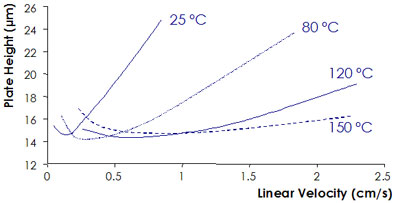
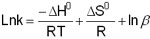
Where
k= retention factor
T = absolute temperature
H = enthalpy
S = entropy
R = gas constant
β = column phase ratio (φ)
For many analytes, retention decreases with an increase in column temperature. As a rule of thumb, a temperature change of 4°C is approximately equivalent to a 1% change in modifier concentration. Some molecules, especially those showing different spatial structures e. g. peptides and proteins and ionically charged molecules, however, demonstrate an increase in retention with increasing column temperature. Take a look at this example:
Van't Hoff plots for bases and neutral reference compounds: acetonitrile-phosphate buffer (A) pH 7.0, and (B) pH 3.0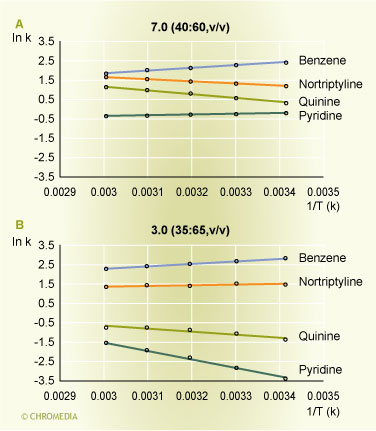 Benzene demonstrates typical small molecule behaviour in the figure, with its retention decreasing as the temperature increases. Nortriptyline, on the other hand, shows “normal” behaviour only in the case of low pH. Quinine deviates from typical small molecule behaviour in both eluents, while pyridine behaves “normally” at neutral pH but shows an increase in retention with temperature increase in the low-pH eluent. The deviations from “normal” small molecule behaviour arise from spatial conformation effects and/or shifts in the pKa and pH values upon addition of organic modifiers to the eluent in the case of ionic analytes. Temperature-induced changes in RPLC ligand conformation can generate additional selectivity effects. Many RPLC columns, particularly di- and tri-functionalized phases, show different shape selectivities at different temperatures. While many di- and tri-functionalized RPLC phases naturally show shape selectivity
  effects, temperature control can induce shape selectivity in monomeric RPLC phases as well.
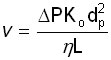
Where:
v= linear eluent velocity
ΔP = Column back pressure
dp = stationary phase particle size
L = column length
η = eluent viscosity
K0 = specific permeability coefficient
This formula shows that the column backpressure is directly proportional to eluent viscosity. This is illustrated hereunder:
Relationships between column back pressure and eluent flow rate at different temperatures.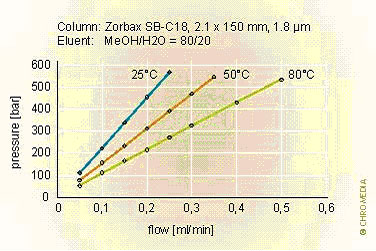 Relationships between column back pressure and eluent flow rate at different temperatures.
Note that the pressure/flow curves are steeper at lower temperatures, where solvent viscosities are lower. If the analyst is limited to pressures below 400 bar, the reduced viscosity at 80° C allows a 120% increase in the flow rate over room temperature. Even the more modest 50°C would allow a flow rate 50% higher than the maximum flow permitted at room temperature. If analysis time and sample throughput are important, raising the temperature can be beneficial- assuming, that is, that analyte and column integrity are preserved at higher temperatures.
Decreasing eluent viscosity has the added benefit of increasing the diffusivity of the analytes therein. Thus, increasing column temperature can improve mass transfer and increase the efficiency of columns substantially.Effect of temperature on column efficiency of bases and neutral reference compounds. (The numbers on the Y-axis indicate the plate number N) 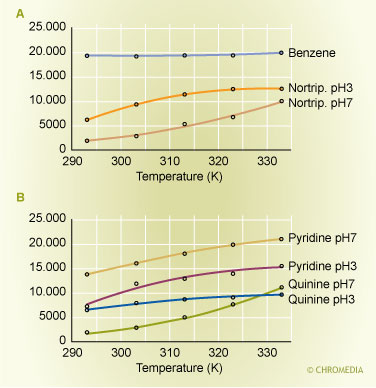 This illustration shows that, with the exception for the neutral analyte benzene, column efficiencies benefit substantially from an increase in column temperature. Generally, a 40°C increase in column temperature can increase efficiency by 30 to 50%, especially in the case of ionic analytes. In addition, the optimum eluent velocity may increase at elevated temperatures.
On improved detectability
The reduced amount of organic solvent in the mobile phase also results in additional advantages. The mobile phase UV transparency in the low UV range is improved. Alternative detection techniques such as FID (Flame Ionization Detection) also become an option when using solvent-free mobile phases. Additionally, an improved peak shape for basic solutes is frequently encountered. The ionic strength and buffer pH required for good peak shape of these solutes can therefore often be changed to levels less harmful for the column and chromatographic system.
On longevity
The thermal stability of a column is important for higher temperature separations. There are currently many RPLC phases of adequate thermal stability on the market. This issue is discussed in more detail in the chapter on 'Chemical and thermal stability'.
On peak shape
Asymmetric HPLC peaks can result from poorly packed columns, sample overloading, slow mass transfer kinetics and silanophilic interactions with ionic (especially basic) analytes. The mass transfer and silanophilic effects can be reduced significantly by increasing column temperature, thus reducing peak asymmetry. This is illustrated in the figure hereunder:
Effect of temperature on asymmetry factor of (a) quinine and (b) nortryptylene. 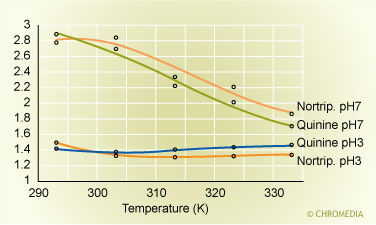 From this figure it can be seen that, at an eluent pH = 7, the asymmetry factors of both analytes benefit from an increase in the column temperature. In contrast, at an eluent pH =3, the asymmetry factors of these analytes remain nearly unaffected. The decreased temperature dependence at pH = 3 can, at least partly, be ascribed to the lower silanophilic activity in the stationary phase at this pH value.
By increasing the temperature, the amount of organic solvent in the mobile phase can be reduced to maintain retention. Roughly, a temperature increase of 4 or 5°C has a similar effect on retention as a 1% increase in methanol or acetonitrile, respectively. Superheated water at 200°C has a similar eluting power as methanol at ambient temperature. Additionally, since the back pressure is reduced at elevated temperature, ethanol becomes a practical alternative for toxic solvents such as methanol and acetonitrile. Mobile phases composed of water, ethanol, and additives like ammonia and acetic acid can be considered non-toxic and can be used for green chromatography. As a consequence, raising temperature may help to reduce the purchase and disposal expenses of organic (and often toxic) solvents.